What Agency Ad Accounts Really Cost: A Transparent Total-Cost Model for Global Media Buyers
Learn how agency ad account costs work, including setup fees, subscriptions, top-up fees, payment costs and a transparent monthly cost formula.

August 7, 2026
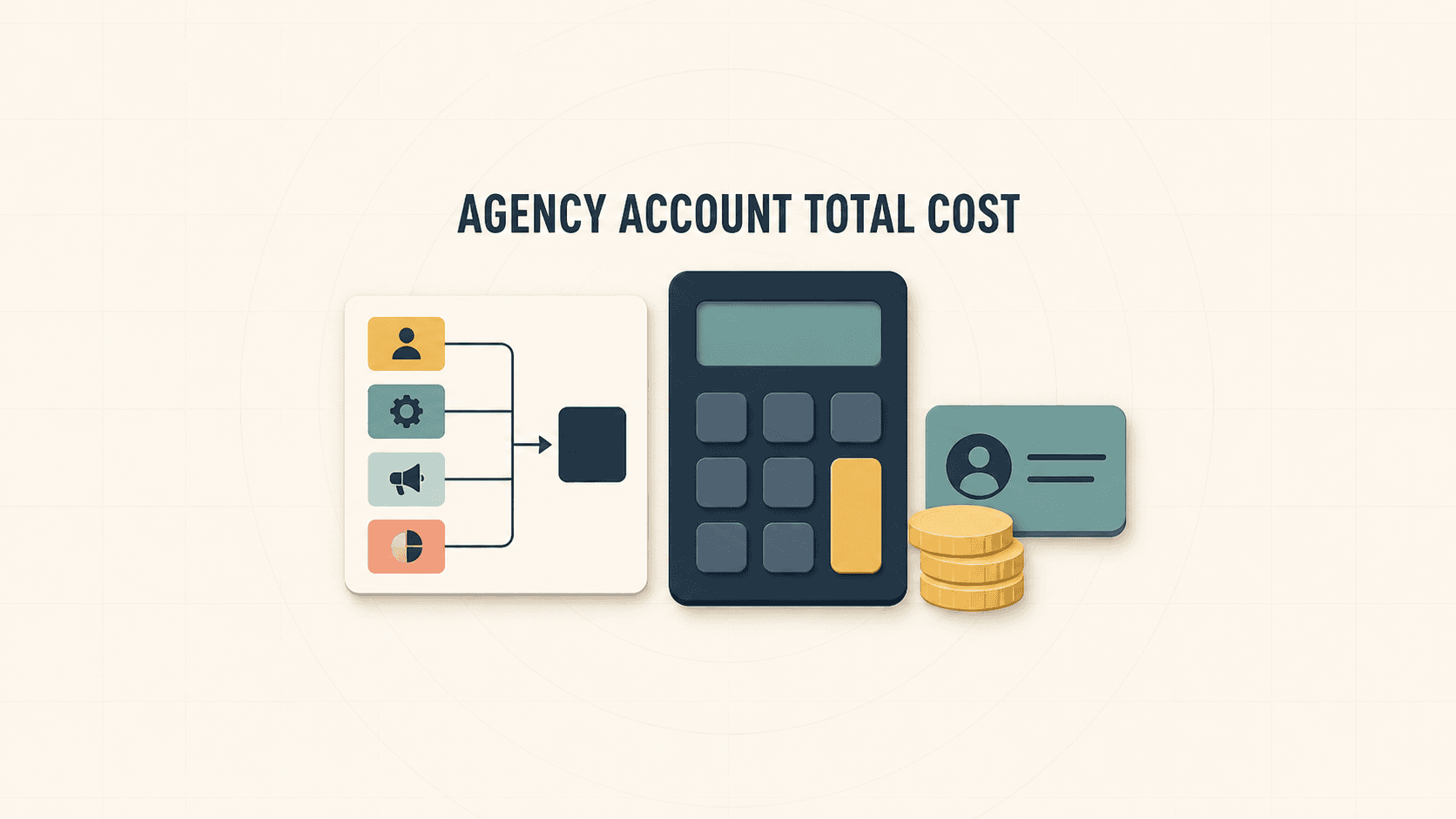
Table of contents
The true cost of an agency advertising account is not just its advertised top-up percentage.
Media buyers should separate three numbers:
Media funding: The amount intended to reach the advertising account and be available for campaign spend.
Provider fees: Subscription, setup or account fees, top-up charges and applicable payment-related costs.
Total cash requirement: Media funding plus all provider fees and other applicable charges.
A transparent monthly model is:
Provider fees = monthly subscription + setup/account fees + sum of each top-up amount × its applicable top-up rate + other applicable charges
Total cash requirement = total media funding + provider fees
The second formula matters because a media buyer funding $10,000 and paying $800 in service fees needs $10,800 in cash, even though only $800 is the provider cost.
AdShow provides agency advertising accounts for Meta and Facebook, Google Ads, TikTok and other major platforms, including Bing, Snapchat, Taboola and Outbrain. Its public marketplace displays account-specific information so buyers can examine setup fees, top-up fees, minimum budgets, geographies and traffic policies before ordering.
A useful comparison separates media funding from provider fees and the total cash required for the month.
Why the Headline Top-Up Fee Is Not the Total Cost
Agency account pricing is often summarized with one percentage: the top-up fee. That number is important, but it cannot answer the complete buying question on its own.
A provider advertising “from 5%” may also have a monthly subscription, an account setup fee, a minimum budget or payment charges. Another provider may show a higher percentage but no monthly commitment. The lower percentage is not automatically the lower-cost option at every spending level.
The account configuration also matters. A plan may limit monthly spend, the number of active accounts or replacement eligibility. A theoretically cheaper plan is not useful if the buyer’s volume or account requirements exceed its published limits.
Finally, some costs never appear on an invoice. Staff time spent requesting quotes, confirming transactions and chasing top-ups is an operational cost. A funding delay can interrupt a campaign. An unclear balance policy can expose the buyer to cash-flow risk.
This is why agency ad account cost should be evaluated as a model rather than a single fee.
The Seven Cost Components Media Buyers Should Check
1. Monthly subscription
A subscription is a fixed recurring charge for access to a service tier. It may affect the top-up rate, monthly funding limit, number of accounts or replacement allowance.
Because the subscription is fixed, its effective percentage is highest when monthly funding is low and falls as funding increases.
For example, a $499 subscription represents 9.98% of $5,000 before any top-up fee is added, but only 0.499% of $100,000. The same plan can therefore be expensive at one spending level and efficient at another.
2. Account setup or request fee
Some agency account options have a one-time setup or account fee. This charge may differ by advertising platform, geography, account type and traffic policy.
Setup fees should be separated from subscription fees. A monthly plan does not necessarily include every account request, and a one-time account fee does not necessarily replace the monthly subscription.
When several accounts are opened in one month, setup fees should be added for every applicable request.
3. Top-up fee
The top-up fee is generally calculated as a percentage of the amount being funded. If V is the top-up amount and r is the applicable rate:
Top-up charge = V × r
At an 8% rate, a $10,000 top-up creates an $800 top-up charge under a charge-on-top model.
Buyers should confirm exactly how a provider applies the fee. The key question is whether the fee is added to the requested media balance or deducted from the amount transferred. The examples in this guide assume that the top-up fee is added on top of the media funding amount.
4. Minimum funding requirement
An account may require a minimum initial budget or minimum top-up. This is not always a fee, because the balance may remain available for advertising. It still affects cash flow.
A buyer planning to test with $1,000 may need to commit more cash if the selected account has a higher minimum. The comparison should therefore include both the provider charge and the amount that must be funded before campaigns can begin.
5. Payment, currency and network charges
Depending on the available funding method, the buyer may encounter payment-processing, foreign-exchange, blockchain-network or bank charges.
These costs may sit outside the provider’s headline rate. A small difference in the top-up percentage can be offset by an unfavorable exchange rate or a repeated transaction charge.
Global media buyers should calculate all amounts in one reporting currency and record the exchange rate used for each funding event.
6. Unused balance, withdrawal and refund conditions
The treatment of unused funds can have a greater financial impact than a one-point difference in top-up fees.
Before funding, buyers should understand:
Whether unused balance remains in the provider wallet or has already entered the advertising platform.
Whether the balance can be transferred to another eligible account.
Whether a refund or withdrawal is available.
Which fees, review conditions or processing rules apply.
How a restriction caused by campaign-policy violations affects eligibility.
These questions should be answered from the provider’s current terms and account-specific conditions rather than assumed from a sales conversation.
7. Operational coordination and delay
Operational cost is the time and campaign impact created by the workflow itself.
When pricing, payments, top-ups and account status are distributed across private chats, staff must maintain a parallel record. A delayed top-up can leave an account without sufficient balance. A team handoff can require another employee to reconstruct the history.
These costs are harder to price, but they should not be ignored. Teams can estimate them using staff hours, average hourly cost and measurable campaign interruptions.
A Transparent Total-Cost Formula
For a media buyer managing several agency accounts in one month, define:
Vᵢ= the amount funded to accounti.rᵢ= the actual top-up rate for accounti.S= the monthly subscription.A= total setup and account-request fees.O= other applicable charges, such as payment, FX, network or tax costs.
The provider-fee formula is:
Provider fees = S + Σ(Vᵢ × rᵢ) + A + O
The total cash requirement is:
Total cash requirement = ΣVᵢ + provider fees
The effective provider-fee rate is:
Effective provider-fee rate = provider fees ÷ total media funding × 100
This model uses a separate top-up rate for each account because Meta, Google Ads, TikTok or other account options may have different commercial conditions.
Media spend should not be counted twice. The amount funded is campaign capital; the subscription, setup charges and top-up charges are provider fees.
AdShow’s Published Pricing Structure in August 2026
AdShow’s published agency account plans currently present four service tiers. The following summarizes advertised starting terms and is not an individual quotation:
Pay as you go
Monthly subscription: $0.
Published top-up fee: from 8%.
Published monthly spend limit: no limit.
Published account limit: no limit.
Published replacement allowance: 0.
Starter
Monthly subscription: $149.
Published top-up fee: from 6%.
Published monthly spend limit: $10,000.
Published active-account limit: one account.
Published replacement allowance: unlimited, subject to eligibility and applicable terms.
Scale
Monthly subscription: $499.
Published top-up fee: from 5%.
Published monthly spend limit: $30,000.
Published account limit: no stated limit.
Published replacement allowance: unlimited, subject to eligibility and applicable terms.
Unlimited
Monthly subscription: $1,499.
Published top-up fee: from 4%.
Published monthly spend limit: no limit.
Published account limit: no stated limit.
Published replacement allowance: unlimited, subject to eligibility and applicable terms.
The word “from” is important. Actual top-up rates and account charges may vary according to the selected platform, account, geography, traffic policy or product. Buyers should review current account-specific details in the AdShow agency account marketplace before ordering.
Plans and marketplace terms can change after the review date shown in this article.
Cost Examples at Different Monthly Funding Levels
The following scenarios illustrate how fixed subscriptions and starting top-up rates interact.
They assume:
Monthly media funding equals the stated amount.
The advertised starting top-up rate applies to the entire amount.
The fee is added on top of the requested media balance.
There are no setup fees, payment costs, FX charges, taxes or unused balances.
The selected plan’s spend and account limits are satisfied.
These examples are educational models, not quotes or guaranteed invoices.
Scenario 1: $5,000 in monthly media funding
Under Pay as you go:
Top-up charge: $5,000 × 8% = $400.
Provider fees: $400.
Total cash requirement: $5,400.
Effective provider-fee rate: 8%.
Under Starter:
Subscription: $149.
Top-up charge: $5,000 × 6% = $300.
Provider fees: $449.
Total cash requirement: $5,449.
Effective provider-fee rate: 8.98%.
At this funding level, Pay as you go is $49 lower under the starting-rate assumptions. Starter may include different account or replacement allowances, so the decision should not be based on the $49 difference alone.
Scenario 2: $10,000 in monthly media funding
Under Pay as you go:
Provider fees: $10,000 × 8% = $800.
Total cash requirement: $10,800.
Under Starter:
Provider fees: $149 + ($10,000 × 6%) = $749.
Total cash requirement: $10,749.
Under the model, Starter is $51 lower than Pay as you go. However, $10,000 is the plan’s published monthly spend limit, and Starter lists one active account. A buyer expecting to exceed either constraint needs to evaluate another eligible plan.
Scenario 3: $30,000 in monthly media funding
Starter is excluded because the modeled volume exceeds its published $10,000 limit.
Under Pay as you go:
Provider fees: $30,000 × 8% = $2,400.
Total cash requirement: $32,400.
Under Scale:
Provider fees: $499 + ($30,000 × 5%) = $1,999.
Total cash requirement: $31,999.
Under the starting-rate assumptions, Scale is $401 lower than Pay as you go. The modeled volume is also at Scale’s published $30,000 monthly spend limit.
Scenario 4: $40,000 in monthly media funding
Starter and Scale are excluded because the modeled volume exceeds their published limits.
Under Pay as you go:
Provider fees: $40,000 × 8% = $3,200.
Total cash requirement: $43,200.
Under Unlimited:
Provider fees: $1,499 + ($40,000 × 4%) = $3,099.
Total cash requirement: $43,099.
Unlimited is $101 lower in the simplified model. Because the difference is small, account requirements, replacement conditions and actual marketplace rates may matter more than the headline calculation.
Scenario 5: $100,000 in monthly media funding
Under Pay as you go:
Provider fees: $100,000 × 8% = $8,000.
Total cash requirement: $108,000.
Under Unlimited:
Provider fees: $1,499 + ($100,000 × 4%) = $5,499.
Total cash requirement: $105,499.
Unlimited is $2,501 lower under the starting-rate assumptions. At higher funding volumes, the lower percentage has more room to recover the fixed monthly subscription.
The Useful Break-Even Points
A break-even point shows where the savings from a lower top-up percentage equal the additional subscription.
The general formula is:
Break-even funding = additional monthly subscription ÷ difference in top-up rates
Using AdShow’s published starting rates:
Pay as you go versus Starter
$149 ÷ (8% − 6%) = $7,450
Below $7,450, Pay as you go has the lower modeled provider fee.
Above $7,450 and up to Starter’s published $10,000 monthly limit, Starter has the lower modeled provider fee.
Pay as you go versus Scale
$499 ÷ (8% − 5%) = approximately $16,633
Below approximately $16,633, Pay as you go has the lower modeled provider fee.
Above that amount and up to Scale’s published $30,000 monthly limit, Scale has the lower modeled provider fee.
Pay as you go versus Unlimited
$1,499 ÷ (8% − 4%) = $37,475
Below $37,475, Pay as you go has the lower modeled provider fee.
Above $37,475, Unlimited has the lower modeled provider fee.
Not every mathematical crossover is operationally useful. Starter and Scale, for example, would cross at a volume outside Starter’s published limit. A valid comparison must respect account, spend and product constraints.
Why the Cheapest Headline Plan May Not Be the Best Fit
Cost selection should follow eligibility and workflow requirements in this order:
1. Identify the required advertising account
Start with the platform, geography, destination, traffic policy and account configuration. A cheap plan does not solve the problem if the necessary account is unavailable or unsuitable.
2. Estimate funded volume, not only expected ad spend
Top-up fees apply to funded amounts. Monthly spend and monthly top-ups may differ when balances carry forward or funding occurs before a campaign period.
3. Check account and spend limits
Remove plans that cannot support the expected volume or number of active accounts before comparing fees.
4. Calculate provider fees at the applicable rate
Use the actual account-specific top-up rate rather than assuming the advertised starting percentage will apply.
5. Add setup and payment-related costs
Include every account request expected during the period, along with payment, FX, network and tax costs where applicable.
6. Review balance and incident conditions
Understand how unused funds, transfers, refunds and replacement eligibility work. AdShow’s account FAQs provide general information, but account-specific terms and the circumstances of an incident still matter.
7. Evaluate operational visibility
Pricing transparency is more useful when the later workflow is also visible. A buyer should be able to connect funding, top-ups, fulfillment states and account incidents to the relevant account record.
The 2026 Agency Ad Account Operations Benchmark provides a separate framework for evaluating that operational maturity.
How AdShow Makes Pricing Easier to Evaluate
AdShow is a self-service platform providing agency advertising accounts for Meta/Facebook, Google Ads, TikTok, Bing, Snapchat, Taboola, Outbrain and other major advertising platforms.
The public marketplace allows buyers to review available account categories and current operational fields before creating a request. Depending on the account, those fields can include setup fee, top-up fee, minimum budget, geography and traffic policy.
After a buyer selects an account, the dashboard connects wallet funding, account requests, fulfillment states, delivered account records and later top-up activity. Telegram bot notifications can alert the buyer when a top-up is completed, while the dashboard retains the transaction context.
This does not make every account identical or eliminate platform risk. It gives the buyer a more structured way to compare the commercial conditions and manage the operational history.
Questions to Ask Any Agency Account Provider About Pricing
Before funding, media buyers should ask:
Is the top-up percentage added to the requested balance or deducted from the payment?
Does the published rate apply to my platform, account type, geography and traffic policy?
Is there a monthly subscription?
Is there a setup or account-request fee?
What is the minimum initial funding amount?
Is there a minimum later top-up?
Are payment, FX, bank or blockchain-network fees additional?
Is the top-up rate calculated on every deposit or reconciled against actual spend?
What monthly spend and active-account limits apply?
What happens to unused balance after a suspension or account closure?
When can funds be transferred, withdrawn or refunded?
What replacement conditions apply, and when is a replacement not eligible?
Where can I see the request, transaction and incident history?
Which commercial terms can change after the account is delivered?
A transparent provider should be able to connect these answers to current written terms or visible account information.
Frequently Asked Questions
How much does an agency ad account cost?
The cost can include a monthly subscription, account setup fee, top-up percentage and applicable payment, FX, network or tax charges. Account-specific pricing varies by platform, geography, traffic policy and service configuration.
What is an agency account top-up fee?
It is a service charge associated with adding funds to an agency advertising account. Buyers should confirm the percentage, the amount on which it is calculated and whether it is added to or deducted from the requested balance.
Is the lowest top-up percentage always the cheapest option?
No. A plan with a lower percentage may include a larger fixed subscription. At lower funding levels, a no-subscription plan with a higher percentage can have a lower total provider fee.
Is media spend part of the agency account fee?
No. Media funding is the amount intended for campaigns. It should be shown separately from provider fees. The total cash requirement includes both.
How should I compare pay-as-you-go and monthly plans?
Remove plans that do not meet the required spend or account limits, then calculate the subscription plus the top-up charge at the actual applicable rate. Add setup and payment-related costs before comparing the result.
Do AdShow’s starting top-up rates apply to every account?
Not necessarily. The plans advertise rates “from” a stated percentage. The actual rate and additional account charges should be checked against the current marketplace option before ordering.
Do agency advertising accounts guarantee lower CPM or CPA?
No. Account pricing and operational structure do not guarantee advertising performance. Campaign results continue to depend on the offer, creative, targeting, landing page, auction conditions and compliance with the relevant platform’s policies.
Which agency advertising platforms does AdShow provide?
AdShow provides agency advertising accounts for Meta/Facebook, Google Ads, TikTok, Bing, Snapchat, Taboola, Outbrain and other major advertising platforms, subject to current availability.
The Best Price Is the Price You Can Reconstruct
Agency ad account pricing becomes easier to evaluate when every cost has a defined place.
Start with the media balance the campaigns require. Add the subscription, setup fees, top-up charges and applicable payment costs. Then examine limits, unused-balance rules, replacement conditions and the operational effort required to manage the account.
The result is more useful than comparing two percentages in isolation. It shows the provider fee, the total cash requirement and the conditions that could change the outcome.
For media buyers operating across Meta, Google Ads, TikTok and other platforms, transparency is not only about finding the lowest rate. It is about knowing what will be funded, what will be charged, what the account can support and where the complete transaction history will live.
Account-specific prices and availability can change. Review the current marketplace information and applicable terms before funding.