TikTok Agency Account Price: Setup, Fees and Real Cost
TikTok agency account price depends on setup, subscription, top-up and media costs. Use a four-ledger model to compare plans, billing routes and operational limits.

September 4, 2026
Table of contents
There is no single universal TikTok agency account price because providers combine setup fees, monthly subscriptions, top-up percentages and account limits differently. TikTok media spend and creative operations are separate costs. As checked on September 4, 2026, AdShow's published terms list Public at $0/month, setup from $50 and ad-spend fee from 7%; Starter at $149/month, zero setup fee, fee from 5%, one active account and a $10,000 monthly spend limit; Scale at $499/month, zero setup fee, fee from 4%, no account limit and a $40,000 monthly spend limit; and Unlimited at $1,499/month, zero setup fee, fee from 3%, no account limit and no spend limit. These are live commercial terms, so recheck the current AdShow money page before purchase. Route eligibility, accepted verticals and other operating terms still apply.
The Five Cost Lines
Provider setup or activation: one-time charge, such as AdShow Public from $50.
Provider subscription: recurring charge, such as $149 for Starter or $499 for Scale.
Provider top-up or ad-spend fee: the published percentage floor, subject to the provider's definition of the fee base.
TikTok media spend: the campaign budget consumed by ad delivery and reported in the advertiser account.
Optional operations: creative production, Pixel or Events API work, catalog maintenance, reporting and support.
A Landed-Cost Formula
For a simple comparison, define monthly landed cost as: TikTok media spend + provider subscription + setup or activation allocated to the period + provider ad-spend fee + optional operations. For a first-month calculation, use the full setup charge. For later months, remove that one-time amount unless the provider charges it again. Using S for monthly TikTok spend, the published-floor provider cost is Public: $50 + 0.07S; Starter: $149 + 0.05S; Scale: $499 + 0.04S; Unlimited: $1,499 + 0.03S. Add S itself to each figure to estimate the total cash requirement before optional services.
Harris Eugene’s operator note: Harris Eugene operator note: compare plans using landed cost and operational constraints, not the lowest headline percentage. Record every ledger before funding. A plan that is cheaper in arithmetic can be unsuitable if its active-account count, monthly-spend cap, route eligibility or support terms do not fit the workload.
Three Worked Scenarios
The following examples use the real published AdShow prices above and treat the percentage as applying to the stated monthly spend. They exclude optional creative and operations. Because the percentages are described as “from,” these are mathematical illustrations rather than guaranteed invoices.
At $3,000 monthly spend: Public costs about $260 in provider charges, or $3,260 including media. Starter is about $299, or $3,299 including media. Scale is about $619, or $3,619. Unlimited is about $1,649, or $4,649.
At $12,000 monthly spend: Public costs about $890 in provider charges, or $12,890 including media. Starter is about $749, or $12,749, but its $10,000 monthly limit makes it unsuitable for this stated spend. Scale is about $979, or $12,979. Unlimited is about $1,859, or $13,859.
At $50,000 monthly spend: Public costs about $3,550 in provider charges, or $53,550 including media. Starter and Scale are outside their published monthly spend limits. Unlimited costs about $2,999 in provider charges, or $52,999 including media.
Based only on the published fee floors, Public and Starter meet at approximately $4,950 of monthly spend. Starter and Scale meet at approximately $35,000, while Scale and Unlimited meet at approximately $100,000. Other pairwise mathematical crossovers include Public versus Scale at about $14,967 and Public versus Unlimited at about $36,225. These figures do not override plan features: the cheapest arithmetic route may fail the active-account or spend-cap test. They also do not account for changing “from” rates, minimums, tax, currency conversion or optional services.
The Four-Ledger Reconciliation Model
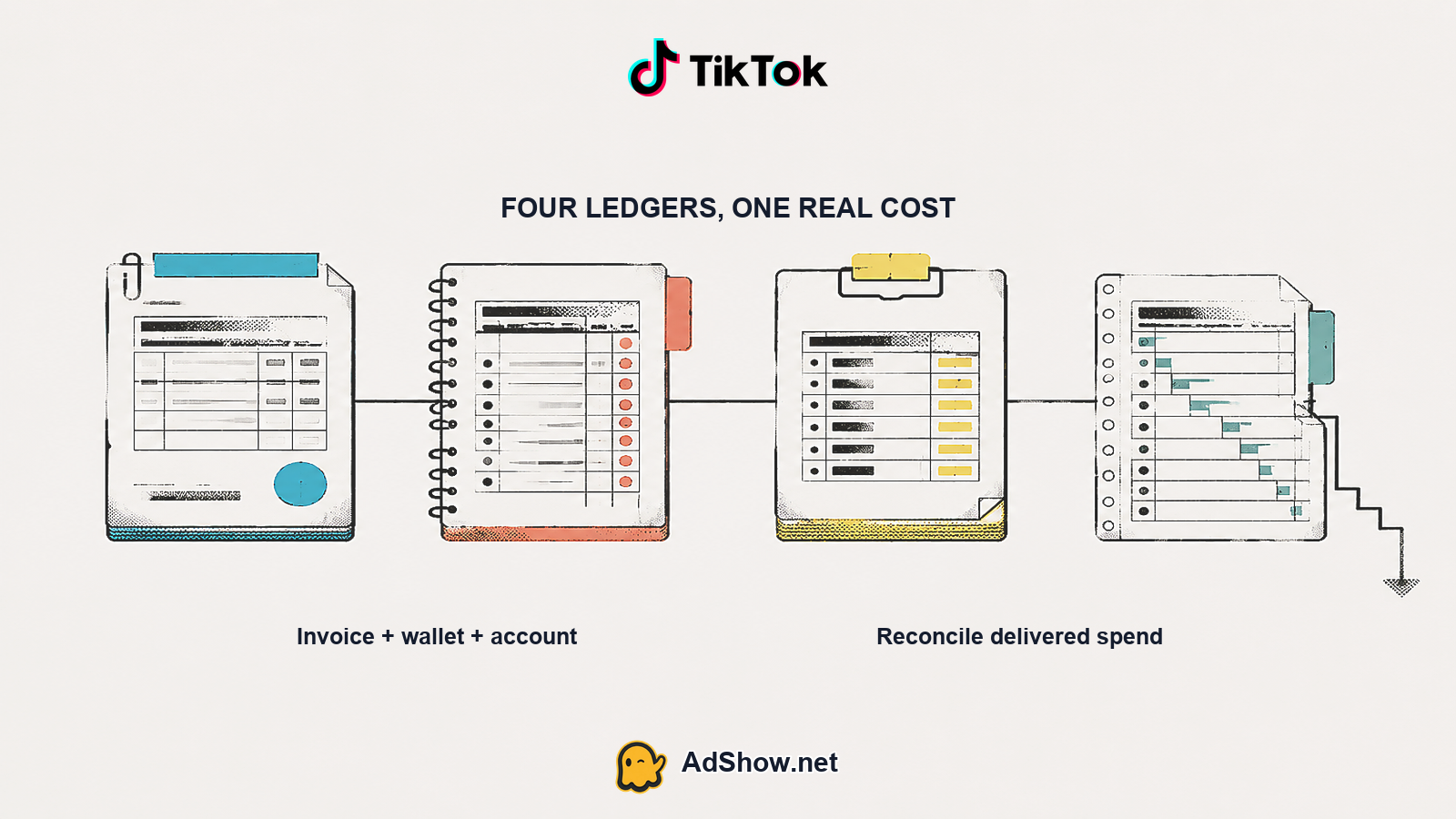
Match the provider invoice to the commercial plan and the fee base stated in writing.
Match each top-up to the provider wallet record, including currency, timestamp, settlement status and unused balance.
Match the funded amount and payment activity to the TikTok Business Center or advertiser-account billing record.
Match TikTok delivery reports to campaign spend, then investigate the difference between funded balance, pending charges, refunds and actual delivery.
A top-up is not automatically delivered media. A provider invoice is not automatically a TikTok invoice. A temporary card verification is not a setup fee. Keeping these ledgers separate makes it easier to identify delayed settlement, duplicated funding, unspent balances, refunds and responsibility for a disputed charge.
TikTok Billing Routes
The account's billing route changes cash timing, but it does not change the provider's commercial price. Under manual payment, funds are added before delivery and campaign costs reduce the available cash balance. Under automatic payment, TikTok charges the primary payment method when the account reaches its billing threshold or bill date, whichever comes first. Monthly invoicing is an eligibility-based credit arrangement with its own invoice and spending-limit terms. TikTok's current billing-options documentation also warns that moving to automatic payment cannot simply be reversed to manual payment, while monthly invoicing cannot be changed back to either of the other two routes.
Manual payment: budget must reach the TikTok cash balance before ads can consume it; insufficient balance can stop delivery.
Automatic payment: spend accrues against a threshold or bill date, and a failed primary method can interrupt campaigns.
Monthly invoicing: available only to eligible businesses and governed by the credit and invoice terms TikTok assigns.
Provider-funded route: document whether the provider tops up a Business Center, an advertiser account or another defined billing layer, and reconcile it against the provider invoice.
TikTok's July 2026 automatic-payment guidance also says card verification may temporarily deduct at least $10 or the local equivalent and that TikTok refunds it within 15 days. This verification amount should not be confused with an AdShow setup fee, a provider top-up fee or media spend. Payment methods and billing options vary by account, country, currency and eligibility; confirm the route attached to the specific account rather than relying on a generic reseller description. The setup guidance is the authoritative reference for that process.
What Promotional Claims Do Not Prove
Recent seller posts show why headline pricing needs due diligence. A February 2026 TikTokAds post advertised an agency account using phrases such as worldwide targeting, unlimited spend, whitelisted and no-ban. That page is promotional material, not independent evidence and not TikTok policy: agency-account promotion discussion. Treat each phrase as a question that requires written scope: which countries, which account limit, what replacement event, and who controls the Business Center?
A separate June 2026 self-promotional post claimed that many visible sellers are resellers and apply additional margins. The poster's identity, partner status and numbers were not independently verified, so the post cannot establish a market-wide markup. It does identify a useful procurement question: how many commercial and support handoffs sit between the advertiser and the entity controlling access and funding? See the claimed agency-supply discussion with that limitation in mind.
An agency account does not guarantee approval, lower CPA, lower CPM, no suspension or unlimited spend outside written plan conditions. It does not cure weak creative, poor learning signals, low-quality leads, tracking defects or policy violations. AdShow's verified scope is self-service agency advertising account access, visible marketplace offers, dashboard requests, funding or top-ups and issue reporting. It does not promise a policy bypass, rights bypass or a specific advertising result. For background, compare this cost article with the separate buy and setup-fee guide, rental guide and agency-versus-personal comparison.
Buyer Evidence Checklist
Legal provider identity, contracting entity and invoice issuer.
The provider's Business Center relationship, account role and who retains administrative control.
Account country, currency, timezone, accepted verticals and route eligibility.
Billing method, fee base, percentage floor, minimum top-up and settlement time.
Active-account cap, monthly-spend cap and the treatment of attempted over-cap spend.
Unused-balance, refund, replacement-account and closure processes.
Invoice trail connecting provider charges, wallet top-ups, TikTok billing and delivered spend.
Pixel, Events API, catalog and audience ownership, including what happens if access ends.
Support escalation path, issue-reporting process and expected responsibility for billing or access disputes.
This checklist is also where the separate buy, rent and personal-account trade-offs become concrete. A low fee may be acceptable for one active account and modest spend, while a higher subscription may be justified by capacity or workflow requirements. The decision should be based on documented control, limits and reconciliation quality as well as the percentage.
Review the current TikTok agency account plans, eligibility details and live commercial terms before funding an account. View current TikTok agency account pricing
Questions from recent advertiser discussions
What is the price of a TikTok agency account?
There is no universal price. On AdShow's published terms checked September 4, 2026, Public is $0/month with setup from $50 and an ad-spend fee from 7%; Starter is $149/month at 5% from, Scale is $499/month at 4% from, and Unlimited is $1,499/month at 3% from. Media spend and optional operations are additional.
Is there a TikTok agency account setup fee?
It depends on the plan and provider. AdShow currently publishes a setup fee from $50 for Public and zero setup fee for Starter, Scale and Unlimited. Confirm the live page, route eligibility and any account-specific terms before payment.
What is a TikTok agency account top-up fee?
A top-up or ad-spend fee is the provider's charge for funding or supporting delivery, commonly expressed as a percentage. AdShow publishes fee floors from 7% for Public, 5% for Starter, 4% for Scale and 3% for Unlimited. The exact fee base and any minimums should be confirmed in writing. TikTok media spend is separate.
Are TikTok agency accounts ban-proof or automatically whitelisted?
No account should be treated as ban-proof or automatically whitelisted. Community promotions may use those phrases, but they are unverified marketing claims. An agency account does not guarantee approval, uninterrupted access, lower CPA or CPM, or immunity from TikTok review and enforcement.
Sources and scope
Official documentation defines platform behavior. Recent community discussions are used only to illustrate reported symptoms and questions; they do not prove the cause of an individual account outcome.
AdShow TikTok agency account service — Live AdShow plan prices, fee floors, account limits and operating workflow checked September 4 2026. Commercial terms are mutable and readers should verify the live page before purchase.
TikTok available billing options — Official June 2026 explanation of manual payment, automatic payment and monthly invoicing in TikTok Ads Manager and Business Center.
TikTok automatic payment setup — Official July 2026 guidance on billing thresholds, valid payment methods and temporary card-verification deductions.
Recent TikTok agency-account promotion discussion — February 15 2026 promotional post illustrates unsupported marketplace language such as whitelisted, unlimited spend and no-ban. It is not independent evidence or TikTok policy.
Recent claimed agency-supply discussion — June 2026 self-promotional post claims a reseller supply chain and markups. Identity and claims were not independently verified; it is used only to frame buyer due-diligence questions.