Google Ads Agency Account Price: Fees, Funding and Total Cost
A Google Ads agency account price is not one number. Learn how to separate account-access fees, funding charges, Google media spend and optional campaign-management costs before paying.

September 2, 2026
Table of contents
There is no single Google Ads agency account price. A buyer may be paying for supplied account access, an activation charge, a recurring subscription, top-up handling, campaign management, or several of these at once. Google media spend is another cost line and should not be confused with the provider’s fee. AdShow provides self-service Google agency ad account access through its dashboard; review the live Google agency ad account offer for the current route, eligibility and commercial terms rather than copying a price from an article.
Use an invoice-first model, not a single advertised price
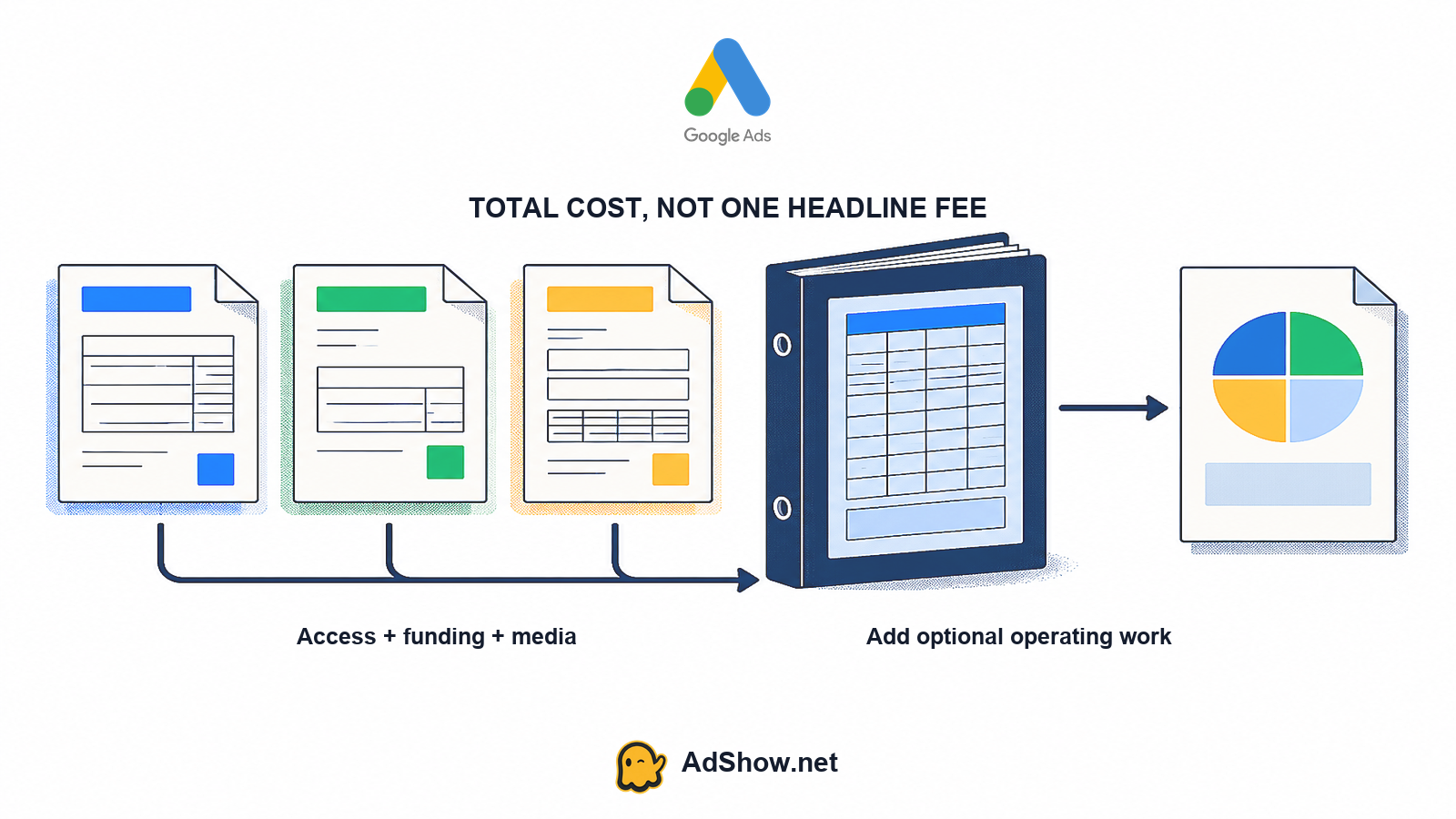
The practical question is not simply “what does an agency account cost?” It is: what will appear on each invoice, wallet movement, card charge or bank transfer, and who owns each balance? Treat the arrangement as five separate lines from the outset. This prevents a service fee from being mistaken for advertising budget, or a management retainer from being described as an account-access charge.
Setup or activation fee: a one-time commercial charge for onboarding, access preparation or account-routing work, if the selected provider applies one.
Recurring subscription: a periodic fee for continued access or service availability, where offered.
Top-up or ad-spend percentage: a handling fee calculated from a funding transaction or a defined spend base. Ask which base is used and whether tax is included.
Google media spend: money intended to buy Google Ads inventory. This is distinct from the provider’s commercial fees.
Operating work: optional campaign management, creative production, feed work, conversion tracking, reporting or consulting, usually priced under a separate scope.
Ask for these lines separately before funding. A vague phrase such as “account fee” can conceal very different services. The June 2026 agency-fee discussion is useful only as anecdotal evidence that buyers commonly mix management activity with account costs; it is not a pricing authority. A management retainer pays for people and deliverables. Access or funding fees pay for a different commercial arrangement. They should be reviewable independently.
Google billing timing and provider fees are different agreements
Google’s payment setup determines when Google is paid for ads. Google documents automatic payments, manual payments and monthly invoicing as separate settings, with availability and details that can vary by account, country and currency. See Google’s official payment settings guidance. A provider’s activation, subscription, top-up or support fee does not become a Google fee merely because it appears near the advertising budget.
For invoice review, identify the legal payor and the payment path. In one arrangement, the advertiser may pay Google directly. In another, the advertiser may fund a provider wallet and the provider allocates funds to the advertising account. In a third, an approved invoicing relationship may govern payment timing. Do not infer the route from the word “agency.” Confirm it in the offer and the resulting billing records.
An MCC is administration structure, not a supplied-account product
A Google Ads Manager Account, often called an MCC, is a hierarchy for managing linked Google Ads accounts. Google describes it as a way to administer multiple accounts and work across them; it is not, by itself, a paid supplied-account service or a promise of special auction treatment. Review Google’s official manager account overview for its administrative role.
A supplied agency-account service is a commercial access and workflow arrangement that may include a dashboard request, funding/top-ups and issue reporting. It should be assessed on its own terms. It does not inherently create a lower CPC, guaranteed policy approval, higher limits, immunity from suspension or a bypass of Google’s policies. The August 11, 2026 discussion about whether agency accounts are worthwhile illustrates terminology confusion between manager accounts and supplied-account services. Community comments are anecdotal, not Google policy.
Worked landed-cost example with fictional numbers
The following example is entirely hypothetical and is not an AdShow quote, market benchmark or promise. Assume a buyer plans USD 8,000 of media spend for one month. The chosen route has a fictional USD 120 activation fee, a fictional USD 80 monthly subscription, and a fictional 3% top-up fee applied to the USD 8,000 funding amount. The buyer also separately contracts a freelancer for fictional tracking and reporting work at USD 600.
Setup or activation: USD 120.
Recurring subscription: USD 80.
Top-up fee: USD 8,000 × 3% = USD 240.
Google media spend: USD 8,000.
Operating work: USD 600.
Illustrative landed cost: USD 120 + USD 80 + USD 240 + USD 8,000 + USD 600 = USD 9,040.
The reusable formula is: total landed cost = setup + subscription + top-up fee + media spend + operating work. If the fee is based on a different amount—for example, a gross wallet deposit rather than net media allocation—replace the top-up-fee input accordingly. Also verify currency conversion, taxes, refunds and payment-processor charges before comparing two offers. A lower access fee can still produce a higher total if its funding basis or operating scope differs.
Harris Eugene’s operator note: Operator note: reconcile three balances every reporting period—provider wallet balance, amount allocated to the Google Ads account, and Google-recorded spend. They answer different questions. Keep transaction IDs, allocation confirmations and Google billing/export records together, then investigate timing differences before assuming that an unspent wallet amount is available media credit.
The evidence pack to request before the first payment
A buyer should be able to map each dollar from payment to advertising delivery and to know what remains controlled by the buyer. This is an editorial procurement check, not legal or tax advice. Request written answers that correspond to the selected product rather than relying on generic sales language.
Customer ID route: identify the Google Ads customer ID, how access is granted and which parties can view it.
Paying manager: state whether the advertiser, provider or another billing entity pays Google, and under what arrangement.
Billing country and currency: confirm account billing country, payment currency, tax treatment and conversion responsibility.
Fee basis: list every setup, subscription, top-up, percentage, card-processing and support fee, including its calculation base.
Wallet-to-account allocation: document how a funded wallet amount is allocated to the relevant advertising account and how that allocation is evidenced.
Unused-balance process: establish whether unused amounts can be returned, reallocated or retained, plus the timeline and conditions.
Measurement ownership: define ownership and administrator access for conversion actions, tags, analytics connections, feeds and reporting exports.
Incident terms: record the route for issue reporting, expected communications, responsibilities and any limits in the service terms.
When self-serve is enough—and when supplied access can help
Self-serve Google Ads is often enough when a business can create its own account, maintain its billing method, manage user permissions and operate campaigns without an outside funding or access workflow. It gives the advertiser a direct operational path and can reduce commercial layers. For a broader view of media-budget planning separate from account arrangements, see how much Google Ads costs.
Supplied access may be operationally useful when a buyer specifically needs the provider’s available account-access workflow, dashboard request process, funding/top-up handling or issue-reporting channel. That is a workflow decision, not evidence that campaigns will produce better creative, complete learning faster or generate better leads. Compare the commercial terms, billing route, measurement access and support process with the self-serve alternative. The related agency account versus individual account guide can help frame that comparison.
Buying checklist: approve the total, not just the access fee
Before approving payment, write down the planned media budget, every non-media charge, the party that pays Google, the funding currency, the amount that reaches the ad account, and the owner of measurement assets. Calculate at least one month of landed cost and one lower-spend scenario, because percentage fees and fixed subscriptions affect them differently. Ensure the selected provider’s live terms—not a cached screenshot or a third-party comment—match the invoice you expect to receive.
The cleanest purchase decision is one where access, funding, media spend and operating work can each be audited without guesswork. If a quote cannot separate those lines, ask for clarification before funds are sent.
Review the current AdShow Google agency ad account route, dashboard workflow and live commercial details before choosing an access and funding arrangement. View Google agency ad account access
Questions from recent advertiser discussions
What is the Google Ads agency account price?
There is no universal price. Your total can include a one-time setup fee, recurring subscription, top-up or spend-based fee, Google media spend and optional management or production work. Check the provider’s live offer for current terms, then calculate the landed cost using each line separately.
Is a Google Ads MCC the same as an agency account service?
No. A Google Ads Manager Account (MCC) is a structure for administering linked accounts. A supplied agency-account service is a commercial arrangement for access and related workflow. An MCC alone does not establish special pricing, different CPCs or protection from Google enforcement.
Who pays Google for ads with an agency account arrangement?
It depends on the billing route. The advertiser may pay Google directly, or a provider may handle a wallet and allocation process, subject to the selected terms. Google payment timing can use automatic payments, manual payments or monthly invoicing where available. Confirm the paying entity, currency and records before funding.
Does agency account access change Google Ads CPC?
No special CPC should be assumed from agency access alone. CPC is influenced by auction conditions, bids, competition, relevance and other campaign factors. A supplied-account arrangement is an access and operations decision, not a guarantee of lower advertising prices or improved results.
Sources and scope
Official documentation defines platform behavior. Recent community discussions are used only to illustrate reported symptoms and questions; they do not prove the cause of an individual account outcome.
AdShow Google agency account service — Current AdShow service workflow and live commercial terms. Readers must verify the selected route, eligibility and fees on the live page.
Google Ads payment settings — Official distinction between automatic payments, manual payments and monthly invoicing; thresholds and availability depend on account, country and currency.
Google Ads manager accounts — Official description of manager-account administration. It does not promise different auction prices or immunity from enforcement.
Recent agency-account terminology discussion — August 11 2026 discussion illustrates confusion between manager accounts and supplied agency-account services. Community comments are not Google policy.
Recent PPC management-fee discussion — June 1 2026 discussion shows why management activity and retainers should be evaluated separately from account-access and media costs.