Google Agency Ad Account vs Individual: What Changes?
A Google agency ad account vs individual account comparison must begin with terminology. Google officially distinguishes serving accounts, manager accounts, payments profiles and Individual or Organization account types. The market phrase “agency ad account” may describe a serving account created or managed through an agency, sometimes with provider billing and support. It is not automatically a special policy class or an upgrade that makes suspension impossible.

August 13, 2026
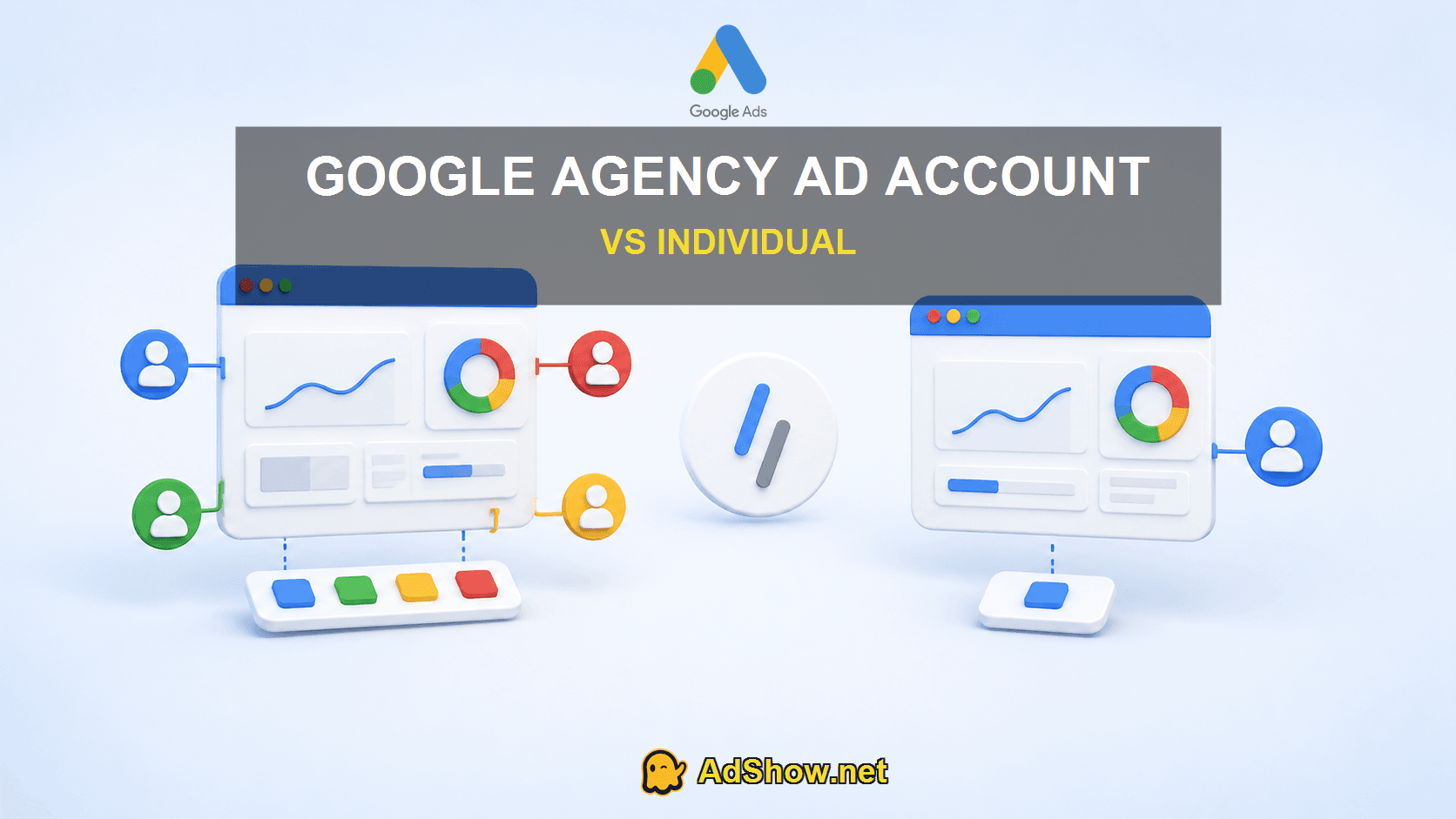
Table of contents
An individual account is usually best when one advertiser can verify itself, pay Google directly and retain full billing ownership. An agency workflow can fit teams needing multiple-account management, alternative approved billing arrangements, account provisioning or operational support.
AdShow option: AdShow provides Google agency ad accounts alongside Meta, TikTok and other major advertising platforms. The self-service dashboard records account requests and top-up operations; eligibility, verification and Google Ads policies still apply.
What is the main difference?
A directly opened Google Ads account usually places verification, payments profile and campaign control with the advertiser. A provider-managed account adds a commercial and operational relationship: the provider may provision access, coordinate funding and assist with account operations under disclosed terms. A Google Ads manager account, or MCC, is only the umbrella used to manage serving accounts; Google explicitly says it is not an upgrade of a client account.
Four layers people incorrectly call one “agency account”
Serving account: the account where campaigns run and costs accrue.
Manager account: the umbrella that views and manages one or more serving accounts.
Payments profile: the legal and billing identity, permissions and payment information.
Provider agreement: the service terms for account access, funding, support and any replacement process.
Ask for these four layers separately. An MCC link does not prove that a provider owns the payments profile, offers monthly invoicing or will return every type of balance.
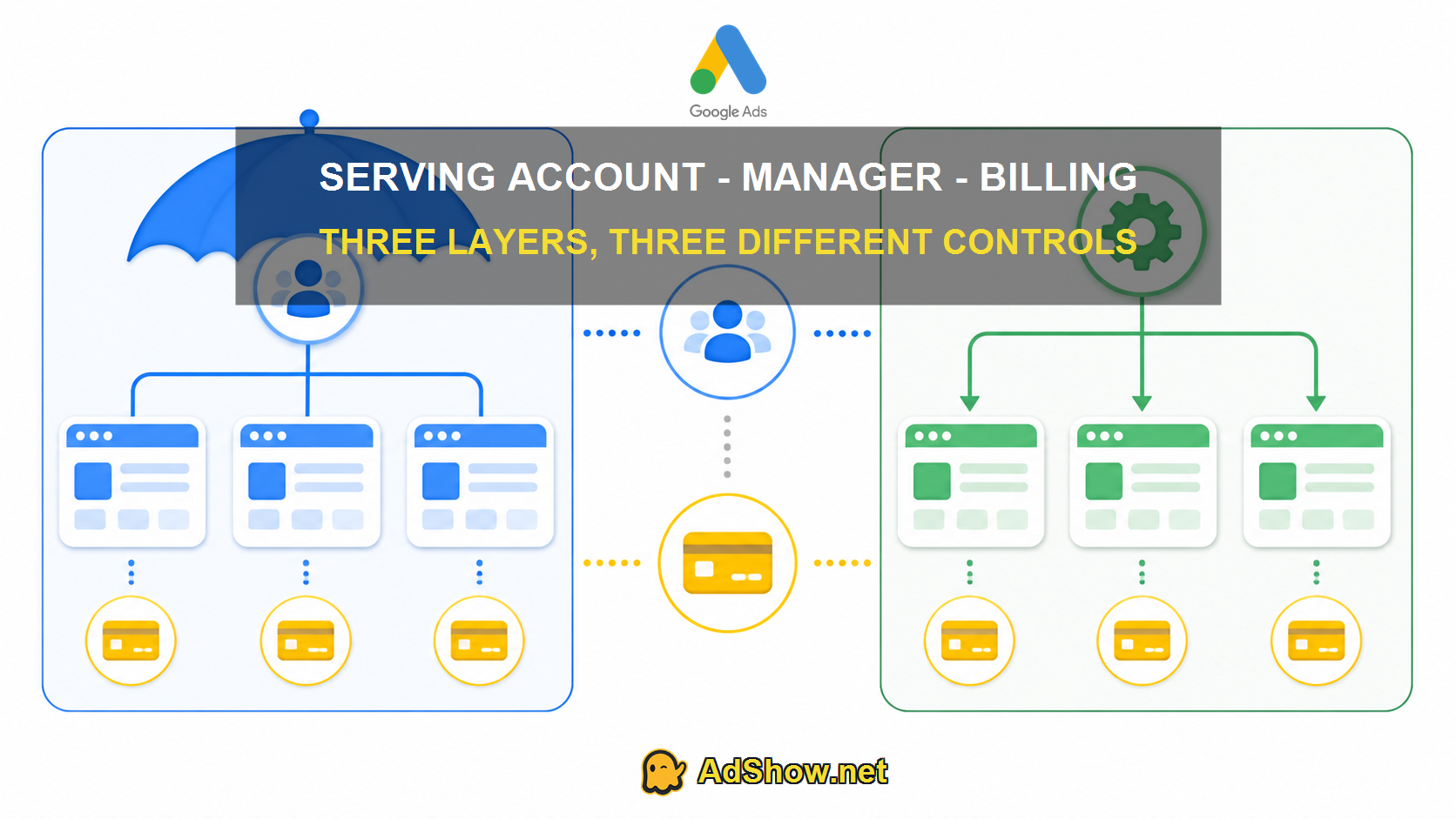
A manager account organizes serving accounts; it does not by itself determine account type, billing or policy status.
Google agency ad account vs individual: practical comparison
Verification
Google allows Individual and Organization account types. The chosen type must match the advertiser and tax reality; documentation may be required. An agency relationship does not remove advertiser-verification obligations.
Control and portability
Direct ownership generally provides the cleanest continuity when changing agencies. With a provider account, determine who can unlink managers, change users, access billing and retain reports if service ends.
Billing
Google documents automatic payments, manual prepayment and monthly invoicing. Availability depends on country, currency and eligibility. Provider prepaid funding is a separate workflow; a provider-wallet balance is not the same as funds already posted to Google Ads.
Team management
An MCC is efficient for reporting, alerts and access across multiple advertisers. A small business with one account does not need an MCC merely to run campaigns.
Support and incident handling
A provider can help collect evidence and route an operational request, but only Google controls policy enforcement. Creating another account to evade a suspension can compound risk.
Performance
No account label guarantees cheaper clicks or conversion. Account history, tracking, feed quality, bidding, query selection, creative and landing-page experience remain decisive.
Harris Eugene’s operator note
“The first screen I ask a buyer to open is not Campaigns—it is Billing and Access. Many disputes described in advertiser communities start because the buyer believed ‘MCC access’ meant ownership. It does not. I would choose an individual setup for a verifiable business with one stable billing path. I would evaluate an agency setup when the operational benefit is concrete: visible fees, documented funding, named users and a support path that survives beyond a chat message.”
— Harris Eugene. This note is an expert interpretation of official Google documentation and current advertiser concerns, not a fabricated client case.
Which setup should you choose?
Choose direct/individual: one advertiser, eligible country, working payment method, straightforward verification and a need for maximum billing ownership.
Choose manager access: an agency manages multiple client-owned accounts but clients retain ownership.
Evaluate a provider account: a legitimate advertiser needs a defined provisioning, funding or support workflow and accepts the provider’s ownership and balance terms.
Compare operational models in the Google agency account provider investigation. If your current account is restricted, resolve the reason first with the Google Ads suspension checklist.
Audit a Google agency account offer in 15 minutes
Ask whether you will receive access to a serving account or only a report.
Record every linked manager and identify which manager has ownership.
Open Access and security and verify your real user role.
Open Billing and identify the payments profile, payer and payment setting.
Confirm the advertiser-verification responsibility and legal name.
Request the complete fee calculation on a sample top-up.
Define data export, unlinking and unused-balance steps if service ends.
A provider may legitimately retain parts of the billing or ownership layer. The issue is not that every provider account must become client-owned; it is whether the buyer understands the arrangement and prices the dependency correctly. If campaign history cannot move, for example, the switching cost belongs in the decision.
Also confirm what support means. “Dedicated support” may mean provider-side account operations, help preparing a Google support case or communication with a representative. It should not be presented as guaranteed reinstatement or permission to avoid an enforcement decision.
Choose the operating model before you fund the account
Choose an individual Google Ads account when the advertiser can verify the business, pay Google directly and retain billing ownership. Choose an agency-operated arrangement when the operational requirement is multi-account access, an approved billing workflow, provisioning or centralized support. The account label alone does not improve campaign performance or bypass Google policy.
Confirm who owns the Google Ads customer ID and who can retain access if the commercial relationship ends.
Write down whether funds are paid to Google directly or credited through the provider, including the treatment of unused balance.
Verify which party completes advertiser verification and which documents may be requested.
Separate account access from performance claims: bidding, policy review and conversion outcomes remain platform and campaign matters.
If agency-operated access is the actual requirement, review the current Google agency ad account options and confirm the live package, billing and eligibility terms before funding.
Questions from recent advertiser and support discussions
Is a Google manager account the same as an agency ad account?
No. A manager account is an umbrella for managing serving accounts. “Agency ad account” is a market term whose ownership, billing and support details depend on the arrangement.
Does an agency account avoid advertiser verification?
No. Google may require verification and accurate Individual or Organization information based on the account and advertiser.
Can the client keep campaign data after leaving an agency?
That depends on serving-account ownership and retained access. Confirm this before launch and export essential records regularly.
Does monthly invoicing come with every agency account?
No. Monthly invoicing and payments-profile links are subject to Google eligibility and the specific commercial structure.
Research scope: Current Google Ads Help documentation on manager accounts, account type, payment settings and access. Provider features must be verified against their current written terms.