6 Best Google Ads Agency Account Providers Investigated in 2026
Six Google Ads agency account providers compared by pricing, approval, dashboard workflow, refund policy and customer complaint patterns.

August 10, 2026
Table of contents
The short answer: the best Google Ads agency account provider depends less on the phrase “agency account” and more on what happens before and after the account is delivered. AdShow is the strongest fit for media buyers who want visible packages and a self-service operating workflow. Threasury is better suited to established, compliant advertisers willing to pass a formal review. Media Blast by Adcore is built for companies comfortable providing full corporate verification. YeezyPay is oriented toward affiliates and crypto-funded buyers. Adtucon targets high-volume teams with a platform plus assisted onboarding. Orange Trail is the most traditional, consultation-led option in this comparison.
That conclusion comes from looking beyond promotional claims. We reviewed public service pages, onboarding flows, policies, help content and customer-review signals. We also attempted real onboarding steps and documented where a buyer encountered a form, an approval gate or a requirement to return to chat.
This article is published by AdShow, which is included in the comparison. To make that conflict visible, we separate what we directly observed, what each provider publicly claims and what was not publicly disclosed. A provider claim is not treated as independently proven merely because it appears on a landing page.
Best Google Ads agency account providers at a glance
Provider | Best for | Workflow observed | Main trade-off |
|---|---|---|---|
AdShow | Self-service operations and protected eligible unused balance | Marketplace, account requests, balances, top-ups and issue reporting through a centralized dashboard | A newer brand than several managed providers |
Threasury | Established white-hat advertisers | Application and compliance review before approval | Applicants can be rejected and directed back to WhatsApp or Telegram |
Media Blast by Adcore | Corporations and structured advertising teams | Dashboard access after company verification and plan selection | Corporate documentation creates friction for individuals and informal teams |
YeezyPay | Affiliates, crypto funding and difficult GEOs | Dashboard combined with email and Telegram-assisted onboarding | Routine access still begins with human contact |
Adtucon | High-volume teams seeking multi-platform infrastructure | Centralized platform with account requests and onboarding assistance | Chat approval, undisclosed public pricing and mixed refund-review signals |
Orange Trail | White-hat advertisers wanting managed compliance | Consultation and pre-vetting through a relationship-led process | Less attractive for small buyers who want to start without booking a call |
Audit date: August 10, 2026. “Not publicly disclosed” means we could not find the information on the public pages reviewed. It does not mean the provider has no fixed policy or price.
How we used negative reviews without turning complaints into facts
Nearly every provider with enough customers will eventually receive a negative review. The existence of one complaint is not a useful ranking method. What matters is whether several reviewers independently describe the same operational failure—and whether the complaint concerns the service being compared.
We therefore used four levels of review evidence:
Isolated allegation: one reviewer reports a problem, with no corroborating pattern.
Repeated complaint theme: several reviewers describe materially similar events, such as refund delay or unresponsive support.
Provider response: the company supplies a denial, explanation or resolution that readers should consider alongside the complaint.
Verified policy conflict: a published contract or policy can be checked against what the customer says occurred.
Trustpilot reviews are user-generated accounts, not court findings or independent audits. A website created specifically to criticize one company carries an even clearer conflict of interest. We use such a site only to identify allegations and documents worth examining; we do not adopt its “scam” label or legal conclusions as fact.
How we evaluated the providers
After 13 years of operating Google Ads, I have found that the account-opening fee is rarely the most expensive part of a provider relationship. The real cost appears when a campaign is ready but the account is still awaiting approval, when a top-up depends on somebody replying in chat, or when unused money becomes difficult to trace after a suspension.
We therefore evaluated the providers through five buyer questions:
Can the buyer see pricing and requirements before starting a conversation?
Can an individual or small media-buying team pass onboarding without full company documents?
Which recurring actions can be completed without WhatsApp, Telegram or an account manager?
What does the provider say it will do when an account is restricted?
Is the unused-balance policy published, including destination, conditions and processing time?
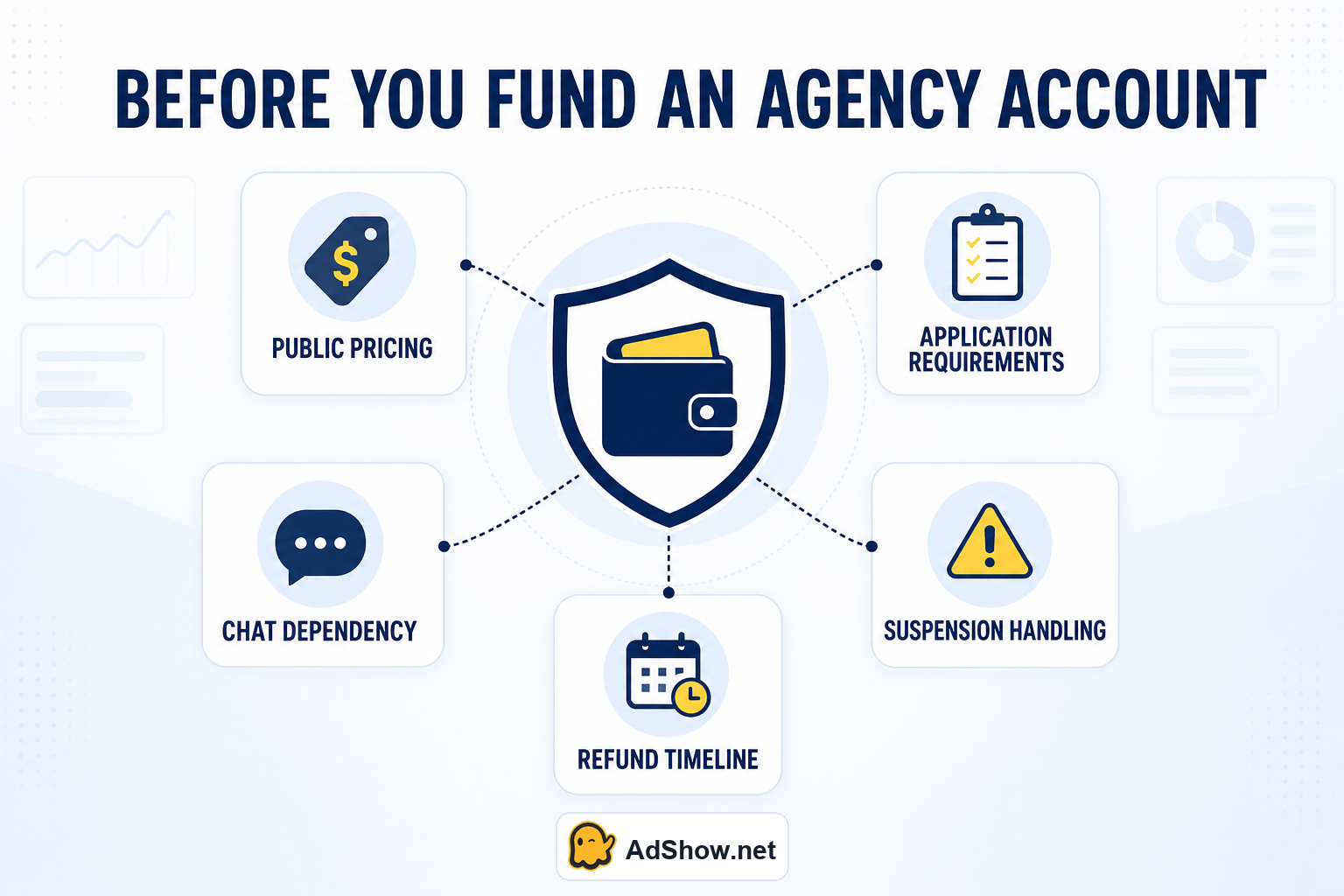
Our comparison prioritizes public pricing, application requirements, chat dependency, suspension handling and refund timelines.
We did not award points for unsupported phrases such as “ban-free,” “unlimited,” “high-trust” or “whitelisted.” Google does not publish a product that exempts an advertiser from policy enforcement simply because its account is managed under an agency MCC. Google describes a manager account as a way to manage multiple Google Ads accounts from one place. Account structure may change billing, access and support, but it does not remove advertiser verification or advertising-policy obligations.
1. AdShow: best for end-to-end self-service operations
AdShow’s Google Ads agency accounts are designed for individual media buyers, performance teams, affiliates, agencies and businesses that want to manage account infrastructure without placing every routine request in a chat window.
What makes the workflow different
AdShow publishes available packages in its marketplace and centralizes account requests, wallet balances, top-up requests and account-status reporting in one dashboard. Users can manage multiple agency ad accounts for different brands, offers or regions. Human support remains available through Telegram and email, but support is an escalation channel rather than the only operating interface.
This distinction matters. Several providers in this comparison have a dashboard. AdShow’s advantage is not the mere existence of a login page; it is the number of recurring account-lifecycle actions that can be initiated and tracked without waiting for an account manager.
Published balance and suspension policy
The AdShow FAQ states that eligible unused advertising balance can be transferred between accounts or refunded. When an account is disabled, the remaining unused balance can be moved to a new account or refunded to the original payment method. Refunds are normally processed within one to five business days. If a submitted URL is rejected during approval, the FAQ states that the customer receives a full refund.
The limits are also disclosed. Subscription and setup fees are non-refundable, and prohibited or fraudulent use can lead to suspension or termination. AdShow does not guarantee account lifetime, ad approval, CPM, CPA, ROAS or profit. That is more credible than promising an account that can never be banned.
Best fit
individual buyers who do not have extensive company documentation;
teams that want visible packages before contacting sales;
operators managing multiple advertising platforms from one account workspace;
buyers who want a published unused-balance process;
subscription customers who want Professional Campaign Setup & Support ($300 Value) included while launching campaigns.
Trade-off: AdShow is newer than established consultation-led providers. Buyers who specifically want a traditional account manager to control the entire relationship may prefer a managed model.
2. Threasury: best for established, compliant advertisers
Threasury publicly positions its Google agency accounts as being built for compliant advertisers. Its process includes eligibility checks, compliance review and onboarding before an account is issued. For a mature business with complete documentation and clean white-hat campaigns, that screening can be valuable.
What our onboarding evidence showed
In the onboarding attempt documented for this review, the application status was marked Rejected. The status page explained that details could not be verified, documents could be incomplete or the use case did not meet policy. The next action was not another self-service step; the applicant was told to update the information and reapply or contact the team through WhatsApp or Telegram.
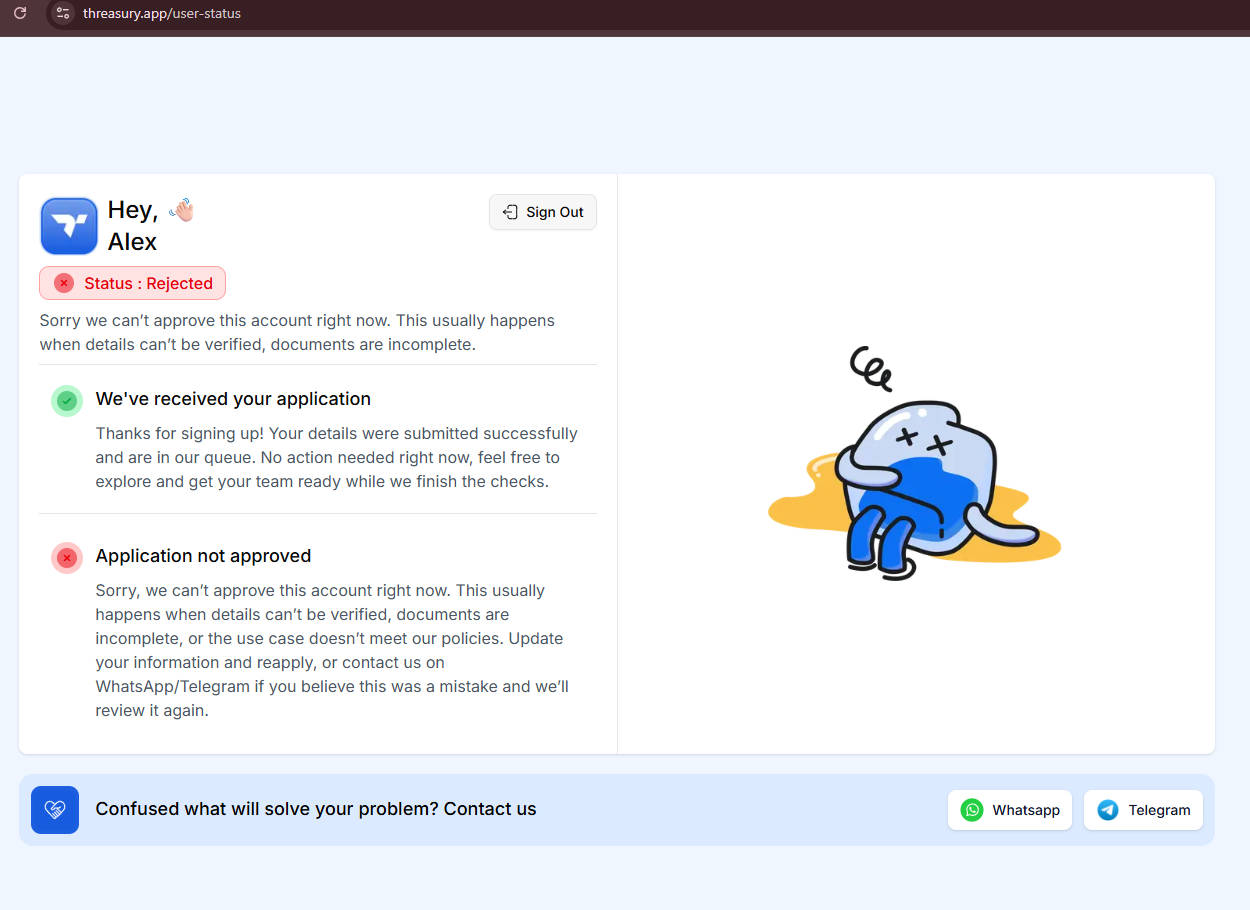
This does not prove that every small advertiser will be rejected, and it should not be interpreted as a criticism of compliance screening. It does show a practical difference: creating a login does not guarantee access to an account, and a rejected buyer can return to a chat-dependent review process.
Best fit: registered businesses with verifiable documents, compliant URLs and enough operational maturity to benefit from pre-screening.
Trade-off: less suitable for buyers who want immediate access or who cannot satisfy a formal application review.
3. Media Blast by Adcore: best for corporate verification and structured teams
Media Blast should not be described as a chat-only service. It provides a real dashboard for managing advertising-account data and allocating balances. Adcore is also a publicly listed company and a Google Premier Partner, which can appeal to corporate buyers.
The company-document barrier
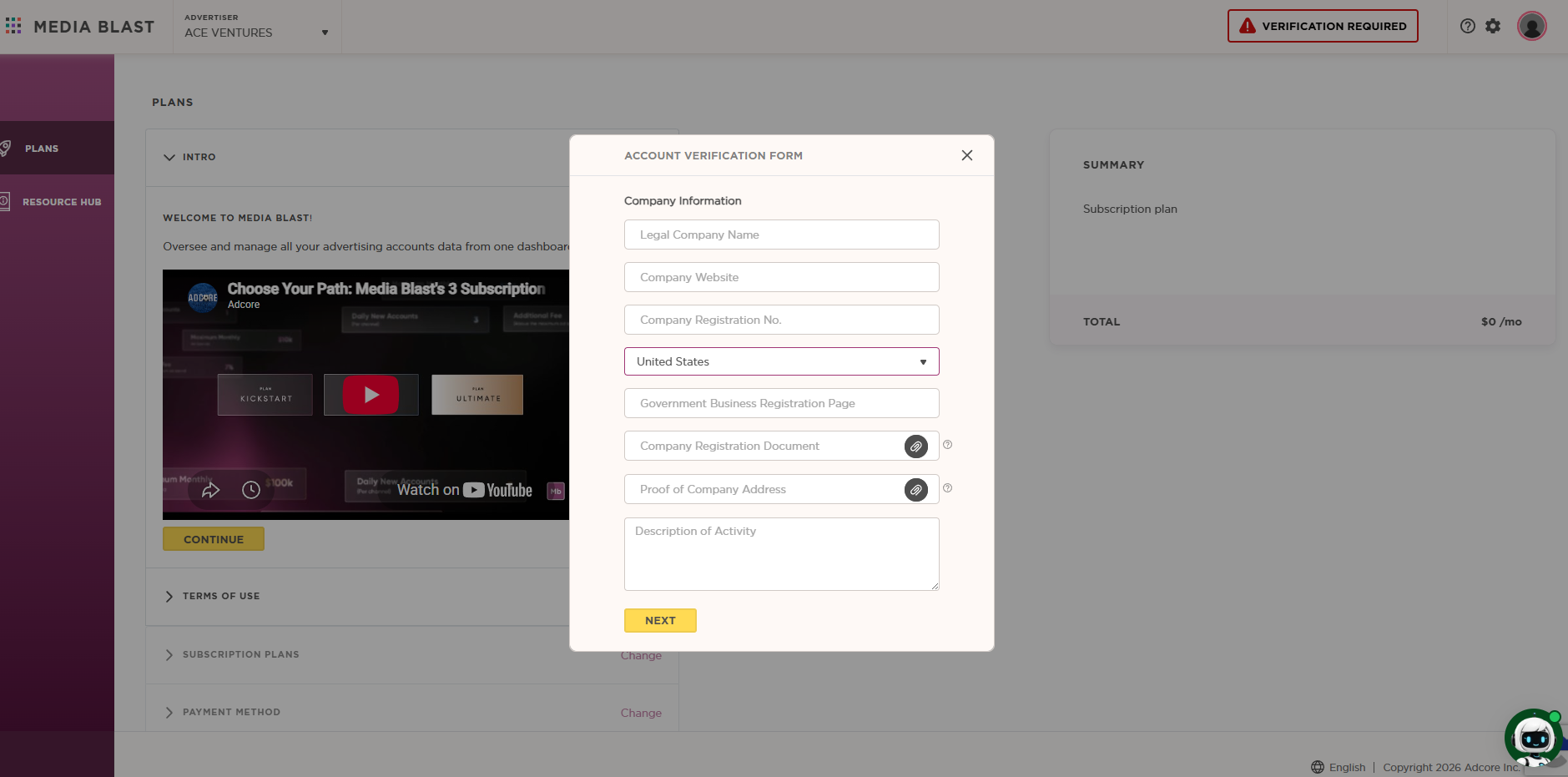
The verification screen captured during our review required a legal company name, company website, company registration number, government business-registration page, company-registration document, proof of company address and description of activity. This is a conventional corporate due-diligence process.
For a registered company, those requirements may be reasonable. For an independent media buyer, sole operator or informal affiliate team, they can stop onboarding before a plan is activated. Media Blast’s terms also state that account creation is subject to Adcore’s discretion.
What the Adcore review profile tells us
At the time of review, Adcore’s Trustpilot profile contained only one customer review. That reviewer alleged platform instability, an unexpected return of ad-account balance to the wallet, a mandatory monthly-spend requirement and unclear fees. The complaint is directly relevant to Media Blast operations, but a sample of one cannot establish how commonly those problems occur. The fair conclusion is not that Media Blast routinely removes balances; it is that buyers should obtain the minimum-spend rule, top-up fee and circumstances for balance reallocation in writing before subscribing.
Best fit: companies with complete corporate records that want a mature dashboard and are comfortable with formal verification.
Trade-off: the documentation burden and approval gate make it less accessible to individuals, while exact commercial costs are not as easy to compare before entering the flow.
4. YeezyPay: best for affiliates, crypto funding and restricted GEOs
YeezyPay has one of the clearest affiliate-focused positions in this market. Its content emphasizes Google Ads agency sub-accounts, crypto-friendly funding and support for buyers in a broad range of GEOs. It also describes a web dashboard for balances, accounts and spending.
Where chat remains part of the product
The contact flow we reviewed asked the visitor for a contact handle and a preferred communication method, with Telegram preselected. YeezyPay’s own onboarding guide instructs users to start through Telegram, receive an invitation and message a dedicated account manager with the email that should be linked to the Google Ads account.
That is not the same as having no dashboard. It is a hybrid model: dashboard for account and funding visibility, Telegram for onboarding and account-manager coordination.
Best fit: affiliates who prefer USDT or other crypto rails, need support across difficult GEOs and are comfortable operating through Telegram.
Trade-off: buyers seeking a low-chat workflow may find the assisted access process less efficient than a marketplace-led self-service model.
5. Adtucon: best for high-volume multi-platform teams—with refund due diligence required
Adtucon is the closest structural comparison to AdShow in this list. Its public site presents a centralized platform, account requests, balance controls, top-ups and multi-platform infrastructure. It is aimed at experienced teams running multiple accounts across Meta, Google, TikTok and other traffic sources.
The operational difference
Adtucon’s public onboarding page states that 90% of clients start on Telegram and asks for a Telegram username. The company describes guided onboarding and account setup handled by its team. In practice, this makes its platform more assisted than AdShow’s marketplace-led model: the dashboard may centralize operations after approval, but access starts with a human review.
What Trustpilot signals—and what it does not prove
At the time of our August 10, 2026 review, Adtucon’s Trustpilot profile showed 31 reviews: 55% were rated five stars and 42% were rated one star. Several recent one-star reviewers independently alleged long delays or disputes involving unused funds. Reported examples included an $800 balance, a refund request said to have remained unresolved for more than four months, and another case in which the reviewer said a top-up remained unspent while the refund had not arrived after 50 days. Other customers posted positive comments about account quality and responsive support.
A separate site named AdtuconScam.com reproduces screenshots and alleges that customers were told after payment that refunds required up to 60 business days, while the site’s author says that timeframe did not appear in a contract they reviewed. The site also aggregates several of the same Trustpilot complaints.
That website is an advocacy and accusation site, not an independent regulator, court judgment or neutral publication. We have not independently authenticated its contract, screenshots, corporate assertions or legal analysis. Its value is narrower: it highlights a specific question that prospective customers can verify for themselves—where exactly is the refund timeframe written in the agreement signed before funding?
The repeated nature of the Trustpilot allegations gives the refund-delay theme more weight than a single isolated complaint, but it still does not prove that Adtucon routinely withholds refunds. Adtucon has responded to some negative reviews by requesting case details and stating that an official refund procedure and expected timeline are communicated to customers. A buyer should request that procedure before paying, not after requesting a withdrawal.
Best fit: high-volume teams wanting multi-platform infrastructure and assisted onboarding.
Trade-off: chat approval, limited public pricing detail and mixed customer-review signals around balance resolution.
6. Orange Trail: best for a traditional managed compliance relationship
Orange Trail represents the traditional side of the market. Its public service is built around consultation, URL approval, compliance review and dedicated support. It says it works only with white-hat advertisers and encourages advertisers to contact the company when their monthly spend is high enough to justify the fees.
What a small buyer should expect
The relationship is primarily initiated through a sales call, WhatsApp or Telegram rather than an open self-service marketplace. During the outreach recorded for this comparison, a small-budget inquiry did not receive a response. One unanswered inquiry is not sufficient to establish a company-wide policy or intent, so we do not describe it as proof that Orange Trail refuses small customers. It is, however, consistent with a service positioned toward advertisers spending around $10,000 per month or more.
What the one-star reviews add
Orange Trail’s Trustpilot profile was overwhelmingly positive at the audit date: 92% of 61 reviews were five stars, while 6% were one star. One 2025 reviewer alleged slow responses, multi-day request delays and fees that felt too high. Orange Trail replied that the reviewer was not a customer and described the review as fake.
Because the identity dispute cannot be resolved from the review page, we do not treat that complaint as verified. It does, however, overlap with the operational risk exposed by our own unanswered small-budget inquiry: service quality in a relationship-led model can depend on whether the sales and support team considers the account a fit. The practical buyer question is therefore not “Does Orange Trail have a bad review?” but “What response-time commitment applies to my spend tier, including weekends?”
Orange Trail publicly states that unspent funds are refundable and that account access usually follows URL approval and onboarding. Its differentiator is managed compliance, not instant access for every buyer.
Best fit: established white-hat businesses that want a compliance team and a relationship-led service.
Trade-off: small buyers may face slower sales engagement, unclear upfront pricing and a workflow that depends more heavily on human availability.
What the screenshots reveal that provider landing pages do not
Marketing pages commonly emphasize stability, scale and support. The onboarding evidence tells a more useful story:
A dashboard does not equal approval. Threasury’s status screen demonstrates that a registered user can still be rejected and redirected to chat.
A professional platform can still exclude individuals. Media Blast’s legal-company and document fields create a clear barrier for buyers without a registered company.
A dashboard can coexist with chat dependency. YeezyPay and Adtucon both describe platform functionality while using Telegram as an important onboarding layer.
Managed service can prioritize larger accounts. Orange Trail’s positioning and consultation model are better aligned with established spenders than buyers testing with a small budget.
Refund language matters more than “account strength.” A buyer needs to know where unused money goes, how long processing takes and what exclusions apply.
This is why we do not rank providers solely by the number of accounts claimed, reported ad spend or unsupported approval-rate percentages. Those figures are difficult for an outside buyer to audit. Application fields, published pricing and refund terms can be inspected before money changes hands.
Complaint-pattern audit: what buyers should verify
Provider | Public complaint signal reviewed | Strength of signal | Question to obtain in writing |
|---|---|---|---|
AdShow | No comparable third-party review sample identified in this audit; its own FAQ publishes the unused-balance process | Policy is public, but independent review history is still limited | Which balance is eligible, and can fraud or prohibited-use review delay it? |
Threasury | Strong positive profile; our direct onboarding application was rejected | Direct evidence of approval friction, not evidence of poor service | Which documents and use cases determine acceptance? |
Media Blast | One relevant Trustpilot complaint about balance movement, minimum spend and fees | Too small a sample to infer a pattern | When can balance be returned to wallet, and what minimum spend applies? |
YeezyPay | No reliable provider-specific Trustpilot profile found during this audit | Insufficient independent review data | What actions require Telegram, and what is the written refund timeline? |
Adtucon | Multiple Trustpilot allegations repeating refund-delay and unresolved-balance themes; a dedicated accusation site reproduces related claims | Repeated allegation pattern, but not an adjudicated finding | Show the signed clause defining refund steps, exclusions and maximum processing time |
Orange Trail | A small minority of one-star reviews includes a response-delay allegation disputed by the provider | Isolated and contested against a strongly positive overall profile | What response-time commitment applies to my spend level? |
Questions to ask before funding any Google Ads agency account
Is this a new client account under an MCC, an existing account or a managed-service arrangement?
Who is the paying manager and who controls the payment profile?
Will I receive administrative, standard or read-only access?
Can an individual apply, or are company documents mandatory?
Which URLs and verticals require approval before funding?
What are the setup, subscription, top-up, currency-conversion and withdrawal fees?
Which actions can I complete inside the dashboard without contacting support?
If the account is suspended, who submits the appeal and how is its status tracked?
Can unused funds move to another account, return to a provider wallet or return to the original payment method?
What is the written refund timeline and which compliance or identity checks can delay it?
Does replacement require approval of the original campaign, URL and connected assets?
What happens to campaign history, conversion tracking and access if I leave the provider?
Our verdict
There is no universally best provider for every advertiser. Threasury and Orange Trail make sense for established white-hat companies that value screening and managed compliance. Media Blast offers corporate-grade infrastructure but requires company verification. YeezyPay is compelling for affiliate buyers and crypto-funded operations. Adtucon offers a broad platform for teams prepared to complete assisted onboarding and verify refund terms carefully.
AdShow ranks first for the buyer profile most underserved by the other options: an individual media buyer, small team or growing agency that wants to see available packages, request accounts, manage balances, initiate top-ups and report account issues from a dashboard without conducting the entire relationship through chat.
The strongest reason to consider AdShow is not a promise that a Google Ads account will never be suspended. No provider controls Google’s enforcement systems. The stronger proposition is operational: clear workflows before funding and a published process for eligible unused balance if an account cannot continue.
Compare current Google Ads agency account packages on AdShow, or review the balance, refund and account-restriction FAQ before registering.
Frequently asked questions from PPC communities and provider reviews
The following questions reflect recurring concerns synthesized from PPC forums, Google support discussions and provider-review pages. They are answered here because they often remain unclear on sales landing pages.
Can a Google Ads agency account prevent suspension?
No. An agency relationship may provide a different billing structure, account infrastructure and support process, but Google can still review or suspend an account for policy, verification, payment or security reasons.
Is a “whitelisted Google Ads account” an official Google product?
Google documents manager accounts, client accounts, payment profiles, Google Partners and category-specific certifications or verification. Providers may use “whitelisted” as marketing shorthand, so ask them to define the exact account relationship or authorization they mean.
Can an individual get a Google Ads agency account?
It depends on the provider. Media Blast’s verification flow requests corporate records, while AdShow is designed to accommodate individual media buyers as well as registered companies and agencies.
Will I own the Google Ads account?
Do not assume ownership from the word “agency.” Ask who created the client account, which manager owns the billing relationship, what access level you receive and whether the account can be transferred when the relationship ends.