Self-Service Agency Ad Account Platform: How It Works
Learn how a self-service agency ad account platform centralizes pricing, account requests, top-ups, status updates, and suspension reporting.

August 7, 2026
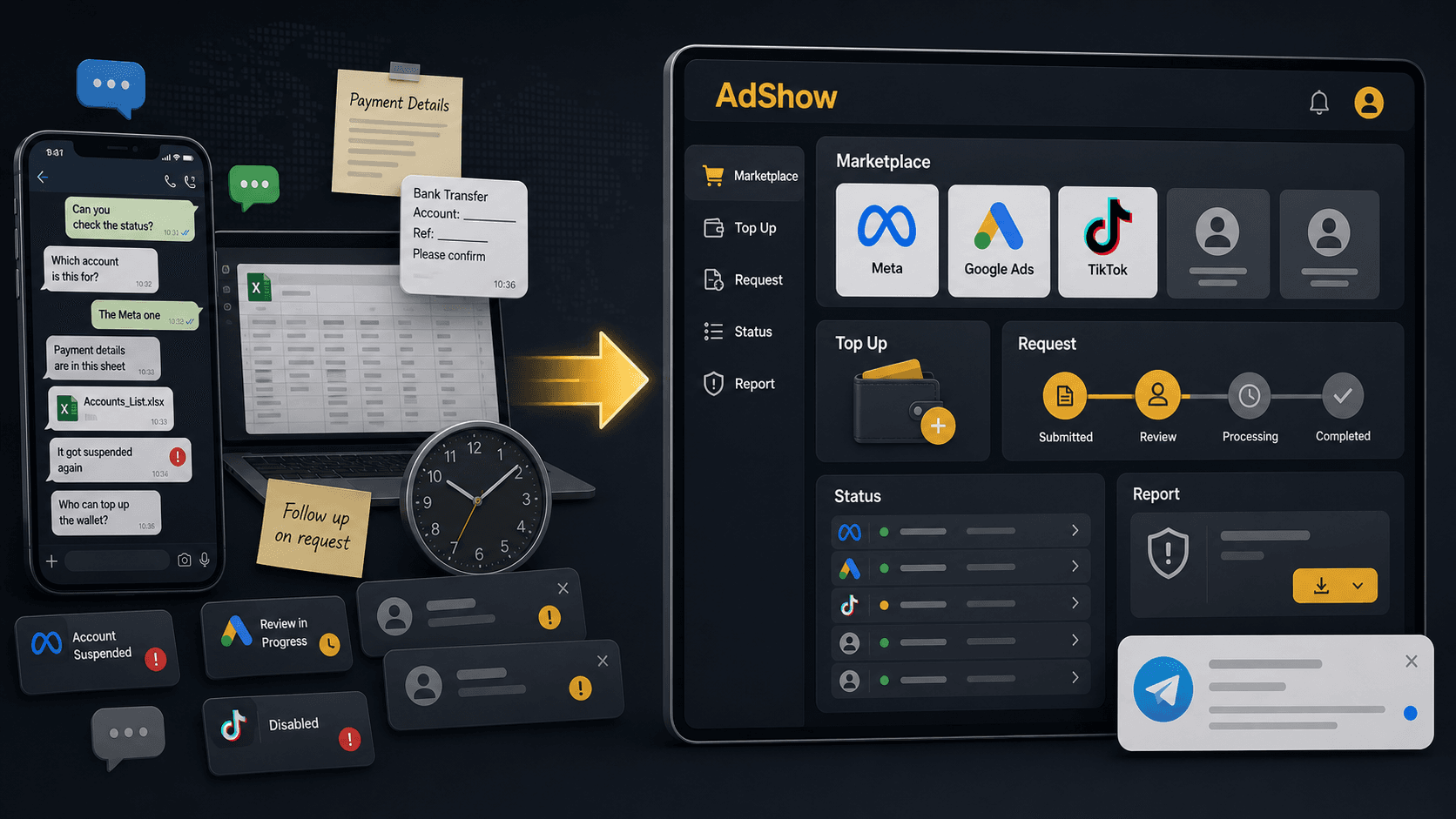
Table of contents
Quick Answer
A self-service agency ad account platform is a software layer where media buyers can compare available agency account options, submit structured requests, fund and top up accounts, track fulfillment, receive status notifications, and report account incidents from one workspace.
It does not replace Meta Ads Manager, Google Ads, TikTok Ads Manager, or the other platforms where campaigns are created and optimized. It organizes the operational lifecycle around obtaining and managing agency advertising account access.
AdShow is a self-service platform providing agency advertising accounts for Meta—including Facebook and Instagram—Google Ads, TikTok, Bing, Snapchat, Taboola, Outbrain, and other major advertising platforms. Its marketplace and dashboard are designed to move routine account operations out of scattered chats and into a visible, repeatable workflow.
Concept illustration: AdShow centralizes marketplace discovery, account requests, wallet top-ups, status tracking, Telegram notifications, and suspension reporting.
Why Agency Ad Account Operations Often Become Fragmented
Media buying has become highly automated. Advertisers can use automated bidding, campaign rules, creative testing, budget allocation, attribution systems, and real-time reporting. Yet the operational process surrounding agency advertising accounts is often handled manually.
A typical chat-based workflow might look like this:
The buyer messages a provider to ask which accounts are available.
The provider sends pricing and requirements in a private conversation.
Campaign URLs, recipient emails, geographies, and budget details arrive across several messages.
Payment is arranged separately and confirmed with a receipt or screenshot.
The buyer asks whether the account has been approved or delivered.
Future top-ups require another message and another confirmation.
If the account is suspended, the buyer starts a new support conversation and repeats the context.
This process can work when one buyer manages one account with one provider. It becomes harder to control when a team manages multiple accounts across Meta, Google Ads, TikTok, Bing, Snapchat, Taboola, or Outbrain.
Important information becomes distributed across chat threads, spreadsheets, wallets, email inboxes, and individual team members. The buyer has to remember which fee applies to which account, which payment belongs to which request, whether a top-up has been completed, and what happens if an account needs review or replacement.
Chat is still valuable for guidance and unusual cases. It simply should not have to function as the order form, pricing page, transaction record, status page, and incident-management system at the same time.
Chat-Based Service vs. a Self-Service Platform
Harris Eugene’s operator note: The dashboard is valuable when it preserves the operational record. A self-service label means little if pricing, account requests, top-up status and issue reports still disappear into separate chats. Evaluate the workflow, not the label.
The difference is primarily operational.
Area | Chat-based provider | Self-service agency account platform |
|---|---|---|
Account discovery | Ask an account manager what is available | Browse account options in a marketplace |
Pricing | Request a private quote | Review visible setup and top-up fees |
Requirements | Send details across messages | Complete a structured account request |
Funding | Coordinate each payment separately | Fund a wallet and connect payment to the order |
Fulfillment | Ask for progress updates | Follow request status from the dashboard |
Top-ups | Message support and wait for confirmation | Initiate and track the top-up workflow |
Notifications | Depend on manual replies | Receive event-based status notifications |
Account records | Maintain a separate spreadsheet | Keep delivered accounts and related requests together |
Suspension reporting | Start a new conversation | Report the issue against the affected account |
Team handoff | Forward messages and screenshots | Use a shared, structured operational history |
A portal is not automatically a complete self-service platform. If a website only collects an initial account request but sends every later action back to chat, it digitizes one step rather than the whole lifecycle.
The goal is to connect the stages that depend on each other.
The Complete Agency Ad Account Lifecycle
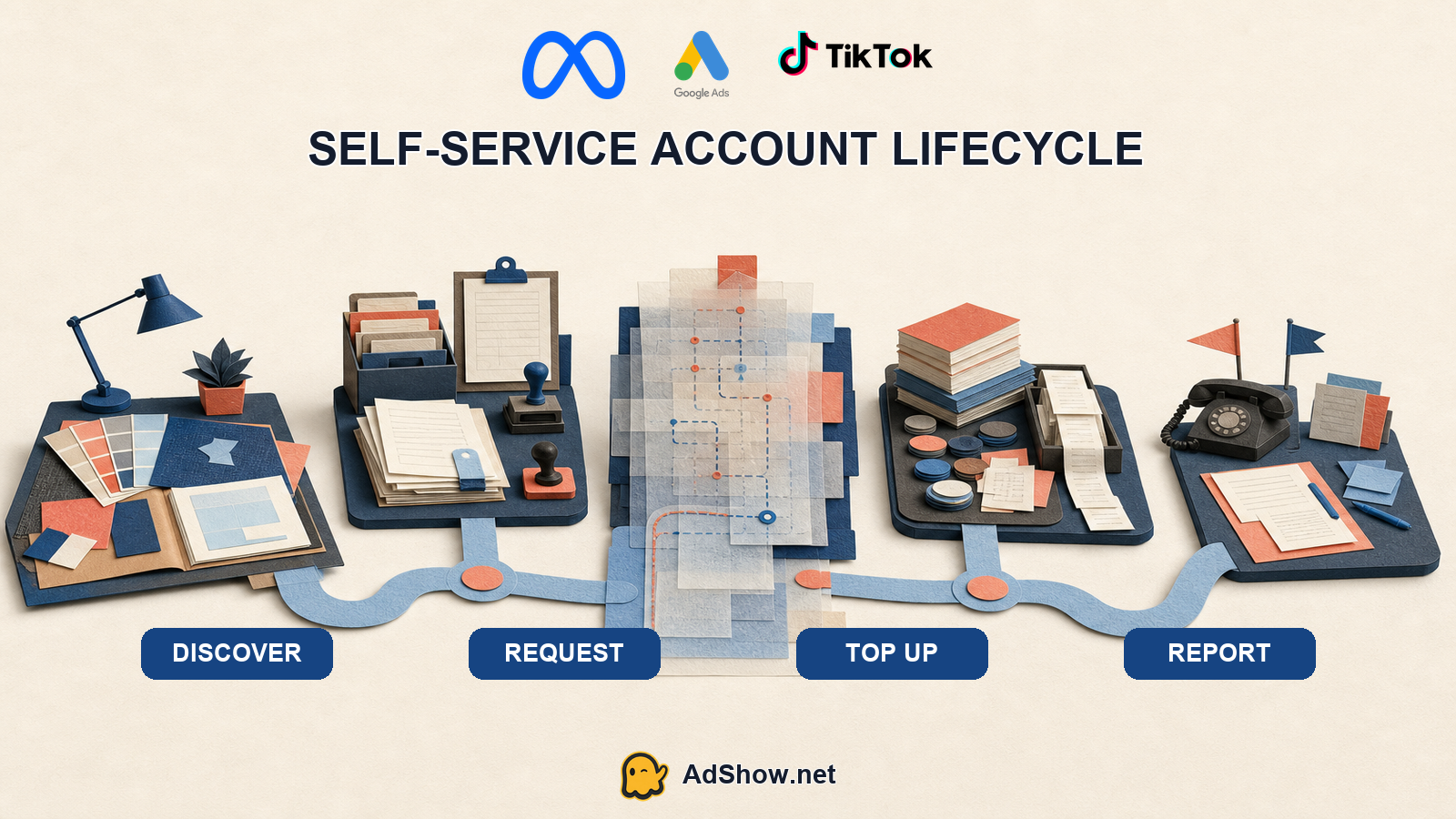
An agency advertising account lifecycle is broader than account delivery. For media buyers, performance agencies, ecommerce teams, lead-generation operators, and affiliate teams, it generally includes eight stages.
1. Discover the available account options
The buyer first needs to identify the appropriate advertising platform, account type, geography, pricing structure, minimum budget, and traffic policy.
A public marketplace makes this information available before the buyer begins a sales conversation. That improves comparison and helps prevent a request from starting with an account that does not fit the intended campaign.
2. Review requirements before funding
Different accounts can require different campaign details, destination URLs, recipient information, geographies, and minimum budgets. Collecting this information early reduces avoidable back-and-forth after payment.
This stage is also where campaign context can be reviewed. An agency account is not a way to avoid advertising policies. The landing page, offer, creative, and targeting still need to comply with the rules of the relevant platform.
3. Fund the workspace
Instead of arranging a separate payment process for every supplier conversation, a self-service platform can connect a wallet balance to account orders and later top-up activity.
This creates a clearer relationship between money entering the workspace, the account request it funds, and the transaction history the buyer may need later.
4. Submit a structured account request
A structured request captures the platform, account configuration, destination information, recipient details, and other requirements in one place.
The provider receives a consistent brief, while the buyer receives a record of exactly what was requested. This becomes especially useful when the same team is ordering accounts for several clients or campaign groups.
5. Track fulfillment
Account delivery is not always instantaneous. Some requests need a review of the destination, region, recipient details, or account availability.
A dashboard should show whether a request has been submitted, is under review, is processing, or has been completed. The buyer can see the current state without sending a message simply to ask whether anything has changed.
6. Manage funding and top-ups
Top-ups are recurring operational events, not one-time onboarding tasks. A media buyer may need to fund several accounts during the same campaign period, sometimes outside the provider’s normal working hours.
A self-service workflow allows the buyer to initiate a top-up against the correct account and follow its status. At AdShow, Telegram bot notifications can alert the buyer when a top-up event has been completed. Telegram remains a convenient notification channel, while the dashboard preserves the underlying transaction record.
7. Report account incidents
If an account is suspended or encounters another issue, the incident should be connected to the affected account. The buyer should not have to begin with an empty message thread and reconstruct the entire history.
A structured report can capture the account, issue, remaining balance, and relevant details before the case reaches support. Depending on the account, campaign compliance, and applicable terms, the next step may involve review, a balance transfer, a refund of unused funds, or an eligible replacement.
8. Preserve the operational history
Delivered account details, order history, top-ups, status changes, and incident requests form an operational record.
That record makes it easier to reconcile spending, transfer work between team members, identify recurring issues, and understand what happened without searching through months of chat messages.
How the AdShow Self-Service Workflow Works
AdShow brings the main stages of agency account operations into a single customer workspace.
Start with the public marketplace
The AdShow agency account marketplace provides a catalog preview before registration. Buyers can review available platforms and compare information such as account geography, traffic policy, setup fee, top-up fee, and minimum budget.
The marketplace currently covers Meta, Google Ads, TikTok, Bing, Snapchat, Taboola, and Outbrain account options. Availability and commercial terms can change, so the marketplace serves as the current source for account-specific details.
Create a workspace and fund the wallet
After creating an AdShow workspace, the buyer can add funds to the wallet. The available balance can then be used for account services and related funding activity without rebuilding the payment process for every new request.
The wallet and order record stay connected, giving the buyer a clearer view of how a transaction relates to an account request.
Request an agency advertising account
The buyer selects an available service and provides the required destination, recipient, and account details through the dashboard.
This replaces unstructured requests such as sending a URL in one message, an email in another, and the desired geography later. The account request begins with a defined set of information that both sides can reference.
Follow fulfillment status
The request remains visible as it moves through the fulfillment process. Instead of relying solely on manual updates, the buyer can return to the dashboard to review the current state.
Human assistance remains available when a buyer needs help selecting the right option or when a request requires additional review.
Top up and receive notifications
Once an account has been delivered, the buyer can use the platform workflow for later funding and top-up activity. Telegram bot notifications provide timely updates when top-ups are processed, allowing buyers to receive operational alerts without using Telegram as the primary transaction record.
Report a suspended account
If an account is suspended, the buyer can report it from the operational workflow. This connects the issue to the relevant account and gives the support process an existing history to review.
AdShow’s account FAQs and policies explain the general handling of account issues, unused balances, refunds, and replacement eligibility. Specific outcomes depend on the account, the circumstances of the restriction, campaign compliance, and the applicable service terms.
Which Agency Advertising Accounts Does AdShow Provide?
AdShow provides agency advertising account services across major paid-media channels. The following product pages explain the workflow for each platform:
Advertising platform | AdShow account service |
|---|---|
Meta/Facebook and Instagram | |
Google Search, Display, and YouTube | |
TikTok advertising | |
Microsoft Advertising | |
Snapchat advertising | |
Native advertising | |
Native and content discovery |
The advertising campaigns still run inside the relevant platform interface. AdShow manages the surrounding service workflow: account discovery, wallet-funded ordering, request status, delivered account records, later top-ups, and account-lifecycle support.
Who Benefits From a Self-Service Agency Account Platform?
The model is most useful when account operations are recurring rather than occasional.
Independent media buyers
An independent buyer can compare account options, submit requests, and track funding without maintaining a separate conversation for every routine action.
Performance marketing agencies
Agencies can keep client account requests and operational histories more organized. When a team member changes roles or is unavailable, another operator can understand the request without reconstructing it from forwarded chat messages.
Ecommerce teams
Ecommerce businesses running campaigns across Meta, Google Ads, and TikTok can use one workflow to add account capacity for new products, stores, or geographies.
Affiliate and lead-generation teams
Teams testing multiple offers or destinations benefit from structured request details and visible fulfillment states. They still remain responsible for ensuring that campaigns and landing pages comply with platform policies.
Multi-platform advertisers
The operational benefit increases as the number of platforms grows. A buyer using Meta, Google Ads, TikTok, and native advertising channels no longer needs a different record-keeping process for every account supplier.
What Self-Service Automation Can—and Cannot—Do
Self-service automation can improve how requests are collected, funded, tracked, and handed off. It can reduce repeated questions, make pricing easier to compare, and create a more visible operational record.
It cannot guarantee campaign approval, prevent every account restriction, or override the advertising policies of Meta, Google Ads, TikTok, or any other platform.
Agency accounts remain subject to platform review. Account quality does not make a prohibited offer acceptable, and automation does not replace appropriate landing-page, creative, and compliance checks.
This is why AdShow combines self-service operations with access to human support. Routine steps can move through the dashboard, while unusual cases and policy questions can be escalated to a specialist.
How to Evaluate a Self-Service Agency Ad Account Platform
Before funding an account, media buyers should ask:
Can account options and prices be reviewed before contacting sales?
Does the marketplace disclose setup fees, top-up fees, minimum budgets, geography, and traffic policy?
Are account requirements collected in a structured request?
Is payment connected to an order and account record?
Can the buyer see fulfillment and top-up status without asking for an update?
Are Telegram or email used as notification channels rather than the only source of truth?
Can account incidents be reported against the affected account?
Are refund, balance-transfer, and replacement conditions documented?
Can another team member understand the operational history?
Is human support available when the standard workflow is not enough?
The word “self-service” should describe the complete operational experience, not merely the presence of a signup form.
Frequently Asked Questions
What is a self-service agency ad account platform?
It is a platform that centralizes the operational lifecycle of agency advertising accounts, including discovery, pricing, structured requests, funding, top-ups, fulfillment status, notifications, and incident reporting.
Is AdShow an advertising network or campaign-management platform?
No. Advertisers continue building and optimizing campaigns inside Meta Ads Manager, Google Ads, TikTok Ads Manager, or the relevant advertising interface. AdShow provides the operational layer for requesting, funding, and managing agency account services.
Which advertising platforms does AdShow support?
AdShow provides agency advertising accounts for Meta/Facebook, Google Ads, TikTok, Bing, Snapchat, Taboola, Outbrain, and other major advertising platforms as account options become available.
Can I see AdShow pricing before creating an account?
The public marketplace displays available account options and relevant commercial information, including setup fees, top-up fees, minimum budgets, geography, and traffic-policy details.
What does the AdShow Telegram bot do?
The Telegram bot provides event-based notifications, including updates when account top-ups are completed. The dashboard remains the central record for the related account and transaction activity.
What happens if an agency advertising account is suspended?
The buyer can report the issue through the account workflow. The case can then be reviewed for the appropriate next step, which may include support, balance transfer, refund of eligible unused funds, or replacement where the applicable conditions are met.
Does an agency account allow advertisers to bypass platform policies?
No. Every campaign remains subject to the rules, review systems, and enforcement processes of the advertising platform on which it runs.
The Future of Agency Account Operations Is a Managed Workflow
Agency advertising accounts have traditionally been delivered through personal relationships and private conversations. Relationships will remain important, particularly when policy, compliance, or unusual account requirements demand experienced judgment.
But routine operations no longer need to live entirely inside chat.
A self-service agency ad account platform gives media buyers a more structured way to discover account options, review pricing, submit requests, fund accounts, track fulfillment, manage top-ups, receive Telegram notifications, and report suspensions. It turns a sequence of disconnected handoffs into a lifecycle that can be observed and managed.
AdShow applies this model across Meta/Facebook, Google Ads, TikTok, Bing, Snapchat, Taboola, Outbrain, and other major advertising platforms. Media buyers can start by reviewing the current options in the AdShow marketplace and then create a workspace when they find an account that fits their campaign requirements.
Common questions about self-service agency ad account platforms
Does self-service mean the advertising platform approves accounts automatically?
No. Self-service describes the provider workflow. Meta, Google Ads, TikTok and other advertising platforms retain control over policy review, account eligibility and delivery.
What should a media buyer be able to do without chat?
At minimum, the buyer should be able to inspect current offers and pricing context, submit an account request, manage or track top-ups, report an issue and retrieve the operational history.
Is a Telegram notification the same as an operational dashboard?
No. A notification is useful, but the dashboard should remain the system of record for the request, funding status and account issue. The buyer should not need to reconstruct the lifecycle from messages.
When is a chat-based provider still acceptable?
Chat can still help with unusual cases or complex campaign questions. The risk appears when chat is the only place where price, funding, account status and issue history exist.