TikTok Agency Account vs Personal Account: What Actually Changes?
A TikTok agency account vs personal account comparison is not simply “strong account versus weak account.” A personal or self-serve advertiser account can be appropriate when one business controls its own campaigns, billing and assets. An agency-provisioned account becomes useful when a buyer needs a managed account workflow, clearer top-ups, multiple operators or support beyond the standard interface. Neither account type is exempt from TikTok advertising policies, and neither guarantees delive

August 13, 2026
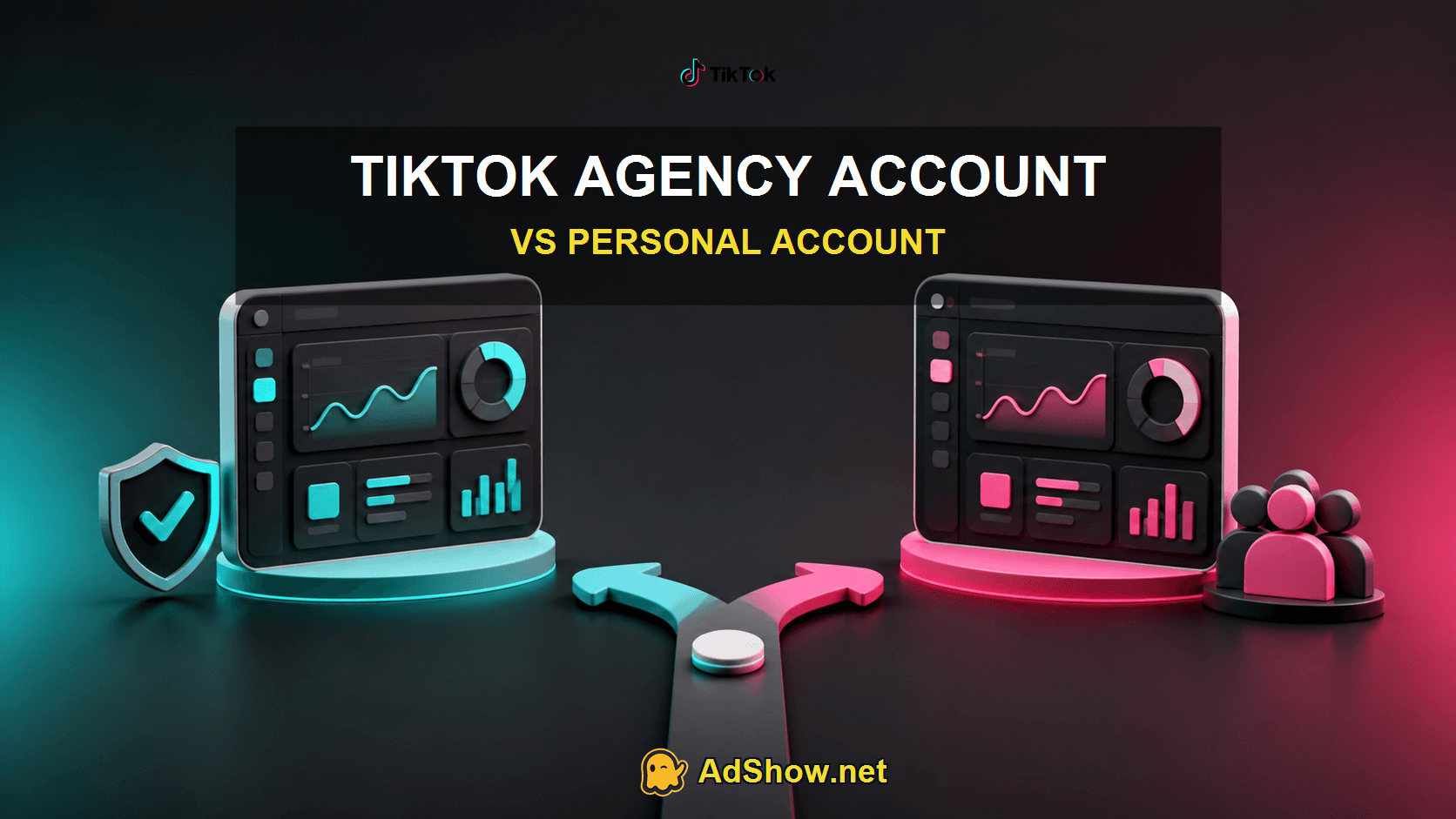
Table of contents
The practical decision is about ownership, permissions, billing, service terms and incident handling—not a mythical “no-ban” status.
Considering an agency workflow? AdShow provides self-service access to TikTok agency ad accounts through a dashboard where eligible advertisers can review current terms, request accounts and manage top-ups. Platform approval and policy enforcement still apply.
What is the short answer?
Choose a self-serve account when you can open an eligible account in your market, own the billing relationship and need only one or a few advertisers. Consider an agency-provisioned account when access, team operations, regional availability, funding records or provider support are the actual constraints. Do not switch only because someone promises better CPM, unlimited spend or immunity from suspension; those outcomes are not properties TikTok guarantees for every agency-linked account.
What does “TikTok agency account” mean?
TikTok’s own documentation describes advertiser accounts created, owned, transferred or accessed through Business Center. It also recognizes agency workflows: an agency can create an advertiser account for a client or request access to an account owned by another business. In the provider market, however, “TikTok agency account” is also used for an advertiser account provisioned and operationally supported by an agency. Those meanings overlap, but they are not identical.
Before paying a provider, ask five separate questions: Who owns the advertiser account? Which Business Center owns or accesses it? Who controls billing? Which assets remain yours? What happens to unused funds if the relationship ends?
How is a personal or self-serve account different?
A self-serve advertiser creates the account directly, supplies its own business and billing details and manages campaigns in TikTok Ads Manager. It can still be organized inside Business Center, shared with employees and linked to TikTok identities, pixels, catalogs and audiences. “Personal” therefore does not necessarily mean one person working without Business Center; searchers often use the word to mean a directly opened, non-provider account.
That distinction matters. TikTok separates user identity, Business Center membership, advertiser-account ownership and asset permissions. Treating all four as one login creates avoidable risk.
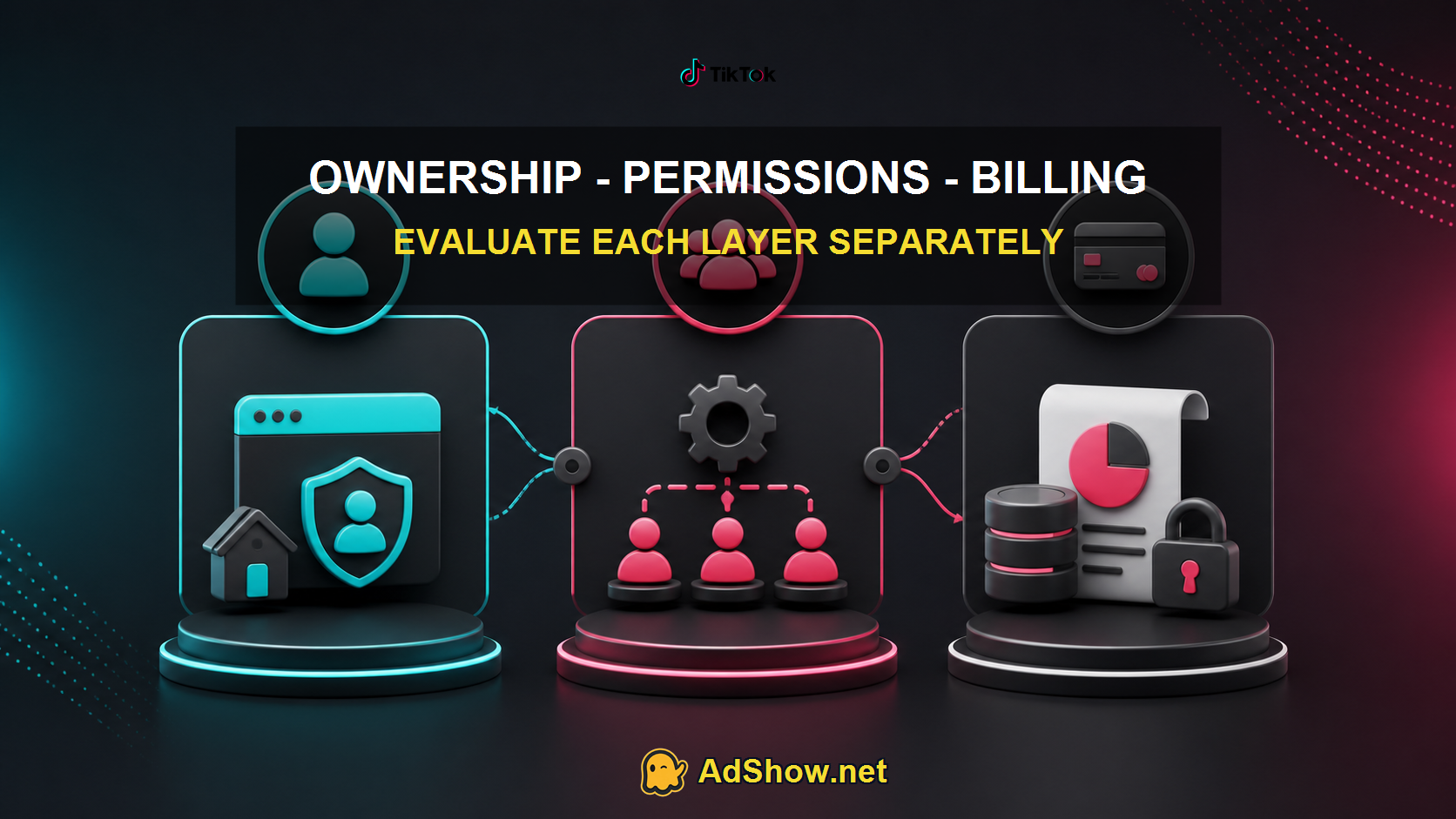
Evaluate ownership, permissions and billing separately before choosing a TikTok account model.
TikTok agency account vs personal: seven decision points
1. Account ownership
Direct ownership gives the advertiser the clearest long-term control. With a provider, ownership and access can vary by offer. Obtain the advertiser ID, Business Center relationship and exit process in writing.
2. Team access
TikTok Business Center supports Admin, Operator and Analyst-style permissions for advertiser accounts. A good agency workflow uses assigned access; it should never require several buyers to share one password.
3. Billing and top-ups
Self-serve accounts may use manual or automatic payment where available. Provider accounts may use prepaid funding or another agreed billing structure. Ask where money is recorded before and after allocation, how long a top-up normally takes and which balance is refundable under the applicable terms.
4. Markets and currencies
Account country, currency and available payment options affect setup. An agency workflow can be useful when a legitimate advertiser needs a supported operational arrangement, but it should not be used to misstate the advertiser or bypass regional rules.
5. Support
Direct advertisers normally use TikTok’s support paths. A provider can add a second operational layer for top-up, account request and incident reporting. That can reduce chat dependency only if the provider has a real dashboard, records and defined response process.
6. Performance
The account label does not rescue a weak offer, poor creative, mismatched optimization event or noncompliant landing page. Auction performance still depends on campaign inputs and TikTok’s systems.
7. Enforcement
Both models remain subject to review, restriction and suspension. A replacement policy, where offered and applicable, is a provider service term—not permission to repeat the behavior that caused enforcement.
Harris Eugene’s operator note
“When I review an account decision, I start with the failure mode. If the buyer’s problem is one card, one owner and one market, a self-serve setup may be cleaner. If the problem is five buyers waiting in chat for funding and nobody can prove where the balance sits, the operational layer is the real bottleneck. Recent community discussions also show buyers asking whether agency accounts inherently perform better. My answer is no: choose the workflow you can audit, then judge performance at campaign level.”
— Harris Eugene, performance strategy across Meta, Google, TikTok and native platforms. This is an expert interpretation of current platform documentation and recent public advertiser discussions, not a claim that every account behaves identically.
What should you verify before funding?
Record the advertiser ID, owner and Business Center relationship.
Confirm permitted verticals, markets, currency and billing model.
Ask for the top-up fee, subscription fee and minimums in one view.
Clarify whether funds sit in a provider wallet or inside TikTok.
Keep Pixel, catalog, domain and TikTok identity access portable where possible.
Read suspension, replacement and unused-balance terms before sending money.
Use named user permissions and two-step verification.
For a broader provider-level comparison, see AdShow’s TikTok agency account provider investigation. If access security is the immediate issue, use the TikTok Business Center access guide.
Run this account-control test before migrating campaigns
Create a one-page asset register before accepting access. List the advertiser ID, owning Business Center, Pixel owner, catalog owner, TikTok identity authorization, domain, billing currency, timezone and each administrator. Then test the workflow with a low-risk campaign rather than moving every asset at once.
Confirm that an operator can build and report without finance access, while the finance role can reconcile funds without changing campaigns. Remove one test user and verify that revocation works. Export the first invoice or transaction record and match it to the platform balance. This small exercise reveals whether the arrangement is genuinely role-based or still depends on a provider manually answering chat.
Finally, write an exit test: which assets can be detached, which remain with the client, how reports are exported and what happens to available and already allocated funds. If the provider cannot answer these questions before a deposit, the account label is not enough evidence to proceed.
Questions collected from recent advertiser and support discussions
Does a TikTok agency account perform better than a personal account?
Not automatically. Account structure can change access, billing and support, but creative quality, offer, targeting, optimization data and compliance remain central to delivery.
Can a TikTok agency account be suspended?
Yes. Agency-created and provider-managed advertiser accounts remain subject to TikTok review and enforcement.
Do I lose my Pixel if I change accounts?
It depends on ownership and permissions. Confirm which Business Center owns the Pixel and whether the new advertiser account can be granted access before moving campaigns.
Is “unlimited spend” a reliable reason to buy?
No. Ask for the actual account, provider and platform limits in writing. Spend capability can depend on account status, billing and platform decisions.
Research scope: TikTok Business Help Center pages updated through June 2026 and public advertiser discussions published or active within the last 12 months. Community comments are individual experiences, not platform guarantees.