How Media Buyers Manage Meta, Google Ads and TikTok Agency Accounts Without Running Operations in Chat
Learn how media buyers manage Meta, Google Ads and TikTok agency accounts through one structured workflow instead of scattered chat messages.

August 7, 2026
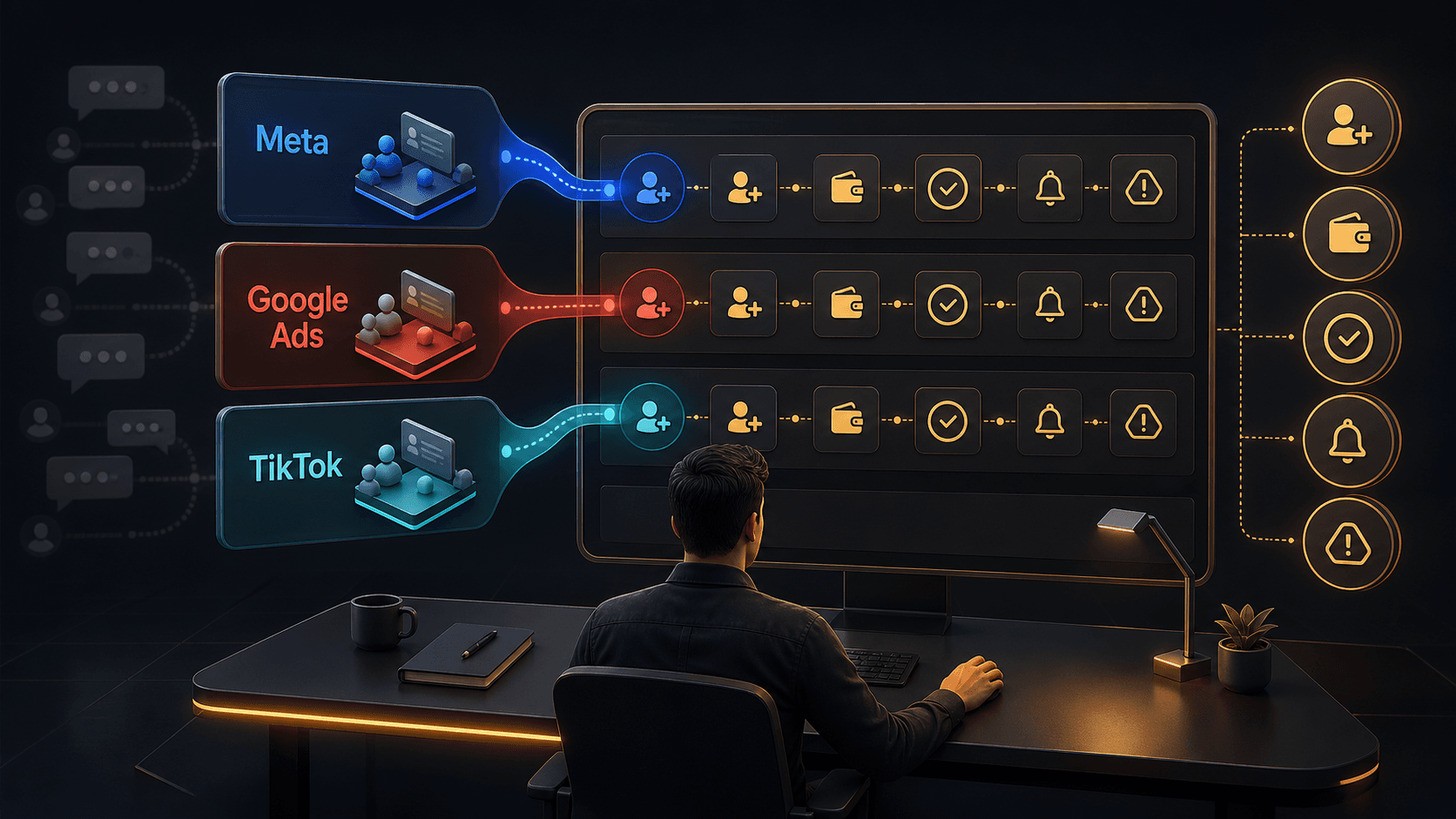
Table of contents
Quick Answer
Media buyers can manage Meta, Google Ads and TikTok agency accounts without running operations in chat by separating campaign execution from account operations.
Campaigns still run inside Meta Ads Manager, Google Ads and TikTok Ads Manager. The surrounding account lifecycle—comparing account options, submitting requests, funding wallets, requesting top-ups, tracking fulfillment, receiving notifications and reporting suspensions—can be organized in a self-service workspace.
AdShow provides agency advertising accounts for Meta and Facebook, Google Ads, TikTok and other major advertising platforms, including Bing, Snapchat, Taboola and Outbrain. Its marketplace and dashboard give media buyers one operational workflow instead of requiring every routine action to begin in a private conversation.
Concept illustration: Meta, Google Ads and TikTok account operations connected to one structured workflow for requests, funding, status, notifications and issue reporting.
Why Multi-Platform Account Operations Become Difficult
Running campaigns on Meta, Google Ads and TikTok is not the same as managing the agency accounts that support those campaigns.
Each advertising platform has its own campaign interface, policies, permissions and billing behavior. Media buyers already expect those differences. The less obvious problem is that the account-service workflow can also fragment.
A team may request a Meta account from one conversation, receive Google Ads pricing in another and send TikTok top-up instructions to a third contact. Campaign URLs live in a spreadsheet. Payment receipts sit in chat. Account ownership is recorded in someone’s private notes. When a balance is delayed or an account is restricted, the team has to reconstruct the history before it can even explain the problem.
The workload increases faster than the account count because every account creates recurring events:
A request must be submitted with the correct platform and campaign information.
Funding must be connected to the correct order or account.
Delivery and top-up status must be checked.
Access and ownership must be recorded.
Restrictions or suspensions must be reported with enough context.
Another team member must be able to take over when necessary.
Chat can coordinate each event, but it does not automatically connect them. When several platforms are involved, the media buyer becomes responsible for stitching the entire operating history together.
Separate Campaign Management From Account Operations
The first step toward a cleaner workflow is to recognize two different layers.
The campaign layer is where media buyers build ads, set targeting, control budgets, review performance and optimize results. For Meta, that work happens inside Meta’s advertising tools. Google campaigns are managed in Google Ads. TikTok campaigns remain in TikTok Ads Manager.
The account-operations layer surrounds that work. It covers how an agency advertising account is selected, requested, funded, delivered, topped up, monitored and supported.
AdShow operates in this second layer. It does not replace the campaign interfaces. It provides agency advertising accounts for Meta/Facebook, Google Ads, TikTok and other major platforms while organizing the service lifecycle around them.
This distinction prevents a common misunderstanding: a unified account-operations dashboard is not a cross-channel campaign optimizer. Its purpose is to make the operational events that support paid media visible and manageable.
For a broader explanation of this category, AdShow’s guide to the self-service agency ad account platform describes the complete lifecycle from marketplace discovery through incident reporting.
What Goes Wrong When Chat Becomes the Workflow
Chat is fast when the request is simple and both people are available. It becomes unreliable when it is used as the permanent system of record.
Pricing becomes difficult to compare
A media buyer may receive a setup fee in one message, a top-up fee later and campaign restrictions somewhere else in the conversation. Comparing Meta, Google Ads and TikTok options then requires transferring information into another document.
If a provider changes availability or a buyer returns to the conversation weeks later, it may be unclear which terms are current. A public marketplace gives the buyer a more appropriate place to review account-specific information before ordering.
Requests arrive in inconsistent formats
Platform, geography, destination URL, recipient details and expected budget may be sent across several messages. Missing information creates more questions and increases the chance that an order begins with the wrong configuration.
A structured request form does not remove platform differences. It ensures that the necessary differences are captured deliberately.
Top-ups become dependent on individual replies
Funding is an ongoing process. A team may need to top up multiple accounts during the same campaign period. If every request is a message, the buyer must wait for confirmation and later match the conversation to the affected account.
The problem is not merely speed. It is traceability. Finance and media-buying teams need to know which transaction funded which account and whether the event was completed.
Status requires repeated follow-up
“Is the account ready?” and “Has the top-up been processed?” should not require a new support request. These are status questions that software can answer when the underlying workflow records its state.
Team handoffs lose context
Private conversations create private knowledge. When a buyer is unavailable, another employee may not know what was ordered, which URL was submitted, how the account was funded or what happened during an earlier restriction.
A shared operational history allows the work to belong to the team rather than to the person who owns the chat thread.
A Practical Operating Model for Three Advertising Platforms
Media buyers do not need to make Meta, Google Ads and TikTok behave identically. They need a consistent operational structure that preserves the relevant differences.
The following model creates that structure without forcing campaign execution into one interface.
1. Build a central account inventory
Every delivered agency account should have a record that identifies the advertising platform, account name or reference, intended campaign or brand, owner, recipient, geography and current operating state.
The inventory should answer basic questions without opening a chat:
Which Meta, Google Ads and TikTok agency accounts are active?
Which client, store, offer or campaign group uses each account?
Who is responsible for operating it?
Which request and funding history belong to it?
Does the account currently require action?
This is the foundation for all later top-ups, status changes and incident reports.
2. Standardize the request process
A common request structure should collect the information every provider needs, then add platform-specific fields where necessary.
The shared information usually includes the requested platform, destination URL, recipient details, target geography and expected budget. A Meta request may require information related to Business Manager access or assets. A Google Ads request may be associated with a customer or manager-account structure. A TikTok request may depend on the intended region and recipient setup.
The goal is not to pretend these systems are interchangeable. It is to prevent important details from arriving piecemeal.
AdShow provides dedicated workflows and information for Meta/Facebook agency ad accounts, Google Ads agency accounts and TikTok agency ad accounts.
3. Connect funding to the affected account
Funding records should never depend on a screenshot alone. A wallet deposit, order payment or top-up request should be associated with the relevant account and transaction history.
This provides two levels of visibility. The operator can see whether the account has the funding needed for campaign activity, while the finance team can see why money left the workspace and where it was allocated.
When multiple platforms are active, this connection becomes essential. A Google Ads top-up should not be confused with the funding intended for a Meta or TikTok account simply because the requests were made close together.
4. Use visible states instead of status messages
Routine workflows should expose their current state. An account request might be submitted, under review, processing or completed. A top-up might be awaiting action, in progress or finished.
The exact labels can vary. What matters is that the buyer can see whether anything has changed and whether action is required.
Notifications should complement this record. AdShow’s Telegram bot can notify buyers when a top-up is completed, while the dashboard preserves the account and transaction context. Telegram remains useful for timely awareness without becoming the only place where the event exists.
5. Attach issue reports to the account
When an account is suspended or encounters another operational issue, the report should begin from that account’s record.
This gives support immediate context: the affected platform, the request history, the account reference and the related funding activity. The buyer can describe the current issue without rebuilding the entire history in a fresh conversation.
The outcome still requires review. Depending on the account, campaign compliance, unused balance and applicable terms, the next step may involve troubleshooting, a balance transfer, a refund or an eligible replacement. AdShow’s account FAQs explain the general handling principles, while individual cases depend on their circumstances.
6. Preserve human support for decisions
Software is most useful for repeatable coordination. It should not pretend that every advertising problem has an automatic answer.
Media buyers may need help choosing the right account option, interpreting a traffic policy, confirming whether a destination is suitable or understanding what information is required after a restriction. Those situations benefit from experienced human judgment.
The efficient model is therefore not “no chat.” It is “no routine operations trapped in chat.” Buyers should be able to use the dashboard for standard actions and contact support when the situation actually requires a conversation.
Managing Meta Agency Ad Accounts
Meta account operations can involve several layers of access, including the agency advertising account, the recipient user or business, and the assets needed for campaign execution.
Before requesting an account, the buyer should identify the correct destination, geography, intended campaign and access recipient. Once delivered, ownership and access details should be recorded centrally so the team knows which business or campaign group uses the account.
Funding events should be attached to the Meta account rather than described only as “the latest top-up.” If more than one Meta account is active, a precise record prevents balances and requests from being confused.
Campaigns remain subject to Meta’s advertising standards and review systems. An agency account may provide a different service structure, but it does not make prohibited creative, misleading claims, cloaking or other policy violations acceptable.
Managing Google Ads Agency Accounts
Google Ads account operations require equally clear mapping between the delivered account, campaign destination, recipient and funding history.
The team should record which brand, website or campaign group is assigned to the account and who is responsible for its operation. If the organization works with several Google Ads accounts, consistent naming and ownership reduce the chance of using the wrong destination or funding the wrong account.
Media buyers should also treat landing-page quality and policy compliance as part of account readiness. A delivered Google Ads agency account is infrastructure for campaign execution, not a substitute for a legitimate destination, accurate claims and compliant ads.
Managing TikTok Agency Ad Accounts
TikTok campaigns often move quickly through creative testing, making operational clarity especially important when several accounts or markets are involved.
The account request should clearly identify the intended region, destination, recipient and campaign context. After delivery, the team should connect top-up requests and status notifications to the specific TikTok account rather than relying on a general conversation.
As with Meta and Google Ads, the account remains subject to TikTok’s advertising policies and enforcement. Creative velocity does not remove the need for compliant claims, landing pages and offers.
How AdShow Organizes Multi-Platform Account Operations
AdShow provides a common operating workflow around the platform-specific agency advertising accounts it supplies.
The process begins in the AdShow agency account marketplace. Buyers can review available options and current operational information such as account geography, traffic policy, setup fee, top-up fee and minimum budget before creating a request. Availability and commercial terms can change, so the marketplace is the appropriate place to check current details.
After creating a workspace, the buyer can fund the wallet, request an account and follow fulfillment from the dashboard. Delivered account records and later top-up activity remain connected to the workspace. Telegram notifications provide timely updates, including top-up completion events, without requiring the buyer to use a Telegram conversation as the primary record.
If an account is suspended, the buyer can report the issue through the account workflow. Support can then review the case with the existing account context.
This operational model applies across the major platforms AdShow provides: Meta/Facebook, Google Ads, TikTok, Bing, Snapchat, Taboola, Outbrain and other available agency advertising accounts.
A Daily Checklist for Multi-Platform Media Buyers
A dashboard helps, but good operations still require clear team habits. A media buyer managing several agency accounts should regularly check the following:
Confirm that every active account has a named owner and campaign purpose.
Review wallet and account balances before planned spend increases.
Submit top-up requests against the correct account record.
Check pending requests and determine whether information or action is missing.
Review completed notifications instead of relying on memory or chat acknowledgments.
Record account restrictions immediately through the affected account workflow.
Keep campaign destinations, creatives and claims aligned with each platform’s policies.
Make sure another team member can understand the account history and take over.
This routine is less about adding administration and more about preventing hidden work. When information is already structured, the checklist becomes a quick review rather than a search across conversations.
When Should Media Buyers Still Use Chat?
Chat remains valuable when the question requires interpretation or when a case falls outside the standard workflow.
Examples include asking which account type fits an unusual campaign, clarifying a traffic policy before ordering, discussing a request that needs additional review or providing context for a complex restriction.
Chat is less suitable for routine actions that need durable records. Price discovery, account requests, payments, top-ups, fulfillment status and issue reports should be visible in the operational system whenever possible.
The distinction is simple: use the dashboard to execute and record the standard process; use chat to resolve uncertainty.
Frequently Asked Questions
Can one dashboard run Meta, Google Ads and TikTok campaigns?
AdShow does not replace the campaign-management interfaces. Campaigns are still created and optimized inside Meta Ads Manager, Google Ads and TikTok Ads Manager. AdShow centralizes the operational lifecycle around requesting, funding and managing the agency account services.
Which agency advertising accounts does AdShow provide?
AdShow provides agency advertising accounts for Meta/Facebook, Google Ads, TikTok, Bing, Snapchat, Taboola, Outbrain and other major advertising platforms, subject to current availability.
Can media buyers see account pricing before contacting support?
The public AdShow marketplace displays current account options and relevant operational details such as setup fees, top-up fees, minimum budgets, geographies and traffic policies.
How are account top-ups managed?
Buyers can initiate top-up activity through the AdShow workflow and associate it with the relevant account. Telegram bot notifications can provide an update when a top-up is completed, while the dashboard retains the operational record.
What happens when a Meta, Google Ads or TikTok account is suspended?
The buyer can report the issue through the affected account’s workflow. Support reviews the account context, campaign compliance, remaining balance and applicable terms before determining the appropriate action.
Does using an agency advertising account bypass platform policies?
No. Campaigns remain subject to the advertising policies, review systems and enforcement decisions of Meta, Google Ads, TikTok and every other platform on which they run.
Is chat support still available?
Yes. Self-service handles routine account operations, while human support remains available for account selection, policy questions, unusual requests and cases that require judgment.
One Workflow, Three Platforms, Clearer Operations
Meta, Google Ads and TikTok will continue to have different campaign tools, policies and account structures. Media buyers do not need to erase those differences. They need a consistent way to manage the service activity surrounding them.
A structured operating model connects discovery, account requests, wallet funding, top-ups, fulfillment status, notifications and issue reporting. It gives the buyer a reliable record, gives finance clearer transaction context and makes team handoffs easier.
AdShow provides agency advertising accounts for Meta/Facebook, Google Ads, TikTok and other major advertising platforms through this self-service model. Buyers can review current options in the marketplace, create a workspace, request the appropriate account and manage its operational lifecycle without turning every routine action into another chat conversation.