5 Best Facebook Agency Ad Account Providers Investigated
Compare five Facebook agency ad account providers by pricing, approval, dashboard control, replacement terms and verified complaint signals.

August 10, 2026
Table of contents
The short answer: AdShow is the strongest fit for media buyers who want to request Facebook agency ad accounts, view packages, manage top-ups and report account problems from a self-service dashboard. Threasury is better suited to documented, policy-compliant businesses willing to pass an eligibility review. Uproas attracts advertisers with aggressive “whitelisted,” “no bans” and “unlimited” messaging, but those claims require unusually careful due diligence. Adtucon offers multi-platform infrastructure with assisted onboarding, while AdBuddie uses a subscription rental model centered on simple setup and replacement promises.
The provider you choose matters because you are not merely renting a login. You are depending on someone else for account provisioning, access permissions, funding records, issue escalation and the destination of unused balance after a restriction. A low fee is not a bargain if every urgent action still depends on a Telegram reply.
This comparison is published by AdShow, which is included below. We therefore separate three kinds of evidence: what we directly observed in an onboarding flow, what a provider states on its own website and what customers allege on third-party review platforms. A landing-page claim is not treated as independently verified simply because it is confidently written.
Best Facebook agency ad account providers at a glance
Provider | Best for | Operating model | Main question to ask |
|---|---|---|---|
AdShow | Self-service media buyers and multi-account teams | Dashboard for marketplace, requests, balances, top-ups and problem reporting | Which package and account region match the intended offer? |
Threasury | Established white-hat advertisers | Dashboard plus eligibility and compliance review | Can the business pass approval with its current documents and landing page? |
Uproas | Buyers considering aggressive vertical support | Sales-led onboarding through form, call, WhatsApp and support | Which “no-ban,” performance and replacement claims are contractual? |
Adtucon | High-volume, multi-platform teams | Platform combined with Telegram-assisted onboarding and approval | What is the written refund timeline for unused funds? |
AdBuddie | Subscription buyers wanting a packaged Meta setup | Plan selection followed by assisted setup through Discord or WhatsApp | What does “lifetime replacement” include and exclude? |
Research updated August 10, 2026. Services, prices and policies can change. “Not publicly disclosed” means the information was not found on the public pages reviewed; it does not prove that no private term exists.
How we evaluated Facebook agency account providers
After years of helping advertisers work through disabled accounts, failed payments and lost Business Manager access, I have learned that the sales page rarely reveals the expensive part of the relationship. The real test starts after money has been sent.
We evaluated each provider against six operational questions:
Pricing visibility: can a buyer understand recurring fees, spend fees and minimums before speaking to sales?
Approval friction: can an individual buyer qualify, or are company documents and manual review required?
Self-service depth: can the buyer request accounts, top up and report restrictions without waiting in chat?
Asset control: who controls the Business Manager, Page, Pixel, audiences and account permissions?
Restriction response: is replacement automatic, conditional or decided case by case?
Balance treatment: where is unused money recorded, and what written conditions govern transfer or refund?
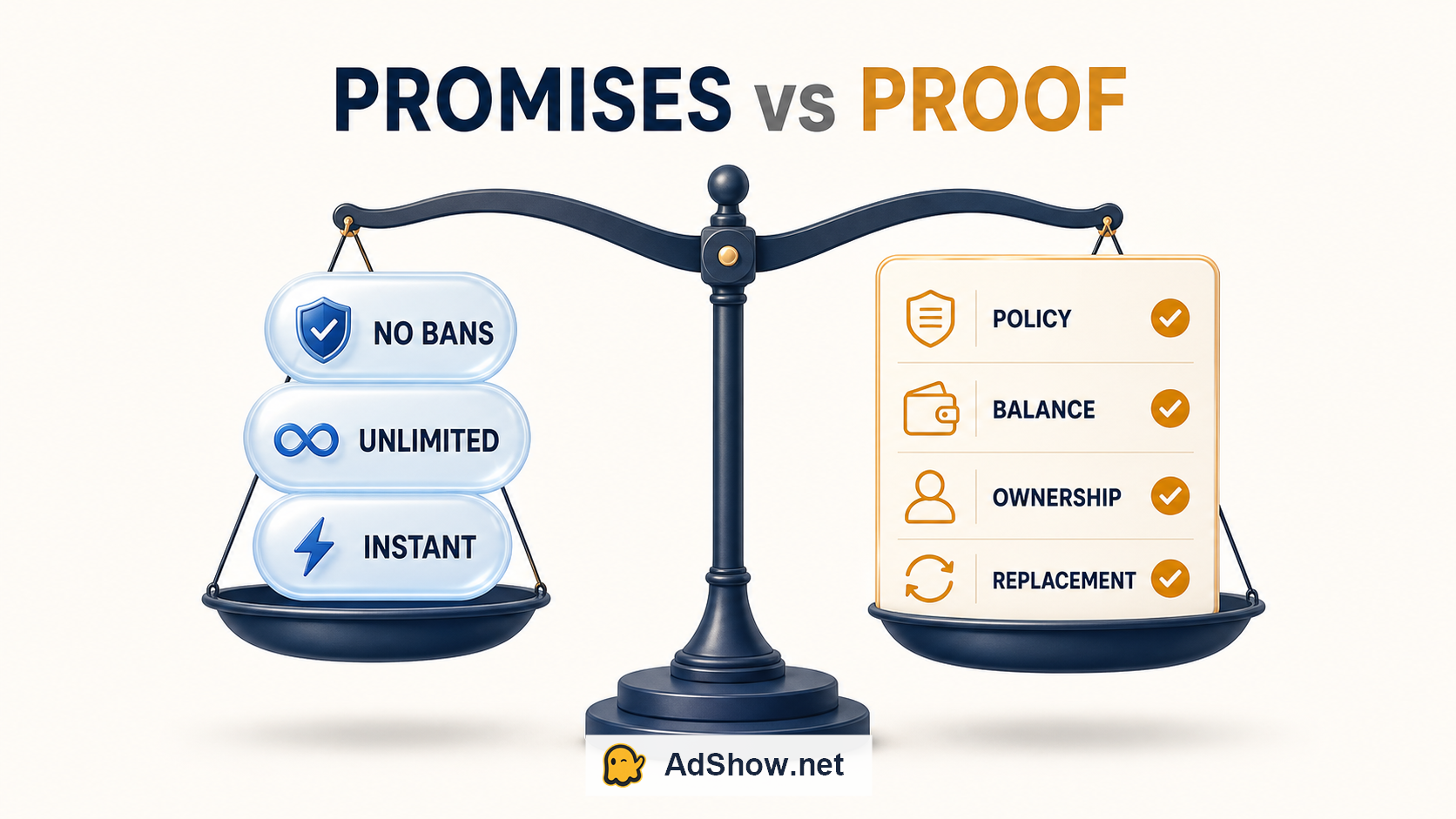
“No bans,” “unlimited” and “instant” are marketing phrases. Policy scope, balance records, ownership and replacement conditions are verifiable operating terms.
We did not award points for the words “whitelisted,” “bulletproof” or “ban-free.” Meta can restrict an ad account, user, Page or Business Account, and the scope of one enforcement action may differ from another. No independent provider can contractually remove Meta’s authority to review or restrict advertising activity.
1. AdShow: best for self-service Facebook agency account operations
AdShow’s Facebook agency ad accounts are designed for media buyers, agencies, affiliates and businesses that want to operate account infrastructure from a dashboard rather than conduct the entire relationship through chat.
What is genuinely different
AdShow displays available packages in its marketplace. From one workspace, users can request accounts, monitor wallet and account balances, submit top-ups and report a suspended account. Telegram notifications can confirm operational events such as a completed top-up, but Telegram is not the system of record.
That last distinction matters. Many competitors now use the word “dashboard,” yet still require the user to return to WhatsApp or Telegram for routine approvals, provisioning and incident handling. A useful dashboard should replace chat for repeatable actions, record their status and preserve an audit trail.
Balance, replacement and campaign support
The AdShow FAQ explains the treatment of eligible unused advertising balance when an account is disabled. Depending on the circumstances and applicable terms, unused balance can be transferred to another account or refunded, while subscription and setup fees remain non-refundable. Buyers should still read the current package conditions before funding because prohibited or fraudulent activity is not protected.
AdShow does not claim that an account can never be restricted. Instead, eligible subscription customers receive Professional Campaign Setup & Support ($300 Value) at no additional charge. The team works with the customer during campaign setup to identify obvious policy and asset-structure risks before launch. This cannot guarantee approval, but it addresses a real cause of avoidable account disruption: advertisers starting with a technically broken or policy-sensitive setup.
Who should choose AdShow?
individual media buyers who cannot supply a full corporate verification package;
teams that want to compare packages before opening a sales conversation;
advertisers managing Meta, Google Ads, TikTok and other agency accounts from one platform;
operators who need a visible workflow for top-ups and suspension reports;
buyers who prefer published balance terms over informal promises in chat.
Trade-off: AdShow is newer than several relationship-led providers. A company that wants a traditional account manager to approve every action may prefer a managed model.
2. Threasury: best for documented, compliant advertisers
Threasury positions its Facebook agency account service as infrastructure for compliant advertisers. Its public process includes signup, an automatic eligibility check, manual review for flagged applications, plan selection and account onboarding. It also provides a dashboard, wallet and instant top-up functionality.
The approval gate is the product—and the trade-off
Threasury’s screening may be valuable for a registered ecommerce brand with a clean offer. It reduces the chance that one risky advertiser damages shared infrastructure. The same gate can exclude smaller buyers, affiliates without conventional company records or advertisers whose landing page cannot be verified.
In an onboarding test documented during our broader provider review, an application reached a Rejected status. The interface said details could not be verified, documents might be incomplete or the use case might not meet policy. The user was directed to update the application, reapply or contact the team through WhatsApp or Telegram.
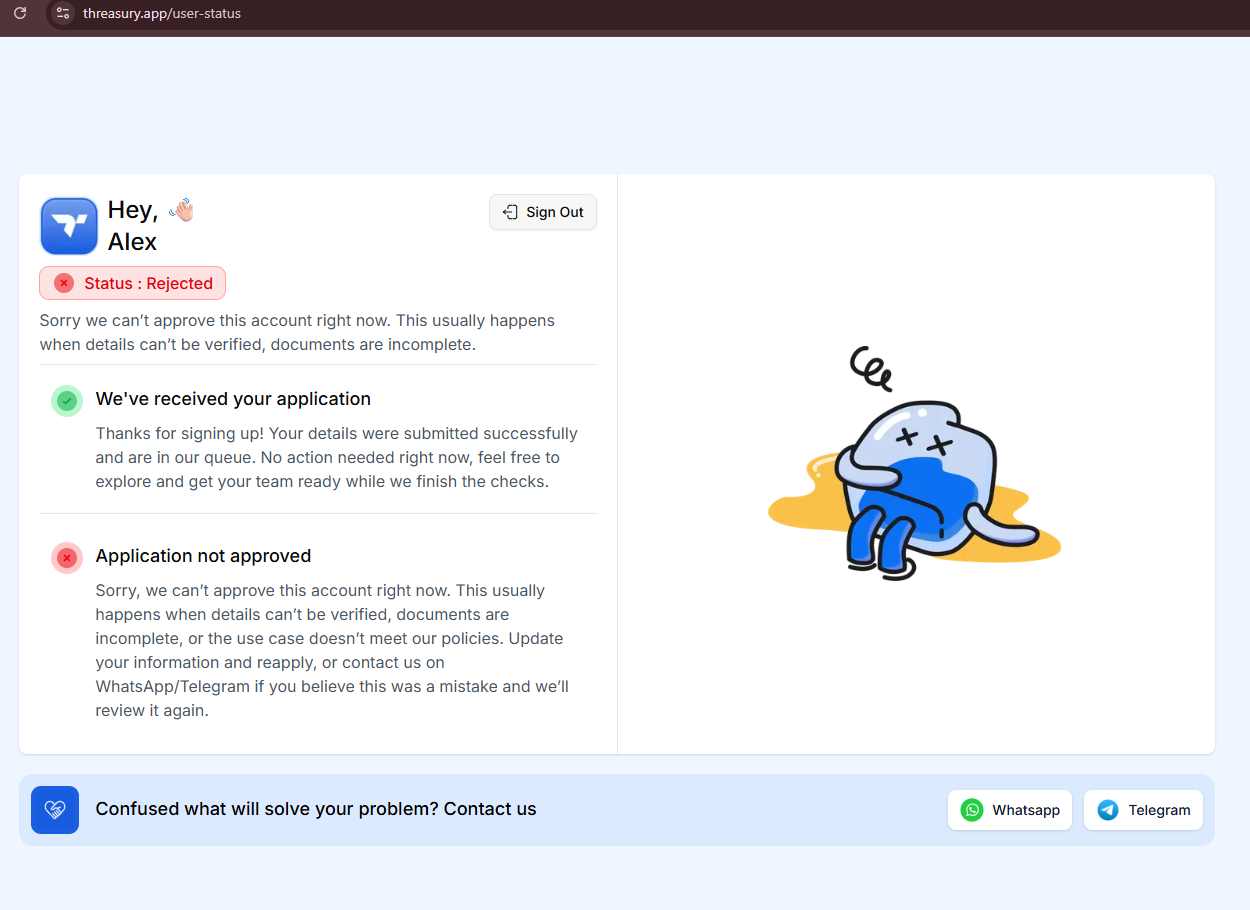
This does not mean Threasury rejects all small advertisers. It demonstrates that registering for the dashboard does not guarantee access to an ad account and that a rejected application can return to a human-assisted workflow.
Best fit: registered businesses running clearly compliant campaigns and willing to submit verifiable information.
Trade-off: approval friction can delay or prevent access for an individual buyer who needs to launch immediately.
3. Uproas: strongest promises, greatest need for verification
Uproas is difficult to ignore because its copy targets exactly what frustrated advertisers want to hear: “No Bans & Restrictions,” “Scale Without Limits,” aggressive vertical support, instant replacement, faster approvals and lower acquisition costs.
The problem is not that Uproas offers replacements. The problem is that several absolute headlines become narrower elsewhere on its own website.
“No bans” conflicts with the need for replacement
The Facebook service page promotes “No Bans & Restrictions.” Its FAQ later says the accounts experience fewer bans and explains that replacement options are available when an account is disabled. “Fewer bans” is a plausible benefit claim; “no bans” implies immunity. They are materially different propositions.
The vertical claim also shifts. “Run Ads for Any Vertical” becomes “Almost Any Vertical” or “many verticals accepted” elsewhere. Every advertiser remains subject to Meta’s policies, landing-page review and enforcement systems regardless of the provider’s relationship with the platform.
Performance figures without a public methodology
Uproas advertises claims including a 687% increase in ad approval rate, up to 50% lower CPA and CPM, Platinum HiVA accounts and access to Meta representatives. At the time of review, we could not find a public sample size, test design, comparison period or independently verifiable dataset explaining how those numbers were calculated.
That absence does not prove the figures are false. It means a buyer cannot determine whether the claimed improvement came from the account, different creative, a different offer, seasonality or selective reporting.
Trustpilot and Reddit create additional credibility questions
Trustpilot currently marks the Uproas rating unavailable because of a breach of its guidelines and states that it removed a number of fake reviews. Trustpilot also contains positive experiences and serious one-star allegations involving repeated restrictions, Business Manager problems, replacement disruption, unclear fund transfers and unresponsive support.
These are customer allegations, not adjudicated facts. The correct conclusion is not that every Uproas customer will experience them. The correct conclusion is that the company’s own rating display and strongest stability promises should not be accepted without written terms.
Reddit provides another useful distinction. One promotional post published by an Uproas founder describes “Facebook insider reps,” creative approval by insiders, direct 24/7 insider support and the ability to run aggressive offers with fewer interruptions. The post includes a “REDDIT” discount code, so it is company advertising—not independent community validation.
By contrast, experienced buyers in broader r/FacebookAds discussions repeatedly advise readers to treat “zero bans,” “unlimited spend” and “instant approval” as marketing rather than guaranteed operating conditions. One commenter who compared a similar campaign on regular and agency infrastructure reported only about a 4% CPM difference and said the real value was higher spending capacity and faster support. That is an individual report, not a controlled study, but it illustrates why account infrastructure should not be confused with auction performance magic.
Questions to ask Uproas before paying
What does “no bans” mean in the signed service agreement?
Which verticals and claims are approved for this specific account?
What does replacement preserve: balance, campaigns, Pixel permissions or only a new account?
What data supports the advertised CPA, CPM and approval-rate improvements?
Which independent review platform supports the rating displayed on the website?
Best fit: experienced advertisers willing to validate vertical eligibility and replacement terms in writing.
Trade-off: unusually aggressive promises, missing public methodologies and the Trustpilot notice increase the due-diligence burden.
4. Adtucon: platform infrastructure with refund concerns to investigate
Adtucon is closer to AdShow than a traditional account broker. It promotes a platform for requesting and managing agency accounts across multiple advertising channels. However, its own materials also indicate that most new relationships begin through Telegram, where the team evaluates the business and assists with approval.
Why the balance process matters
Adtucon’s public Trustpilot profile has a polarized distribution, with positive reviews praising account access and support alongside repeated one-star allegations concerning refund delays, unresolved balances and communication after an account problem. A separate website dedicated to criticizing Adtucon contains more serious accusations, but it is an advocacy site with an obvious conflict of interest—not an independent authority.
We therefore do not repeat its “scam” conclusion. We use the existence of the dispute to identify questions a buyer should settle before funding:
Is money held in a provider wallet or already allocated to the advertising account?
What events make unused funds eligible for withdrawal?
What is the contractual processing deadline?
Can the user initiate and track a refund without Telegram?
What evidence will be provided if Meta or a payment partner delays the balance?
Best fit: high-volume teams comfortable with assisted onboarding and a multi-platform account provider.
Trade-off: pricing and refund mechanics should be obtained in writing before a large transfer, particularly where public complaints describe similar balance problems.
5. AdBuddie: simple subscription packaging with absolute claims
AdBuddie is a newer Meta account rental provider with a straightforward proposition: select a monthly plan, receive setup assistance, top up by bank transfer or crypto and obtain replacement coverage. Its public plans are based on monthly spending capacity, ranging from lower-spend packages to an unlimited tier.
What is attractive
The website presents plan features clearly, including 0% top-up fees, free Facebook profile and Business Manager setup, 24/7 support and cancellation at any time. For a new advertiser who wants a packaged service rather than a custom quote, that simplicity is useful.
What remains unclear
AdBuddie also advertises “zero restrictions,” “without limits” and “lifetime account replacements.” Its FAQ says an account restricted “for any reason” will be replaced immediately at no extra cost. Before relying on that language, a buyer should obtain the exclusions and operational scope in writing.
A replacement account is not the same thing as an uninterrupted campaign. It may not preserve campaign history, learning status, audience permissions, Pixel access or the time needed to reconnect assets. The public page also relies primarily on first-party testimonials; we did not find a substantial independent review footprint comparable with older providers.
Best fit: smaller advertisers attracted to a subscription package with assisted Business Manager setup.
Trade-off: absolute marketing claims and limited independent evidence make the exact replacement and balance terms especially important.
What Reddit actually says about Facebook agency accounts
Reddit is useful for discovering buyer questions, not for declaring a provider guilty. Anonymous comments can be genuine, promotional or written by competitors. We found no strong complaint thread naming Threasury, Adtucon or AdBuddie that met a reasonable evidence threshold, so we did not invent one.
The broader consensus is more valuable:
agency infrastructure may improve spending capacity and escalation access;
it does not exempt campaigns from Meta policy;
advertisers should verify who owns the Business Manager and shared assets;
replacement and unused-balance terms should be documented before funding;
accounts accepting every risky vertical may expose buyers to shared-infrastructure risk.
This is also why we distinguish an Uproas founder’s Reddit advertisement from independent community feedback. Both can be cited, but they answer different questions.
How to choose without reading every provider page
Start with the failure scenario, not the headline. Send each provider the same five questions:
If the account is restricted tomorrow, which campaigns and assets remain accessible?
Where is my unused balance recorded, and how do I request a transfer or refund?
Can I submit that request from a dashboard, or must I wait for a chat reply?
Which fees are refundable and which are not?
Which claims in your sales page are guaranteed in the contract?
A serious provider should be able to answer without promising immunity from Meta. If the response is “don’t worry, our accounts never ban,” you still do not know who controls the assets, what happens to the balance or how long recovery takes.
Final verdict
Choose AdShow when self-service workflow, visible packages and traceable account operations matter most. Choose Threasury when you have a documented white-hat business and value pre-screening more than instant access. Consider Uproas only after converting its strongest marketing claims into written, account-specific terms. Consider Adtucon when you need assisted multi-platform infrastructure and have verified the refund process. Consider AdBuddie when simple subscription packaging matters, but confirm what lifetime replacement actually preserves.
The safest competitive advantage is not a “no-ban” account. It is an operating system that makes pricing, funding, account status, escalation and balance treatment visible before something goes wrong. Buyers can review current options in the AdShow marketplace or create an account to inspect the available workflow.
Frequently asked questions collected from Reddit, forums and media-buyer communities
These questions reflect recurring concerns found in advertiser discussions. The answers below combine operational experience with the public provider information reviewed for this article.
Are Facebook agency ad accounts really ban-free?
No. Agency infrastructure may provide stronger billing history, higher spending capacity or better escalation paths, but Meta can still restrict an ad account, user, Page or Business Account. Treat “no ban” as marketing unless a provider defines the exact contractual remedy.
Does a whitelisted Facebook account lower CPM or CPA?
Not automatically. Auction performance still depends on the offer, creative, audience, conversion data, competition and campaign setup. Ask for the methodology behind any performance figure attributed solely to the account.
What should happen to unused balance after a suspension?
That depends on where the money is held, its allocation status, platform restrictions and the provider’s terms. Before funding, obtain the eligibility rules, destination and expected processing time for transfers or refunds.
Does replacement preserve campaigns and Pixel data?
Not necessarily. A new account may still require campaigns to be rebuilt and assets to be reassigned. Pixel ownership, Business Manager permissions and the scope of Meta’s restriction determine what can be reused.
Is a dashboard enough to prove a provider is self-service?
No. Test which actions can actually be completed inside it. A dashboard that only displays balances while account requests, top-ups and suspension cases still depend on Telegram is a hybrid workflow, not full self-service operations.
Should a beginner rent a Facebook agency ad account?
Only when the operational benefit justifies the cost. A beginner with a small compliant campaign may be better served by a self-owned account. Agency infrastructure becomes more valuable when spending limits, multi-account operations, funding workflow or downtime create measurable business costs.
Editorial disclosure: AdShow is both the publisher and a provider evaluated in this article. Competitor statements were reviewed from public pages available on August 10, 2026. Third-party reviews and Reddit comments are user-generated reports, not findings of fact. Readers should verify current contracts and policies directly before transferring funds.