Facebook Agency Account for Rent: What You Get Before You Pay
Before renting Facebook agency access, inspect the account route, Business Portfolio permissions, durable assets, fee basis, balance trail and incident terms.

September 1, 2026
Table of contents
Yes—AdShow provides Facebook agency ad account access for rent through listed dashboard services, but a buyer should inspect the exact access route and terms before paying. Start with the live Facebook agency account service, where availability, eligibility and public offer details can change. In this context, “rent” means managed or supplied access to an advertising account; it does not normally mean that ownership of the account, your Page or your business data is transferred to you. The procurement question is therefore not “Can I get an account?” It is “What records prove what I receive, who controls it and what happens if something goes wrong?”
Treat “rent” as an access arrangement, not an ownership sale
A Facebook agency account for rent is commonly a provider-supplied route for launching and managing ads. The provider may make an ad account available through its operating structure while you receive permissions through a designated Meta Business Portfolio. That can be operationally different from opening a self-serve account yourself, but it is not a shortcut around Meta rules, account review or asset policy requirements.
AdShow’s visible service flow centers on selecting a listed service, submitting a dashboard request, paying through a wallet, specifying a Business Portfolio destination, receiving a delivery or account record, and reporting lifecycle incidents through the dashboard. Use that workflow as a record trail, not as a reason to skip due diligence. Verify the live offer directly for current fees, access conditions, funding rules and issue eligibility; this article does not quote pricing because marketplace ranges and terms may change.
Do not merge four separate things into one vague promise of “account access.” An ad account is the billing and campaign container. A Facebook Page is a public-facing business asset with distinct permissions. A Pixel or dataset is the event-data asset used for measurement and optimization. A verified domain and its web events configuration are separate business assets again. Meta’s guidance distinguishes Page access types, including Facebook access and task access, and explains that Business Portfolio access works differently; that supports checking permissions asset by asset rather than assuming an ad-account invite grants everything you need. Meta Help on Page access is the authoritative reference for that distinction.
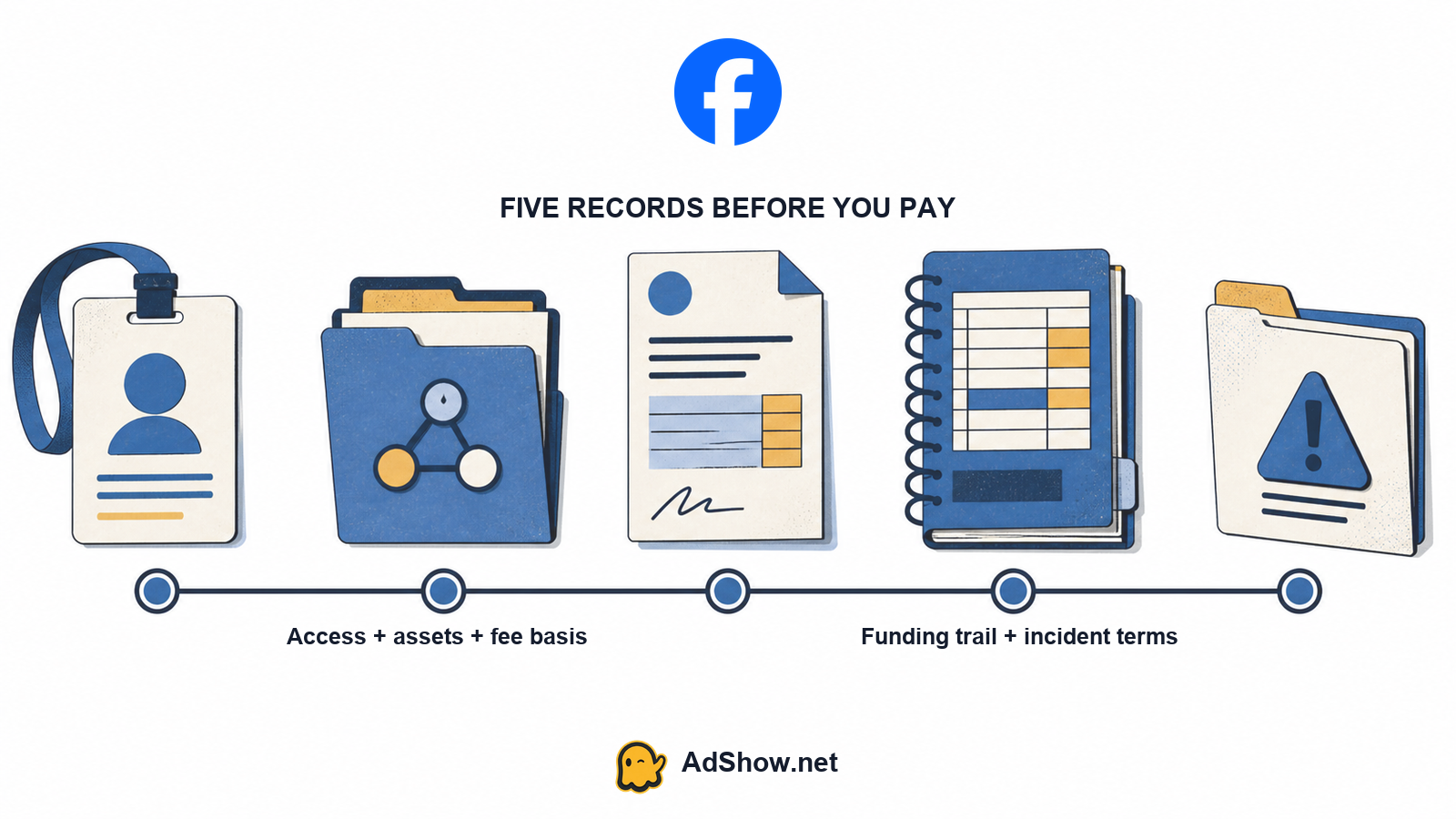
Run the five-record handover test before you fund anything
Ask for records, not broad assurances. A provider that can describe the route, permissions, charges and incident process in writing gives procurement something concrete to evaluate. These five records turn a loosely described rental into an inspectable handover.
Provider identity and account route: Record the legal or trading identity you are paying, the dashboard order or request ID, the named service, and whether the account is supplied directly through the provider’s route or through another intermediary. Confirm the exact delivery mechanism before payment.
Recipient Business Portfolio and roles: Record the Business Portfolio ID that will receive access, the people or partner roles to be assigned, what each role can do, and who can remove access. Verify the invitation appears in the intended portfolio rather than relying on screenshots.
Durable assets: List the Page, Pixel or dataset, domain, catalog, conversion configuration and creative library needed for the campaign. Mark whether each remains under your business control independently of the rented ad account.
Setup, subscription, top-up basis and balance location: Record each charge category, currency, whether a top-up is media balance or provider wallet balance, the percentage or fixed basis where applicable, and where unused funds sit. Ask whether funding can move between accounts and under what documented conditions.
Replacement, refund and incident eligibility: Save the restriction-reporting path, evidence required, reporting window, replacement conditions, refund exclusions, response process and any treatment of remaining balance. “Support available” is not a complete incident term.
Check fee language against the funding trail
A low headline access price can conceal the more important landed cost: setup, recurring access or subscription charges, funding or top-up charges, currency conversion, and rules for unused balance. Your inspection should match every charge to a dashboard record, invoice or order confirmation. Also establish whether the balance is held in a wallet, applied to a particular advertising account, or treated as a separate prepaid service amount. Those are different commercial positions.
Hypothetical example only—not AdShow pricing: if a provider disclosed a $100 setup charge, a $50 monthly subscription and a 3% top-up charge, funding $1,000 of media balance would produce a first-period landed cost of $1,180 ($100 + $50 + $1,000 + $30). The useful point is the formula, not the sample figures: setup + recurring charge + media funding + stated funding percentage + any disclosed conversion or tax treatment. Confirm whether the $1,000 is fully deployable ad spend, where it is recorded, and what happens to it after an incident.
For a wider way to compare price components without treating a headline number as the whole cost, see this Facebook agency ad account price guide. It should complement, not replace, the live service terms attached to the route you intend to use.
Red flags are claims that cannot be turned into terms
“Low-ban,” “whitelisted,” “unlimited spend,” and “guaranteed approval” are claims to verify, not platform guarantees. A provider may describe operational history, account configuration or support arrangements, but neither supplied access nor any label removes Meta’s right to review ads, assets, billing activity or advertiser behavior. Do not buy based on an implication that policy, identity, creative quality or destination requirements no longer apply.
Agency access also does not improve auction economics by itself. It cannot inherently create lower CPM, higher ROAS, stronger lead quality or faster learning. Those outcomes depend on the offer, targeting, creative, conversion path, measurement, competition, budget and compliance, among other factors. Read what “whitelisted” really means before treating resilience language as a promise.
A seller will not identify the service route, recipient Business Portfolio or support channel in writing.
A fee is described as “all-in” but setup, subscription, funding, withdrawal, conversion or replacement terms are absent.
The offer promises approval, zero restrictions, unlimited spend or performance outcomes without precise and enforceable terms.
You are urged to use a personal account bought from someone else, accept random direct messages, evade verification, or reuse assets that were already rejected.
The provider cannot say where unused balance is recorded, what evidence an incident requires, or whether your Page and data remain accessible if the ad account is replaced.
Use forum discussions as questions, never as proof
Recent July 2026 Reddit threads are useful only as anecdotal buyer signals. A July 30 discussion about legitimate accounts reflects concern about scams and confusion between buying and renting; a July 27 thread on agency versus normal delivery focuses on operational access and support rather than auction magic; another July 27 provider-vetting discussion raises hidden fees, balance movement, ownership and support. These posts are not Meta policy, provider verification or performance evidence. They do, however, reinforce why the five records should be collected before payment: buyer question, agency-versus-normal discussion, and provider-vetting discussion.
Harris Eugene’s operator note: Preserve control of the Page, Pixel or dataset, domain and conversion data outside any one replaceable ad account. Keep an internal asset register showing administrator ownership, connected domains, event destinations and the recovery or export procedure for each durable asset.
Choose self-serve when control outweighs access convenience
Self-serve is usually enough when your business can establish its own Business Portfolio, payment method, Pages, domains and measurement setup, and you value direct administration over an external access arrangement. It is also the cleaner choice when you need long-lived ownership continuity, internal finance controls and minimal dependency on a provider’s incident process.
Supplied access may be operationally useful when a team needs a listed, managed route with dashboard ordering, wallet funding, designated Business Portfolio delivery and a defined issue-reporting channel. That does not make it appropriate for prohibited activity, personal-account trading, policy evasion or recycling rejected ads, Pages or destinations. Compare agency access with a personal account based on control, records and operational needs—not on an assumed immunity from enforcement.
Make the payment decision only after the records match
Proceed when the provider identity, account route, recipient permissions, asset boundaries, complete fee basis, funding location and incident terms are documented and fit your operating model. Pause if a material point is verbal only, if balance handling is unclear, or if access to your durable assets depends on a replaceable account. The best procurement outcome is not simply receiving access; it is being able to prove the route, retain your core assets and follow a defined process when access changes or an issue is reported.
Review the live Facebook agency account offers, delivery route and current terms before placing a dashboard request. Explore Facebook agency account access
Questions from recent advertiser discussions
What does a Facebook agency account for rent usually include?
It usually means managed or supplied access to an advertising account through a provider’s route. Confirm the receiving Business Portfolio, assigned roles, funding process, support path and whether Pages, datasets, domains and catalogs are included or remain separate.
Do rented Facebook agency accounts guarantee lower CPM or better ROAS?
No. Account access alone does not guarantee auction costs, approval, delivery, lead quality or ROAS. Campaign results still depend on the offer, creative, measurement, destination, audience, competition, budget and compliance.
Can I own the Page and Pixel while renting the ad account?
You should aim to retain independent business control of durable assets where possible. Verify Page permissions, Pixel or dataset ownership, domain administration, catalog access and conversion-data arrangements separately from the supplied ad-account access.
What should I ask about unused top-up balance?
Ask where the balance is recorded, whether it is provider wallet balance or account-applied media balance, whether it can be moved, what happens after a restriction or replacement, and which written terms govern any refund or remaining-balance treatment.
Sources and scope
Official documentation defines platform behavior. Recent community discussions are used only to illustrate reported symptoms and questions; they do not prove the cause of an individual account outcome.
AdShow Facebook agency account service — Current AdShow workflow and live service claims: listed route, dashboard request, wallet funding, Business Portfolio recipients, delivery/account records and lifecycle reporting. Readers must verify current fees and eligibility on the live page.
Meta Help: Page access — Official Meta help distinguishes Facebook access and task access for Pages and notes that business-portfolio access works differently. It supports the asset-permission distinction, not claims about supplied ad-account performance.
Recent buyer question about legitimate accounts — July 30 2026 discussion shows fear of scams and confusion between buying and renting. Community replies are anecdotal and not Meta policy.
Recent discussion of agency versus normal delivery — July 27 2026 discussion argues the practical value is operational support/access rather than auction magic. Any claimed CPM figures are anecdotal and must not be presented as benchmarks.
Recent provider-vetting discussion — July 27 2026 buyers discuss hidden fees, replacement timing, balance movement, ownership and support. Use these as due-diligence questions only.