Facebook Ad Account No Ban? What “Whitelisted” Really Means—and Why Policy Still Wins
Is a Facebook ad account really no-ban or whitelisted? Learn what those sales claims mean, what still triggers restrictions and how AdShow supports setup

August 9, 2026
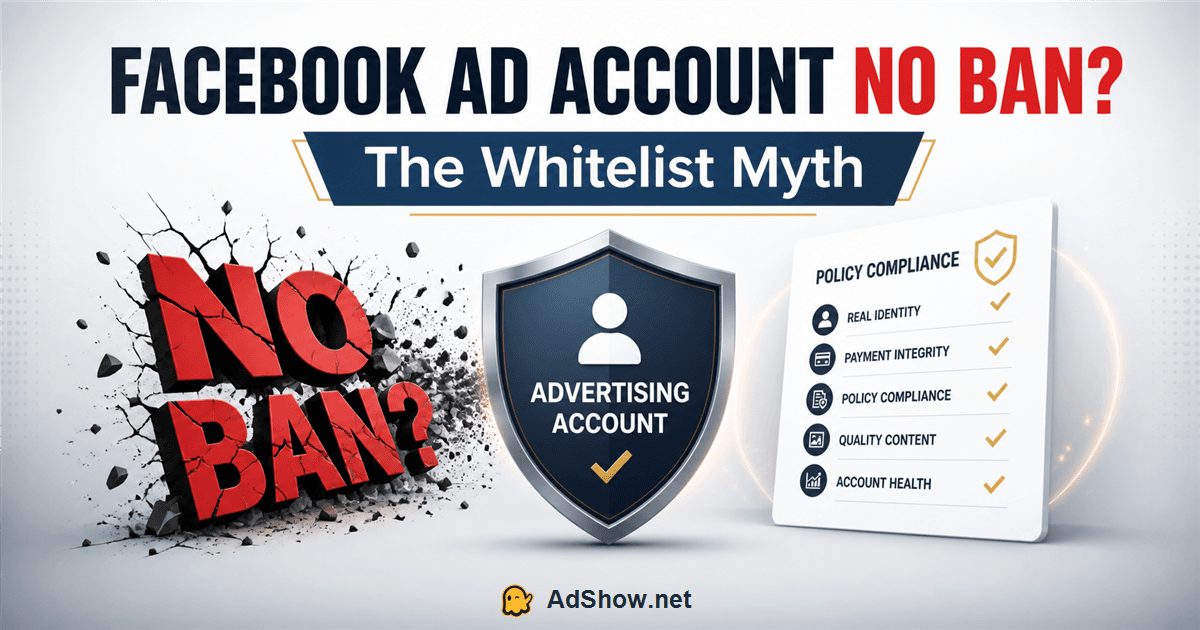
Table of contents
There is no Facebook ad account that is universally immune from restrictions. “No ban” is a sales promise, not a Meta account status that gives an advertiser permission to ignore advertising policy.
That does not mean every Facebook agency ad account is identical. Account origin, billing structure, spending history, provider operations and support can affect the advertiser’s experience. But none of those factors removes Meta’s ability to review an ad, restrict an asset or investigate the people and businesses connected to it.
After working with media buyers who arrive after repeated restrictions, I have found that the phrase Facebook ad account no ban usually hides a different need. Buyers want fewer avoidable shutdowns, clearer rules, dependable funding and someone who will help them launch correctly. Those are operational needs—not immunity.
The direct answer: can a Facebook ad account be “no ban”?
No provider can guarantee that Meta will never restrict a Facebook ad account.
Meta says its review process may examine an ad’s image, video, text, targeting and destination, including the landing page. Ads can be reviewed before launch and reviewed again after they are live. Meta also says restrictions may apply when advertisers severely or repeatedly violate policy, evade enforcement, use inauthentic accounts or manage assets connected to abusive activity.
An agency cannot switch off those systems. If a seller claims an account can run any creative, any business model or any landing page without consequences, the promise is incompatible with the existence of platform review.
The more useful question is:
What does the provider do to reduce preventable setup errors, clarify account terms and support the advertiser when the platform reviews or restricts an asset?
Why media buyers search for no-ban Facebook accounts
The search is understandable. Buyers often arrive after experiencing one or more of these problems:
a new account is restricted shortly after launch;
approved campaigns stop delivering;
business verification creates delays;
a payment event triggers review;
a personal profile restriction affects business access;
several replacement accounts repeat the same failure;
an agency gives no clear explanation beyond “the account died.”
“No ban” sounds like a clean solution to a messy operational problem. It promises that the buyer can stop diagnosing the business, creative, destination, payments and access structure. That simplicity is precisely why the phrase converts.
Unfortunately, replacing diagnosis with a guarantee does not remove the underlying trigger.
What does a “whitelisted Facebook ad account” mean?
The market uses whitelisted Facebook ad account as if it were one standardized product. In practice, sellers may use the word to describe very different situations:
an account supplied through an agency or partner relationship;
an established account with spending history;
a verified business with cleaner operational history;
an advertiser authorized for a category that requires approval;
an account with access to a specific feature or support channel;
or simply an account marketed as safer than a newly created account.
These meanings are not interchangeable. Authorization for one regulated category does not authorize every category. A long spending history does not excuse a prohibited creative. Agency access does not make a misleading landing page compliant.
Before buying, ask the provider to define “whitelisted” in operational terms:
What exact account relationship or approval does the word describe?
Does it apply to the account, the business, a feature or a particular advertising category?
Which restrictions and policies still apply?
What evidence can the provider show without exposing another client?
What happens if the account is reviewed or restricted?
If the only explanation is “this account never bans,” the term is functioning as sales copy rather than useful due diligence.
What an agency ad account may improve
A properly operated agency-account service may provide practical benefits such as:
a clearer process for requesting accounts;
visible fees and funding terms;
centralized top-ups and transaction records;
established support and incident-reporting procedures;
account options suited to different markets and spending requirements;
help preparing a campaign before launch.
The value comes from infrastructure and operations. It should not depend on pretending that policy review no longer exists.
What no account can exempt you from
Advertising creative and copy
Meta may evaluate claims, imagery, wording, targeting and the overall user experience. An established account cannot turn prohibited content into permitted content.
Landing pages and funnels
Review does not stop at the ad. A mismatch between the creative, offer and destination can create problems even when the ad itself looks conservative.
Business model and restricted categories
Some products are prohibited; others require conditions, location-specific authorization or disclosures. “Whitelisted” should never be interpreted as universal category permission.
Identity and business authenticity
The people, Page and business assets connected to an account matter. Meta identifies inauthentic accounts and attempts to evade enforcement as restriction risks.
Payments
Funding history, failed charges and unusual payment changes can create operational disruption. An agency billing model may change how funding is managed, but it does not make payment integrity irrelevant.
Connected assets and security
An ad account exists inside a larger environment. A compromised administrator, abusive Page, suspicious partner or connected asset can affect the risk picture.
Why replacing accounts may not solve repeated bans
When several accounts fail around the same campaign, the account may not be the common cause. The repeated element could be:
the same claim or creative pattern;
the same landing page;
the same restricted product;
the same Page or Business Portfolio;
the same compromised administrator;
an unresolved payment issue;
or behavior Meta interprets as evading a previous decision.
This is why “free replacement” and “no ban” are not the same thing. Replacement describes what a provider may do after an incident, subject to its terms. It does not prove that the next account is immune or that repeating the campaign is safe.
What AdShow offers instead of a no-ban promise
AdShow subscription customers receive Professional Campaign Setup & Support ($300 Value) at no additional cost. The AdShow team works directly with the customer during campaign setup, helping the buyer structure the launch, identify avoidable mistakes and align the setup with Meta’s advertising requirements.
The difference is important:
No-ban promise: asks the buyer to trust an absolute claim about Meta’s future enforcement.
Professional setup and support: gives the buyer real assistance before and during launch.
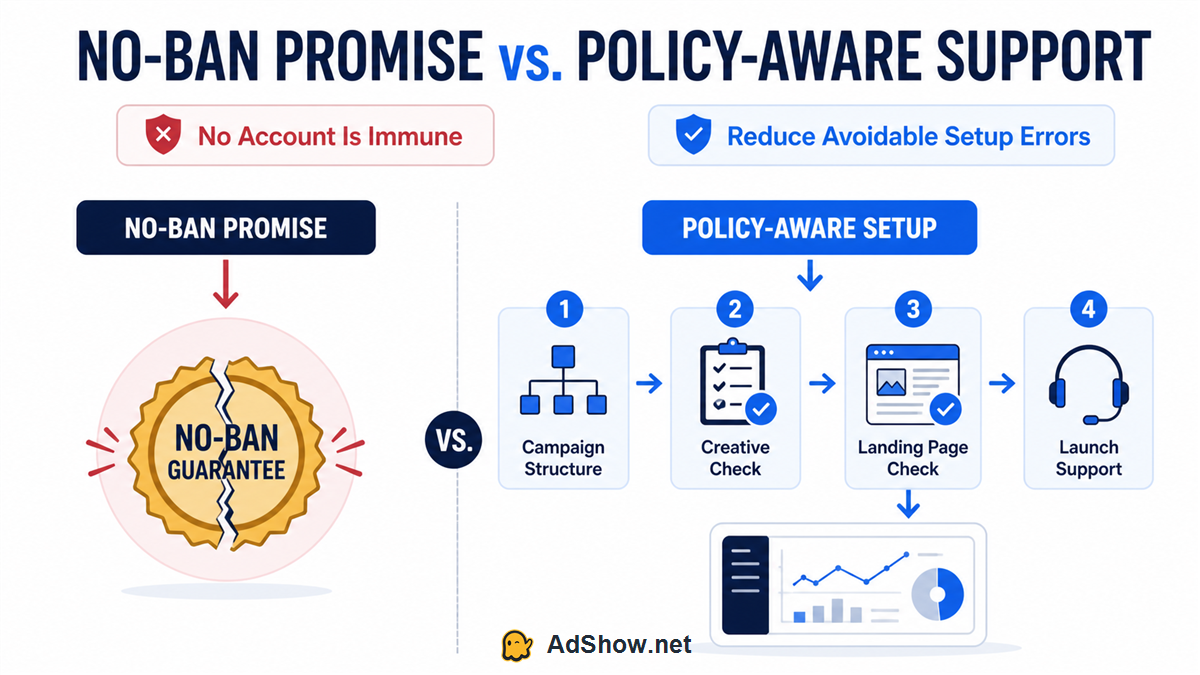
Professional support can reduce preventable operational and setup mistakes. It cannot make prohibited advertising compliant, guarantee approval or prevent Meta from reviewing an account.
AdShow’s role is to accompany the customer through campaign setup—not disappear after account delivery and return only when something breaks.
How the AdShow subscription model supports buyers
Many agency-account providers still run the account lifecycle through private chat. The buyer asks for an account, waits for a reply, requests a top-up and later tries to reconstruct pricing or account history from messages.
AdShow combines human campaign support with self-service operations:
agency advertising account options for Facebook, Google Ads, TikTok and other major platforms;
visible pricing in the marketplace;
account requests through the dashboard;
automated top-up workflows and notifications;
suspension reporting and account-status operations;
Professional Campaign Setup & Support for subscription customers.
Buyers can review current Facebook agency ad account options and subscription terms directly through AdShow rather than relying on a vague “no ban” promise sent in chat.
A provider checklist before you fund an account
Ask these questions before sending money:
What exactly does “no ban” or “whitelisted” mean in this offer?
Which Meta policies and category restrictions still apply?
Is pricing visible before funding?
Where is unallocated balance recorded?
Can I see top-ups, requests and account status in a dashboard?
Does the provider review the campaign, creative or landing page?
What does support include before launch?
What is the suspension-reporting process?
Are replacement conditions written down?
Does the provider distinguish ad rejection, account restriction, Business Portfolio restriction and compromised access?
A reliable answer may include limitations. An unreliable answer usually turns every limitation into another absolute superlative.
When a Facebook agency ad account is still useful
Rejecting the no-ban myth does not mean rejecting agency accounts. A Facebook agency ad account may be useful when the buyer needs clearer account procurement, funding visibility, operational support and scalable account management.
The best fit is a buyer who understands that infrastructure and compliance work together. The account is not a substitute for a legitimate offer, accurate claims, a consistent landing page and secure business access.
If an account is already restricted, do not relaunch blindly. First determine whether the decision applies to the ad account, personal profile, Page or Business Portfolio. Our guide to what to do when a Facebook ad account is disabled explains the recovery scope in more detail.
Frequently asked questions collected from media-buyer communities
These questions reflect recurring language used across advertising forums, Reddit discussions, Facebook groups and provider sales pages. Community claims help identify buyer confusion, but official Meta policy and written provider terms should control decisions.
Is there a Facebook ad account that never gets banned?
No provider can credibly guarantee that Meta will never restrict an account. Meta retains review and enforcement authority over ads, destinations, advertisers and connected business assets.
Are whitelisted Facebook ad accounts real?
The term may describe a genuine partner relationship, authorization, established account or specific feature access, but the market does not use it consistently. Ask what exact status the provider means and what limitations remain.
Can a whitelisted account run any niche?
No. Products, categories and locations remain subject to Meta’s policies and any required authorization. Approval for one category or market is not universal permission.
Do agency ad accounts get reviewed?
Yes. Agency access does not eliminate ad review or later review after an ad becomes active.
Does professional campaign setup guarantee approval?
No. It can reduce avoidable setup errors and help align the campaign with policy requirements, but Meta makes platform review and enforcement decisions.
What is included with AdShow’s Professional Campaign Setup & Support?
AdShow subscription customers receive the service at no additional cost, with a stated value of $300. The AdShow team works directly with the customer during campaign setup rather than only supplying account access.
Is replacing a disabled account the same as fixing the problem?
No. If the creative, landing page, business model, payment issue or connected asset remains unchanged, the same risk may follow the replacement.
The bottom line
“Facebook ad account no ban” is a powerful search phrase because it promises relief from a real pain. But a promise of immunity is not the same as a stable advertising operation.
AdShow’s alternative is concrete: self-service account operations, visible pricing and Professional Campaign Setup & Support ($300 Value) included for subscription customers. The objective is not to pretend Meta’s rules disappeared. It is to help the buyer launch with better preparation, clearer operations and direct human support.