Facebook Ads Learning Limited: When to Fix It and When to Leave It
Facebook Ads Learning Limited is not automatically a failure. Use delivery, event quality, qualified CPA and tracking evidence to decide whether to wait, change, consolidate or pause.

August 31, 2026
Table of contents
Facebook ads learning limited is a signal about volume and optimization conditions at the ad-set level, not an account ban and not proof that the campaign is losing money. The right decision is not “remove the label at any cost.” First compare actual delivery, the chosen optimization event, tracking quality, qualified results and CPA. If a low-volume ad set is profitable and spending normally, leaving it alone may be safer. If it has no meaningful events, poor tracking or no spend, the label is a prompt to diagnose rather than a diagnosis itself.
Start with the decision, not the badge
Learning limited generally means Meta does not have enough recent optimization signals, or enough stable conditions, to learn confidently from the ad set. That does not tell you whether the economics are good. A campaign can generate a small number of profitable purchases and remain learning limited. Another can spend without producing a qualified lead, while appearing technically active. Those are different operating problems and should not receive the same fix.
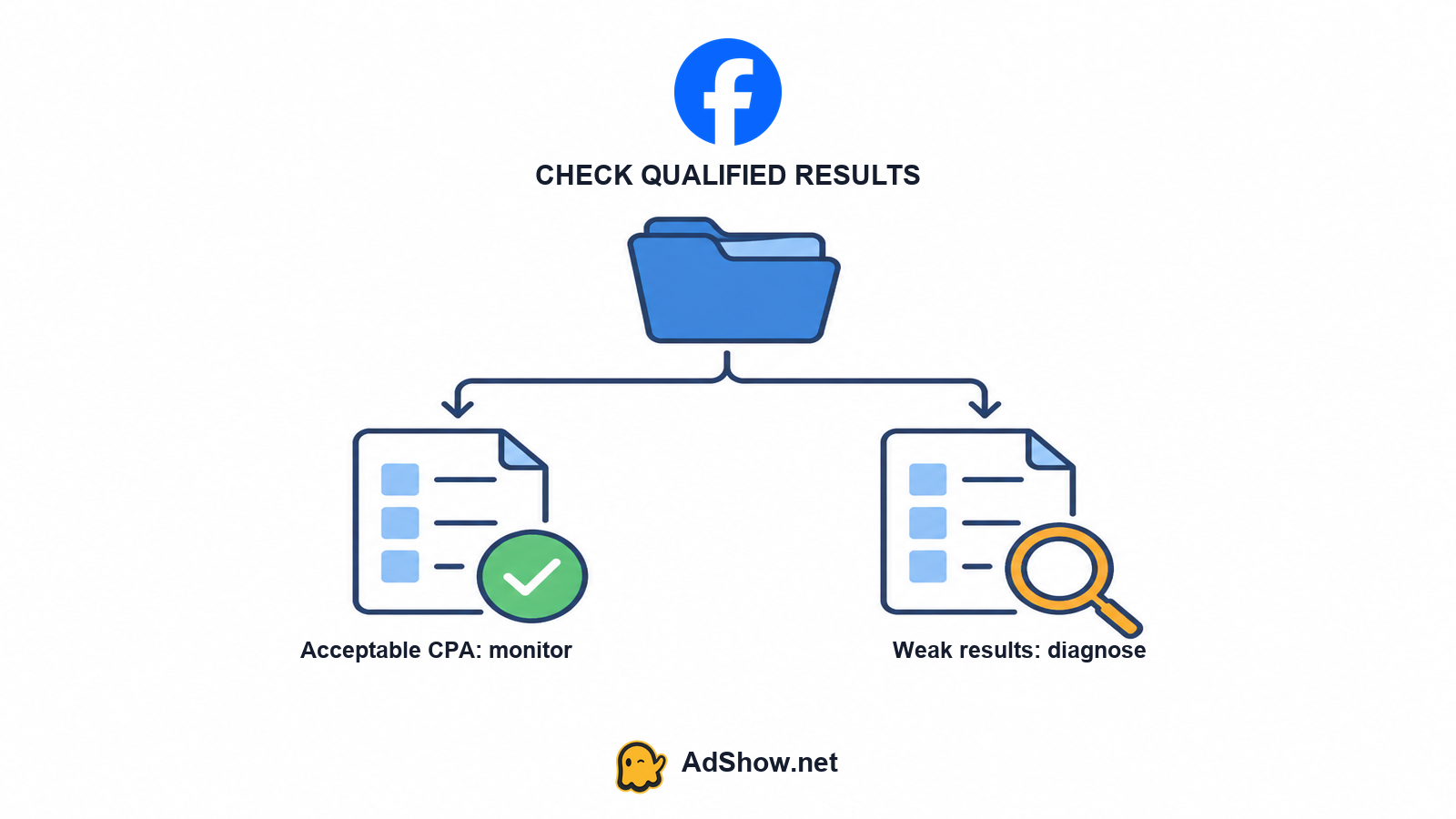
Keep the ad set under observation when it is spending, producing the selected event and meeting your qualified CPA target, even if the status remains learning limited.
Change the setup when delivery is weak, the event is too rare for the business, tracking is unreliable, or results are materially worse than the acceptable CPA.
Pause or rebuild only after separating a genuine performance problem from delayed attribution, CRM rejection, auction volatility or a recent edit.
Treat zero spend as a delivery restriction or setup problem, not as the same condition as low-volume learning.
Meta’s public Blueprint material describes patience during the learning phase and recommends using Ads Manager reporting, while its public Performance 5 framework discusses simplification, automation, creative diversification, data quality and results validation. Those are general principles, not a universal repair formula. See the Meta Blueprint learning and reporting overview and Performance 5 framework. The current public pages do not expose a universal numeric exit threshold, and the learning materials may require login.
The 50-events claim needs a label
Advertisers often repeat a “50 events in seven days” rule when discussing learning limited. Treat that as a community heuristic, not a verified current Meta requirement. It is also not a spending requirement: buying more impressions or multiplying budget does not guarantee 50 useful events. Meta’s delivery systems can consider more than a simple public counter, and the relevant event depends on the optimization choice, account context, auction and signal quality.
The practical question is therefore not “How much must I spend to unlock learning?” Ask instead: What event is the ad set optimizing for? Is that event firing once per real action? Are conversions delayed? Are leads accepted by sales? Is the observed CPA inside the business target? If those answers are unknown, forcing an exit from the status is premature. Public Blueprint pages support patience and reporting, but they do not provide evidence for promising a particular event count or timeline.
Low volume can still be economically sound
Use a fictional planning example, not a forecast. Suppose an ad set has a weekly budget of $210 and the observed CPA is $30. If the same economics continued unchanged, $210 divided by $30 is about seven events in a week. That arithmetic does not predict seven future conversions, prove that the ad set needs more budget, or justify multiplying spend. It simply shows why a genuinely low-volume ad set may remain limited.
If those seven observed events are real purchases, profitable after margin and fulfillment, and accurately attributed, the label may be tolerable. If they are unqualified leads, duplicate events or delayed conversions that sales later rejects, the apparent CPA is misleading. Evaluate the business result at a sensible reporting window, then decide whether the limitation matters. For a wider scale discussion, use how to scale Facebook Ads without breaking performance, but do not treat scaling advice as a reason to intervene in every low-volume ad set.
Audit the signal before rebuilding
Before changing the optimization event or making a new campaign, inspect the path from impression to business outcome. Browser and server events can be duplicated if event IDs are not handled correctly. Purchase values or currencies can be missing. A browser event may fail while a server event arrives late, or a conversion may appear in Ads Manager after the CRM has already rejected the lead. Check event matching, deduplication, event parameters, attribution windows and timestamps against a sample of real records.
Confirm that the selected optimization event fires consistently and represents the action you actually value.
Compare Ads Manager results with payment records, CRM stages or qualified lead records rather than relying only on platform-reported volume.
Look for delayed conversions before judging a recent period, especially where the purchase or sales cycle is longer than a day.
Check whether a recent creative, audience, bid, budget or attribution edit restarted the learning process.
Do not switch from Purchase to AddToCart merely to make the status look healthier; optimize for the strongest business signal the setup can reliably support.
Harris Eugene’s operator note: Harris Eugene's operator note: Treat Learning Limited as a diagnostic flag, not a command to spend more. Record the baseline, event quality and qualified CPA before touching the budget or optimization event; otherwise the edit removes the evidence needed to judge whether it helped.
Consolidate only where the economics match
Consolidation can help when several ad sets target genuinely similar people, use the same optimization event, compete in the same auction and have comparable customer economics. Fewer fragmented ad sets can give delivery more room to find signals. But merging different geographies simply because they have low volume can hide important differences in shipping cost, purchasing power, language, compliance, sales handling or lifetime value. A city, country or customer segment that looks inefficient in a blended report may be profitable on its own.
Consolidation is also a significant structural edit. It can change audience overlap, creative distribution and attribution context, so compare the post-change period with a documented baseline. Avoid stacking consolidation, new creative, a new event and a budget jump in one move. If the campaign is already profitable, stability may be worth more than a cleaner status label.
Separate learning limited from zero delivery
A learning-limited ad set that spends and records events is not the same as an ad set that spends nothing. Zero delivery can involve review, account or payment issues, audience constraints, bid controls, schedule settings, rejected ads or other delivery restrictions. For that problem, start with the delivery diagnosis and account notices. The Facebook Ads active but not spending checklist is the more relevant companion resource.
Do not open another account just because an ad set says learning limited. AdShow provides self-service agency advertising account access, with visible marketplace offers, dashboard requests, funding or top-up workflows and issue reporting. That scope does not cure weak creative, faulty tracking, poor lead quality or an unsuitable optimization event. Account operations and campaign diagnosis are separate decisions.
Use a controlled change log
When change is justified, write down the reason before editing. A compact log makes it easier to distinguish a real improvement from random auction movement. Include the baseline period and qualified CPA, the exact hypothesis, one main variable, a loss cap and the point at which you will reassess. For example: baseline is 14 days of spend and qualified purchases; hypothesis is that duplicated Purchase events are understating signal quality; variable is event deduplication; loss cap is the maximum acceptable incremental spend; reassessment is after the agreed attribution delay and a defined number of real opportunities.
Record spend, impressions, selected events, qualified outcomes, revenue or value, CPA and any delivery warning before the edit.
Change one material factor where practical: tracking, audience structure, creative, budget, bid or optimization event.
Set a review date based on the conversion cycle and data delay, not on a universal percentage or guaranteed learning timetable.
Stop or reverse the test when the loss cap is reached, tracking becomes less trustworthy or business quality falls.
Keep the original evidence so a later decision does not rely on memory or the current status badge.
A short keep, change or pause clinic
Keep: delivery is normal, the event is correctly tracked, qualified results meet the target and the business can tolerate the volume.
Change: the optimization event is misaligned, data is duplicated or delayed, qualified CPA is unacceptable, or fragmentation is clearly limiting comparable ad sets.
Pause: spend continues without meaningful or qualified outcomes, the economics fail after the attribution window, or the setup cannot be trusted enough to evaluate.
Investigate separately: the ad set has no spend, repeated edits keep resetting delivery, payment or policy notices appear, or the audience and bid settings prevent auction participation.
Recent forum discussions illustrate why anecdotes need careful handling. A June 1, 2026 Reddit discussion includes advertisers reporting profitable campaigns that remained learning limited, while an Aug. 6, 2026 Reddit question describes roughly one purchase a day and concern about a weekly threshold. An Apr. 2, 2026 BlackHatWorld thread discusses repeated resets after changes. These are useful questions and observations, not Meta policy, controlled evidence or guarantees. They do not justify duplicating campaigns, rotating accounts or adopting unverified thresholds. The cited pages are community reports; official public Blueprint access is limited, and no gated lesson is represented here as reviewed.
Need account operations rather than a forced learning-phase fix? Review available AdShow agency advertising account access and use the dashboard to request an offer, funding or issue support. Explore AdShow agency advertising accounts
Questions from recent advertiser discussions
Does Facebook Ads learning limited mean my account is banned?
No. Learning limited is normally an ad-set delivery and optimization-volume status. It is not, by itself, an account ban or proof of policy enforcement. Check actual delivery, account notices and campaign results separately.
Should I increase the budget to reach 50 events?
No automatic budget increase is justified by the commonly repeated 50-events-in-seven-days claim. That number is a community heuristic, not a verified universal current requirement, and higher spend cannot guarantee useful events. Increase budget only when the economics and business capacity support it.
Should I change Purchase to AddToCart to remove learning limited?
Usually not. AddToCart may generate more events but can be a weaker business signal. First verify Purchase tracking, deduplication, attribution delay and profitability. Choose an event for its business value and reliable signal, not merely for a better-looking status.
When should I consolidate learning-limited ad sets?
Consider consolidation when ad sets have genuinely similar audiences, optimization events, auction conditions and customer economics. Do not merge geographies or segments with materially different margins, sales processes or customer value just to increase event volume. Log the baseline and reassess after the relevant conversion delay.
Sources and scope
Official documentation defines platform behavior. Recent community discussions are used only to illustrate reported symptoms and questions; they do not prove the cause of an individual account outcome.
Meta Blueprint: first-ad learning and reporting — Current public course overview supports learning-phase patience and using Ads Manager reports. No numeric exit threshold shown; do not claim to have accessed gated lesson.
Meta Blueprint: Performance 5 — Public current framework: account simplification, automation, creative diversification, data quality, results validation. Supports general practice, not a universal fix.
Recent learning-limited discussion — June 1 2026 individual advertisers report profitable campaigns can remain learning limited. Anecdotal, not a guarantee or Meta policy.
Recent low-budget concern — Aug 6 2026 poster gets about one purchase/day and worries about a weekly threshold; use as question not verified algorithm rule.
Forum: repeated learning resets — Apr 2 2026 thread reports instability after repeated changes. Community advice and thresholds unverified; do not endorse account rotation.