How to Create a Facebook Business Account Safely
A practical, ownership-first guide to creating a Facebook business account, connecting assets, assigning permissions and protecting access before you spend.

August 27, 2026
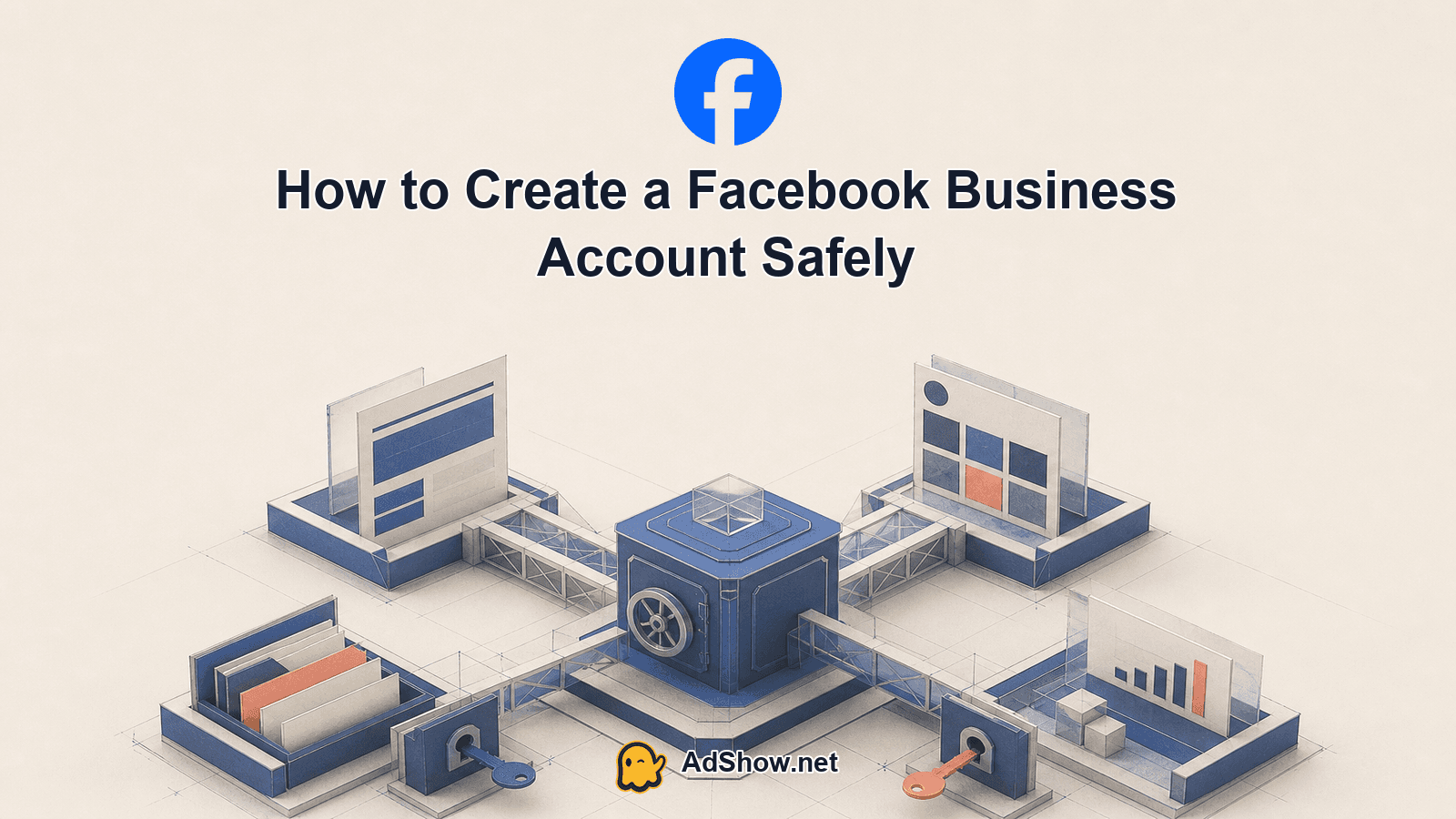
Table of contents
To create a Facebook business account safely, start with a real person’s Facebook profile, then create or select a Meta business portfolio, connect the correct Page and Instagram account, add an ad account, configure payment and measurement, and assign only necessary permissions. The key decision comes before the first click: decide who owns each asset. A personal profile authenticates a person; a Page represents a business; a business portfolio organizes people and assets; an ad account buys ads. These are related, but they are not interchangeable.
Resolve the naming confusion first
Meta’s interface and product names change. You may see Meta Business Suite, business portfolio, business settings or other labels for overlapping parts of the setup. Follow the current labels shown in your account rather than an old screenshot. The underlying ownership questions remain the same.
Personal Facebook profile: the individual login that authenticates a person. Meta’s Page-access guidance requires a personal Facebook account rather than a gray account for access management.
Facebook Page: the public-facing business or brand presence. A Page can have people with different levels of Facebook access or task access.
Meta business portfolio: the business container used to organize people and assets such as Pages, Instagram accounts and ad accounts.
Ad account: the billing and campaign workspace used to create, fund and measure ads.
Creating a portfolio does not automatically give you ownership of every asset you can see. Similarly, having Page access does not necessarily mean you control the business portfolio or its ad account. A recent August 2026 advertiser discussion illustrates this confusion anecdotally: the user treated portfolio creation as equivalent to usable asset access. That is an account-specific community example, not evidence of a universal Meta rule.
Prepare ownership, security and payment before creation
Use this checklist before opening Meta Business Suite. It prevents the most expensive setup mistake: attaching assets to a portfolio that nobody can clearly administer later.
Choose a real, accountable owner who can respond to security prompts and maintain the business relationship. Do not use replacement identities, shared fake profiles or disposable logins.
Use a business email address and, where relevant, a domain that the business controls. Keep recovery details current and separate from a single employee’s personal inbox.
Confirm who owns the Facebook Page and Instagram account. Record whether you will add them, claim them, or request access from their current owner.
Decide who is financially responsible for advertising charges, refunds, tax records and payment-method changes.
Turn on two-factor authentication for every person who will administer the portfolio or ad account. Meta also supports security keys through Accounts Center and two-factor authentication.
Create an access map: owner, backup administrator, media buyer, creative or community operator, finance contact and external partner. Assign each person only the permissions their work requires.
Prepare a simple asset register with asset name, ID, owner, assigned people, payment responsibility, domain, Instagram handle and recovery contact.
Harris Eugene’s operator note: decide ownership before clicking Add. Permissions can usually be repaired more easily than disputed ownership. A short written ownership map is often more valuable than adding every colleague immediately.
Create or select the business portfolio
Sign in to Meta Business Suite with the personal Facebook profile of the accountable owner. Open the current business or settings area and choose the option to create a business portfolio, or select the existing portfolio if the business already has one.
Enter accurate business details, including the legal or trading name requested by Meta, business email and other requested information. Use details that the business can substantiate if Meta asks for confirmation.
Review the portfolio identity before continuing. Check spelling, country, time zone and the email receiving important notices. Changing details later may require additional verification or create confusion across invoices and access records.
Record the portfolio name and business ID in the asset register. Do not assume that a new portfolio has inherited assets from an older Business Manager or another employee’s account.
The portfolio is an organizational layer, not a substitute for a personal login. Keep the owner’s profile secure, but do not make one person the only person who can recover the business. Add a second trusted full-control administrator for continuity where practical; this is sound operational redundancy, not a universal Meta requirement. For a deeper threat model and recovery preparation, use this Facebook Business Manager access security guide.
Add the Page and Instagram account through the correct path
Open the portfolio’s asset-management area and add the Facebook Page. The available path depends on whether your business already owns the Page, you are claiming an eligible asset, or another business owns it. Choose the ownership or request-access option that matches the facts. Do not claim an asset simply because your team manages its content.
For a Page the business owns, add or claim it using the current Meta workflow and confirm that the accountable owner has the required Page access.
For a Page owned elsewhere, request the appropriate access from its current owner. Keep the request and approval record with the asset register.
Connect the Instagram account only through an account controlled by the business. Confirm the correct handle before accepting permissions, especially when several brands share similar names.
Check the resulting roles in both the portfolio and Page-access views. Full control carries additional powers, including managing access and other settings; task access is narrower.

Meta’s official Page-access documentation distinguishes Facebook access, task access and full control. A person may be able to perform advertising or content work without being able to add or remove administrators. That separation is useful: give a media buyer campaign-related access where possible, while reserving ownership changes for a very small group.
Create or add the ad account without mixing ownership
In the portfolio’s ad-account section, choose whether to create a new ad account, add an existing one owned by the business, or request access to an account owned by another business. Select the path that reflects legal and operational ownership. An agency or contractor can manage an account without owning the client’s Page, portfolio or customer data. If the operating decision is between business-owned access and managed agency access, compare a Facebook agency ad account with a personal account before assigning ownership.
Enter the ad account name, time zone and currency carefully. These settings affect reporting and billing workflows and may not be freely changeable later.
Record the ad account ID and relationship to the portfolio. Note whether it is owned by the business, shared by a partner or merely accessed by your team.
Assign the media buyer or agency partner the minimum role needed for campaign creation, analysis or account management. Avoid granting full control for routine buying.
Verify that the Page, Instagram account, pixel or dataset and domain used in campaigns are connected to the intended portfolio and ad account.
Full control is powerful because it can affect people, assets and access itself. It should be rare, not the default permission for every employee or vendor. A June 2026 Reddit discussion about the fear of a single full-access administrator is useful as an anecdotal signal of operational concern, but community theories about restrictions or account behavior are not Meta rules.
Configure payment, measurement and account security
Add the payment method under the correct ad account and confirm who receives billing notifications. Use a payment method controlled by the responsible business or an expressly authorized payer. Check the billing threshold, invoice details and spending controls in the current interface before launching.
Set up the relevant Meta Pixel or dataset and confirm that events are arriving from the correct domain.
Configure domain ownership and measurement settings where the campaign requires them. Test key events rather than assuming a connection is working.
Enable login alerts and two-factor authentication for administrators. Meta’s security guidance also recommends vigilance against phishing and malicious software.
Consider a FIDO2 or U2F security key for high-value administrator accounts, especially where a password or phone-based code alone would create unacceptable risk.
Keep payment, domain, Page, Instagram and ad-account ownership records together. A campaign can run while the underlying ownership remains poorly documented.
An agency ad account does not change auction rank, policy standards or campaign profitability. If you need a self-service route to Facebook agency ad account access, AdShow provides visible offers, account requests, wallet funding or top-ups and issue reports through its dashboard; Telegram can provide notifications and human guidance. That access does not replace your business portfolio security, ownership decisions or compliance with Meta policies.
Maintain an asset register and offboarding process
A safe setup is maintained, not completed once. Review the asset register monthly and after every staffing or agency change. For each asset, record its owner, ID, connected portfolio, administrators, partner access, payment responsibility, domain, Instagram handle and last review date.
Remove former employees, contractors and agencies from the portfolio, Page, Instagram account, ad account and connected datasets.
Revoke partner access and check whether any person still has direct Page or Instagram access outside the portfolio.
Rotate shared operational secrets, review payment methods and confirm that billing contacts still belong to the business.
Check two-factor authentication and recovery methods for every remaining administrator.
Export or retain invoices, campaign records and relevant access approvals according to the business’s record-keeping requirements.
Confirm that a second trusted administrator can locate the portfolio, identify the owner and follow the recovery process without relying on the departing person.
If a restriction, review or access problem occurs, use Meta’s official support and account workflows. Do not attempt to bypass enforcement with proxies, anti-detect browsers, replacement identities or undisclosed account transfers. Community posts can help you recognize common language and symptoms, but they cannot establish that a particular setup guarantees approval or avoids restrictions.
Review available Facebook agency ad account options through AdShow, then keep your own portfolio, asset and permission controls documented. View Facebook agency ad accounts
Questions from recent advertiser discussions
Do I need a personal Facebook profile to create a business portfolio?
Yes, a personal Facebook profile authenticates the person administering the business. Use a real, accountable profile and secure it with two-factor authentication. Do not use a gray account or a shared replacement identity.
Is a Facebook Page the same as a business portfolio?
No. A Page represents the public business presence. A Meta business portfolio organizes people and assets, including Pages, Instagram accounts and ad accounts. Access to one does not automatically provide ownership of the others.
Should every media buyer receive full control?
No. Give buyers the narrowest permissions needed for their work. Full control can change people, assets and access, so reserve it for a small number of trusted administrators and maintain a continuity plan.
Can an agency ad account prevent Facebook restrictions?
No. An agency account does not change Meta’s policy standards, review decisions, auction rank or profitability. Advertisers remain responsible for accurate business information, secure access, compliant ads and proper asset ownership.
Sources and scope
Official documentation defines platform behavior. Recent community discussions are used only to illustrate reported symptoms and questions; they do not prove the cause of an individual account outcome.
Meta Help Center: about Facebook Page access — Official explanation of Facebook access, task access and the additional powers carried by full control.
Meta Help Center: give, edit or remove Page access — Official instructions and the requirement to use a personal Facebook account rather than a gray account for Page access.
Meta Help Center: account security — Official security overview covering login alerts, two-factor authentication, phishing and malicious software.
Meta Help Center: add a security key — Official steps for adding a FIDO2/U2F security key through Accounts Center and two-factor authentication.
Recent advertiser discussion: full-access admin — June 2026 discussion showing the operational fear created by a single point of administrative access; community theories are not treated as Meta rules.
Recent advertiser discussion: business portfolio access — August 2026 example of a user confusing portfolio creation with usable asset access; anecdotal and account-specific.