How to Advertise on Facebook Without Wasting Budget
A preflight-to-launch field manual for advertising on Facebook: secure access, verify measurement, choose the right outcome, launch cleanly and diagnose the first week.

August 26, 2026
Table of contents
The minimum viable answer to how to advertise on Facebook is: secure the correct business access, define one measurable business outcome, verify the destination and tracking, then build the campaign, ad set and ad around that outcome. Do not begin by randomly exploring Ads Manager. An early mistake in identity, permissions, conversion setup or destination can invalidate the data you need later. AdShow provides self-service agency advertising account access and operations for Facebook and other major platforms, but it does not lower auction prices, guarantee delivery or replace Meta policy compliance.
Start with the four checks that prevent expensive rework
Before selecting an objective, confirm who owns the Facebook Page, ad account, pixel or dataset, domain and payment method. The person launching campaigns should have the required business and ad-account permissions, while ownership should remain with the real business wherever possible. Avoid shared personal logins, replacement identities, proxies and anti-detect browsers. Those practices create security and policy risk rather than reliable access.
Secure business access: verify the Business Portfolio, Page, ad account, dataset or pixel, domain and billing permissions. Record which person or business owns each asset.
Choose one business outcome: for example, completed purchases, qualified lead submissions or booked consultations. Do not use a softer metric merely because it is easier to obtain.
Verify the destination and measurement: test the product page, form, checkout, thank-you page, event firing, consent flow and mobile experience before spending.
Build in order: campaign for the business outcome, ad set for conversion location, audience, geography, placements and budget, then ad for identity, creative, copy and destination.
Meta’s own training frames objective selection around the business goal and measurement. That is the useful principle; interface names and available settings can change in the live account. A current independent walkthrough can help locate controls, but it should not override the settings and warnings shown in your account.
Do not use Traffic as a warm-up for a Sales campaign
If the business outcome is a purchase, select the Sales objective and optimize for the purchase event when the destination and event are ready. Traffic optimizes delivery toward visits or related traffic signals. It does not train the system to find the same people most likely to complete a purchase. Running Traffic first may produce inexpensive clicks while leaving the actual sales problem unanswered.
This is not a promise that Sales will be cheap or that every account has enough conversion volume for stable optimization. It means the optimization signal should match the decision you are paying for. Recent advertiser discussions show that beginners repeatedly debate Traffic versus purchase-focused campaigns; those discussions are anecdotal and do not establish a platform rule or a universal budget threshold.
Harris Eugene’s operator note: Harris Eugene’s operator judgment: the first irreversible setup mistake is usually not a weak headline. It is choosing an identity, conversion event or destination that cannot produce trustworthy attribution. Catch that before launch. Creative can be replaced; a week of contaminated data is much harder to recover. This is a defensible diagnostic rule, not a claim about a particular account or campaign.
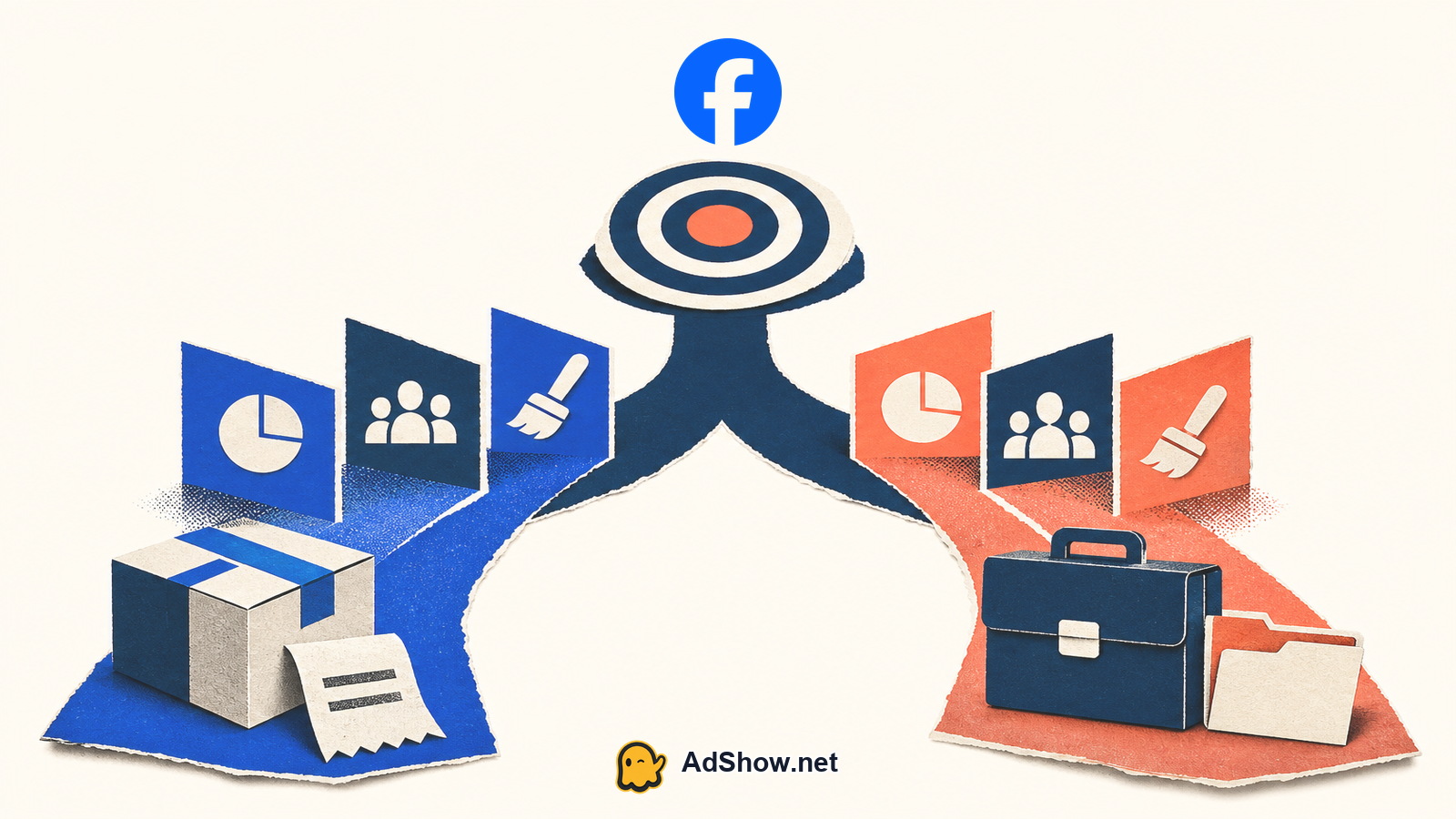
Use a short path for ecommerce purchases
For an online store, keep the launch path close to the transaction:
Select Sales as the campaign objective and choose the website or another genuine purchase destination available in the account.
Select the purchase event only after testing that the event fires on the correct product, cart or checkout journey. Confirm that currency, value and deduplication behave as expected.
Set the ad set geography to the markets you can serve, with language and age restrictions only where commercially or legally justified. Do not target countries that cannot receive the product.
Start with a clear audience hypothesis. Broad targeting can be valid when the creative, offer and event quality support it; narrower audiences need a reason beyond habit.
Use placements that match the available creative and destination experience. Automatic placements can be a reasonable starting point, but inspect where delivery occurs rather than assuming every placement performs equally.
Send the ad to the exact product or collection that matches the promise. A generic homepage adds friction and makes post-click diagnosis harder.
The purchase path is only as strong as the offer and checkout. Ad Manager cannot reveal whether margin, shipping, stock, payment failure or page speed will make the economics work. Calculate the maximum acceptable cost per purchase from contribution margin before launch; do not define success by clicks alone.
Use a separate path for service-business leads
For a service business, decide whether the real conversion is a website form, an instant form or a message. Choose the conversion location that matches how the team actually receives and follows up with prospects.
Select Leads if the intended outcome is a completed lead action, then choose the website, instant form, messaging or other available location that the business can operate reliably.
Define a lead clearly: include the fields and qualifying questions needed by sales, but remove unnecessary friction that does not improve lead quality.
Test the handoff. Submit a test lead, confirm notification delivery, verify CRM or spreadsheet capture and assign an owner for follow-up.
Use serviceable geography rather than an attractive but unreachable audience. Include operating hours, language and eligibility constraints in the offer or form when they affect qualification.
Judge the campaign on qualified leads and downstream contact, not merely form completion. A cheap lead with no response or no fit is not a successful conversion.
Lead campaigns often expose an operational problem rather than a media problem. If nobody calls back, the form is not routed, or the service cannot handle demand, increasing budget will multiply waste. Meta can report the lead event; it cannot know whether the lead became revenue unless your measurement system records that later stage.
Set the ad set before polishing the ad
At ad-set level, make each decision explicit. Geography should reflect fulfilment or service coverage. Audience settings should follow the offer and available data, not a list of every interest that sounds relevant. For sensitive categories, additional restrictions may apply; check the live account and current policy instead of relying on an old tutorial.
Placements: begin with a coherent placement strategy and inspect delivery by placement. Do not cut placements solely because one has fewer visible clicks.
Budget: choose an amount the business can sustain through the learning and observation period. A small budget may limit the speed of evidence, but comments in advertiser communities are anecdotal and do not prove a universal minimum.
Schedule: use a start time that allows someone to inspect the launch and handle leads, comments, payment issues or disapprovals.
Creative: show the offer, audience problem and next action quickly. Match claims to the landing page and avoid unsupported guarantees, misleading urgency or prohibited personal-attribute language.
Identity: select the correct Facebook Page and Instagram account where relevant. Preview every placement that matters before publishing.
Keep the first launch legible. Too many audiences, ads, countries and conversion events spread a limited budget across competing hypotheses. The objective is not to prove every idea at once; it is to produce interpretable evidence about one offer and one outcome.
Name the build so the evidence survives the handoff
Use names that preserve the decision logic. A practical pattern is: campaign for outcome and market; ad set for geography, audience and placement approach; ad for angle, format and version. For example: `Sales_UK_Purchase_Aug26`, `UK_Broad_AutoPlacements`, and `BenefitVideo_V1`. Add a short change log outside Ads Manager with launch time, budget, event and major edits.
Before publishing, complete a 24-hour preflight:
Business identity, Page, Instagram account, ad account and payment method are correct.
The destination works on mobile, loads without unexpected redirects and matches the ad promise.
The selected event fires once at the intended point, with the expected value, currency and attribution setup.
The form, checkout, CRM, notification and follow-up process have each passed a test.
Geography, age, language, exclusions and special-category settings are appropriate.
Creative previews are readable, policy-safe and technically valid across the selected placements.
Budget, schedule, account spending limits and naming are documented.
Someone is assigned to review delivery and business outcomes during the first day.
Observe the first seven days without chasing noise
Do not edit every few hours because one metric moved. Constant changes can make the evidence harder to interpret and may interrupt delivery. Set review points instead, while acting immediately on broken destinations, incorrect tracking, harmful comments, account restrictions or a clear policy issue.
Day 0 to 1: confirm approval, spend, impressions, destination loading, event receipt and lead or purchase handoff. If there is no delivery, investigate identity, billing, schedule, audience size, bid or account restrictions before judging economics.
Days 2 to 3: check whether the campaign is receiving the intended event signal. Separate delivery failure from weak economics: no impressions is not the same problem as expensive purchases.
Days 4 to 5: inspect click-through rate, landing-page views, event rate, cost per result, placement mix and frequency together. A high click rate with poor post-click action points toward offer, page or tracking friction.
Days 6 to 7: compare results with the pre-declared acceptable cost per purchase or qualified lead. Keep, revise or stop based on the business threshold and evidence, not on a single attractive metric.
Some facts cannot be known before launch: the auction price, delivery speed, conversion rate, approval outcome and final cost per result. You can control the setup quality and the clarity of the test, not the market’s response. If a campaign is active but not spending, troubleshoot delivery conditions first; if it spends but produces unprofitable outcomes, investigate the event, offer, creative, destination and follow-up separately.
Treat account access as part of performance control
A clean campaign can still be disrupted by an administrator being hacked, disabled or removed. Review business access regularly, use appropriate security controls and keep ownership records current. AdShow can provide agency account operations, but no provider can promise a ban-free account, cheaper auctions, approval or immunity from policy enforcement. Those claims would obscure the risks that advertisers need to manage.
If you need operational access rather than another tutorial, review AdShow’s self-service Facebook agency account option. It can support account access, wallet funding, top-ups and issue reporting, with notifications and human guidance available through Telegram. Agency access remains subject to Meta policy and does not repair tracking, auction costs, creative, offer or funnel quality. Review Facebook agency advertising account access
Questions from recent advertiser discussions
How much should I spend on Facebook ads to start?
Use a budget the business can sustain long enough to observe the chosen event, then judge it against an acceptable cost per purchase or qualified lead. There is no universal minimum that guarantees useful results.
Should I choose Traffic before Sales?
Not as a required warm-up step. If purchases are the business outcome and purchase tracking works, Sales with the purchase event is the more relevant starting signal. Traffic measures visits, not purchases.
Why is my Facebook ad active but not spending?
Check billing, schedule, account restrictions, audience size, bid or cost controls, approval status, placements and delivery warnings. No spend is a delivery problem; expensive results after spend are an economics problem.
Can an agency ad account guarantee lower costs or prevent bans?
No. Agency access may solve an access or operations need, but auction prices, approval, delivery and policy enforcement remain controlled by the platform and campaign conditions.
Sources and scope
Official documentation defines platform behavior. Recent community discussions are used only to illustrate reported symptoms and questions; they do not prove the cause of an individual account outcome.
Meta Blueprint: campaign objectives — Official Meta training on aligning a business goal with an Ads Manager objective and measuring success.
Meta Blueprint: get started with advertising — Official Meta learning catalog covering the Facebook Page, Ads Manager, objective selection and campaign measurement.
Shopify: Meta Ads Manager guide 2026 — Current independent walkthrough of Ads Manager and campaign objectives; interface labels can change and should be checked in the live account.
Recent discussion: first Meta campaign setup — June 2026 discussion showing the recurring beginner choice between Traffic and purchase-focused measurement; anecdotal advice, not an official rule.
Recent discussion: small-budget Meta setup — January 2026 discussion illustrating how advertisers simplify testing under a small budget; comments do not establish a universal minimum.