Agency Ad Account Prepaid Balance: Where Does Your Money Sit?
An agency ad account prepaid balance can refer to three different records: money deposited with a provider, money assigned to a specific advertiser account, or available funds already recognized by the advertising platform. These are not interchangeable. Before funding Meta, Google, TikTok or a native-ad account through an agency, identify the balance layer, the party controlling it and the written rule for unused funds.

August 13, 2026
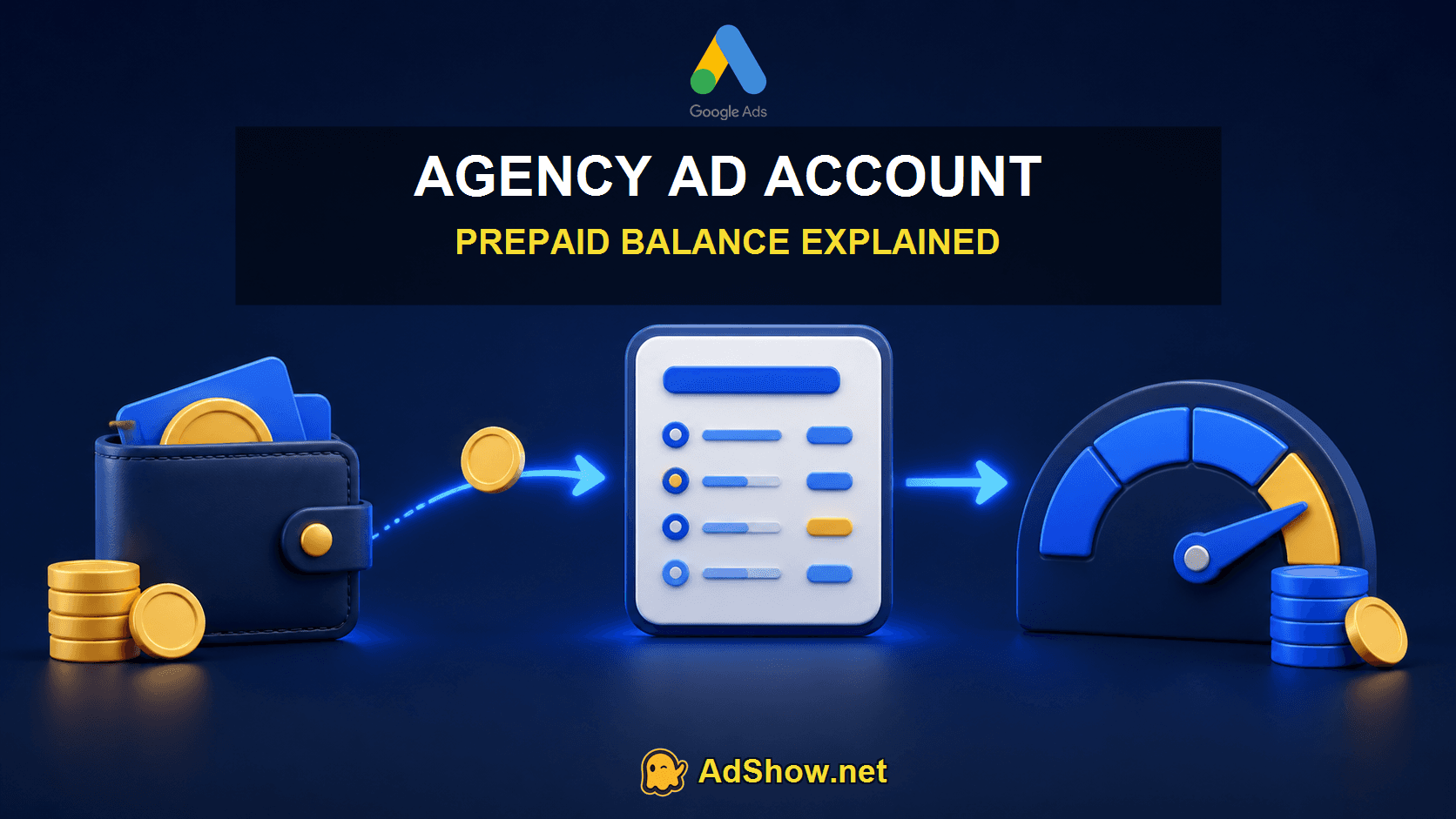
Table of contents
The safest operational habit is to reconcile every top-up from provider receipt to platform billing screen, then record spend and remaining balance separately.
AdShow workflow: AdShow’s self-service platform provides agency advertising accounts for Meta, Google Ads, TikTok and other major platforms. Users can review current offers in the marketplace, request accounts and follow top-up operations from a dashboard rather than relying only on chat. Current fees and balance conditions remain offer-specific.
What are the four balance states?
Provider wallet balance: funds recorded by the provider but not necessarily allocated to an advertiser account.
Pending top-up: an instruction or payment awaiting processing, verification or posting.
Platform available balance: money or credit displayed inside the ad platform for future eligible spend.
Media spend and adjustments: delivered advertising costs, taxes, credits, reversals or other ledger entries.
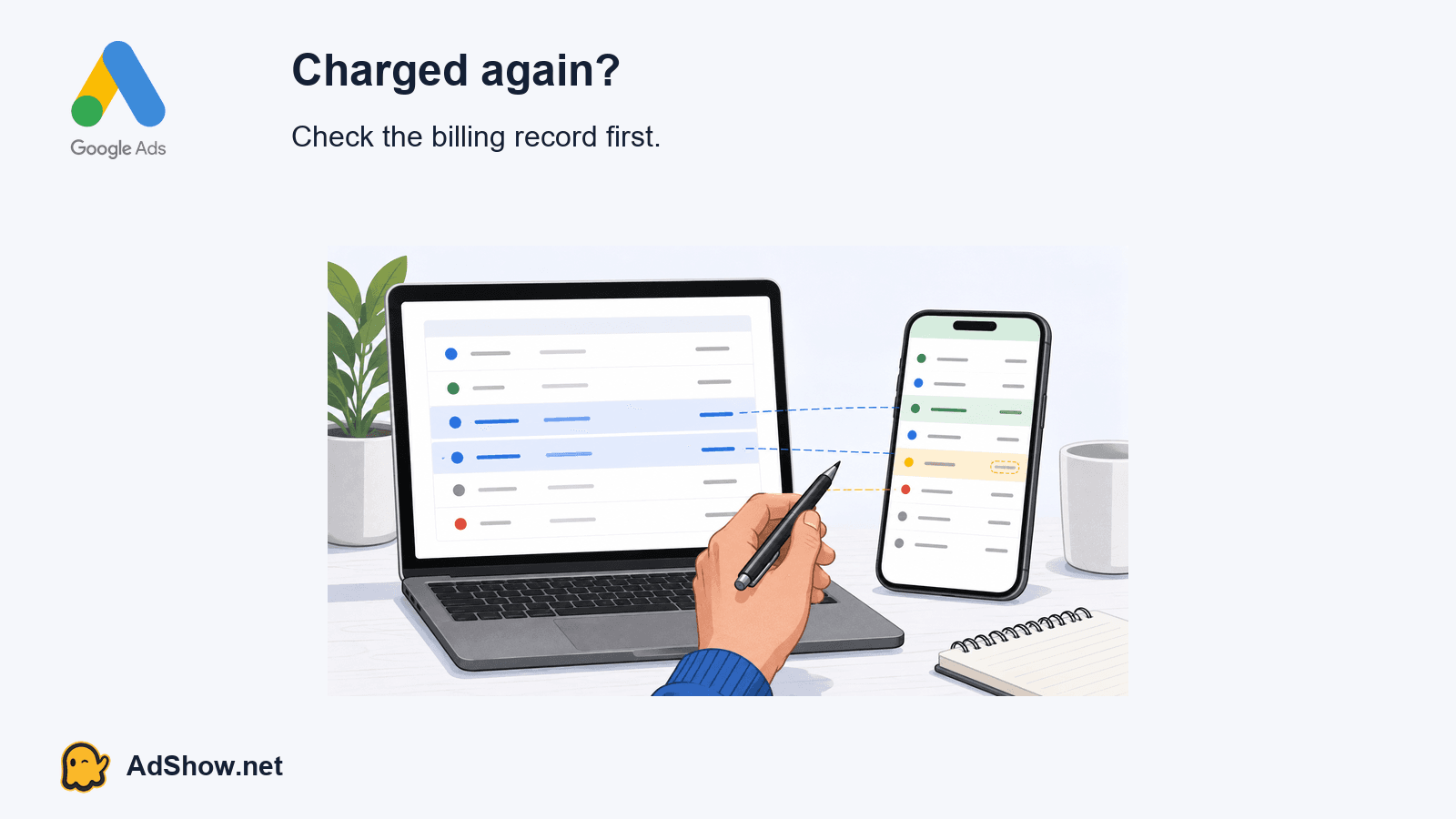
A screenshot of one layer does not prove another. For example, a provider receipt proves a payment was recorded; it does not by itself prove the platform has posted funds.

Reconcile each funding stage and preserve the transaction ID, advertiser ID, amount, fee and timestamp.
Why do balances appear inconsistent?
Processing time
Bank transfer, card review and provider allocation can produce a temporary gap. A posted payment and usable advertising credit may have different timestamps.
Fees, tax and currency
The amount sent may differ from the media amount after top-up fees, VAT or exchange-rate conversion. Compare net advertising credit, not only the headline fee.
Wrong advertiser ID
A top-up can be directed to the wrong account when CIDs or advertiser IDs are copied manually. Verify the final digits and account name before approving.
Reserved versus available funds
A provider-side balance may be reserved for a pending request. Ask the dashboard or support team to identify available, reserved and allocated amounts.
Promotional credit
Platform promotional credit can have expiry and refund restrictions unlike deposited cash. Never add it to “refundable cash” without checking the platform terms.
Account restriction
A suspended account can stop campaigns while funds remain visible. Refund, transfer and replacement are separate questions determined by platform status, permissions and provider terms.
Harris Eugene’s operator note
“When a buyer says ‘my balance is missing,’ I avoid debating the total first. I ask for four screenshots or records: provider ledger, top-up request, platform billing summary and delivered spend. Recent advertiser discussions show why this matters: funds can be visible in one section while delivery still asks for payment or verification. The reconciliation trail usually tells us whether we have a delay, allocation error, billing hold or account-status issue.”
— Harris Eugene. This is an operational framework based on current billing documentation and recent public discussions, not a claim about an undisclosed client.
What must a top-up record contain?
provider transaction ID and payment timestamp;
platform and exact advertiser ID;
gross deposit, fee, tax, exchange rate and net media credit;
requested, processing, completed or failed status;
platform posting evidence;
name of the authorized requester;
refund or transfer eligibility under the applicable terms.
For cost planning, use the agency ad account total-cost model. For enforcement scenarios, read what happens to balance, campaigns, Pixel and replacement after suspension.
How should media buyers control prepaid risk?
Start with a test amount appropriate to the account and campaign plan.
Reconcile the first posting before sending a larger amount.
Keep working capital in the provider wallet only when its status and terms are visible.
Use role-based approvals for top-ups.
Export ledgers regularly.
Do not prepay more merely because an agency promises a lower nominal fee.
Review refund, transfer and suspension clauses before an incident.
Use a daily prepaid-balance reconciliation
At the same cutoff time each day, record opening platform balance, completed top-ups, delivered media cost, adjustments and closing balance. The basic control is: opening balance plus posted funds and credits, minus spend and other charges, should explain the closing balance. Record provider-wallet movement separately.
When the numbers do not reconcile, do not call the difference “lost money” until you check posting time, tax, currency conversion, pending delivery cost and adjustments. Freeze another large top-up while the discrepancy is unexplained, preserve screenshots with timestamps and open one support case containing the full transaction trail.
This ledger also improves provider comparison. A 3% headline fee can cost more than a higher visible fee if conversion, minimum deposit, withdrawal conditions or downtime are worse. Measure the net usable media value and the time until funds become spendable.
Questions from recent billing and advertiser discussions
Is provider wallet balance the same as platform balance?
No. Provider-side funds may still be available or reserved before allocation. Platform balance is the amount posted or credited within the advertising platform.
Is every unused prepaid balance refundable?
No. Eligibility depends on the payment source, platform status, promotional-credit rules, permissions, taxes and provider terms.
Can prepaid funds exist while ads do not deliver?
Yes. Account review, payment verification, campaign settings, auction constraints or an allocation problem can stop delivery even when a balance is visible.
What proof should I keep after a top-up?
Keep the payment receipt, provider transaction ID, advertiser ID, net credit calculation, status timestamps and platform billing confirmation.
Scope: This guide distinguishes operational records; it does not replace the current billing or refund terms of Meta, Google, TikTok, another platform or a provider.