Are Google Ads Worth It? Run the Break-Even Test
Google Ads is worth testing only when search demand, contribution margin and conversion economics support an affordable acquisition cost. Start with the break-even CPC.

August 27, 2026
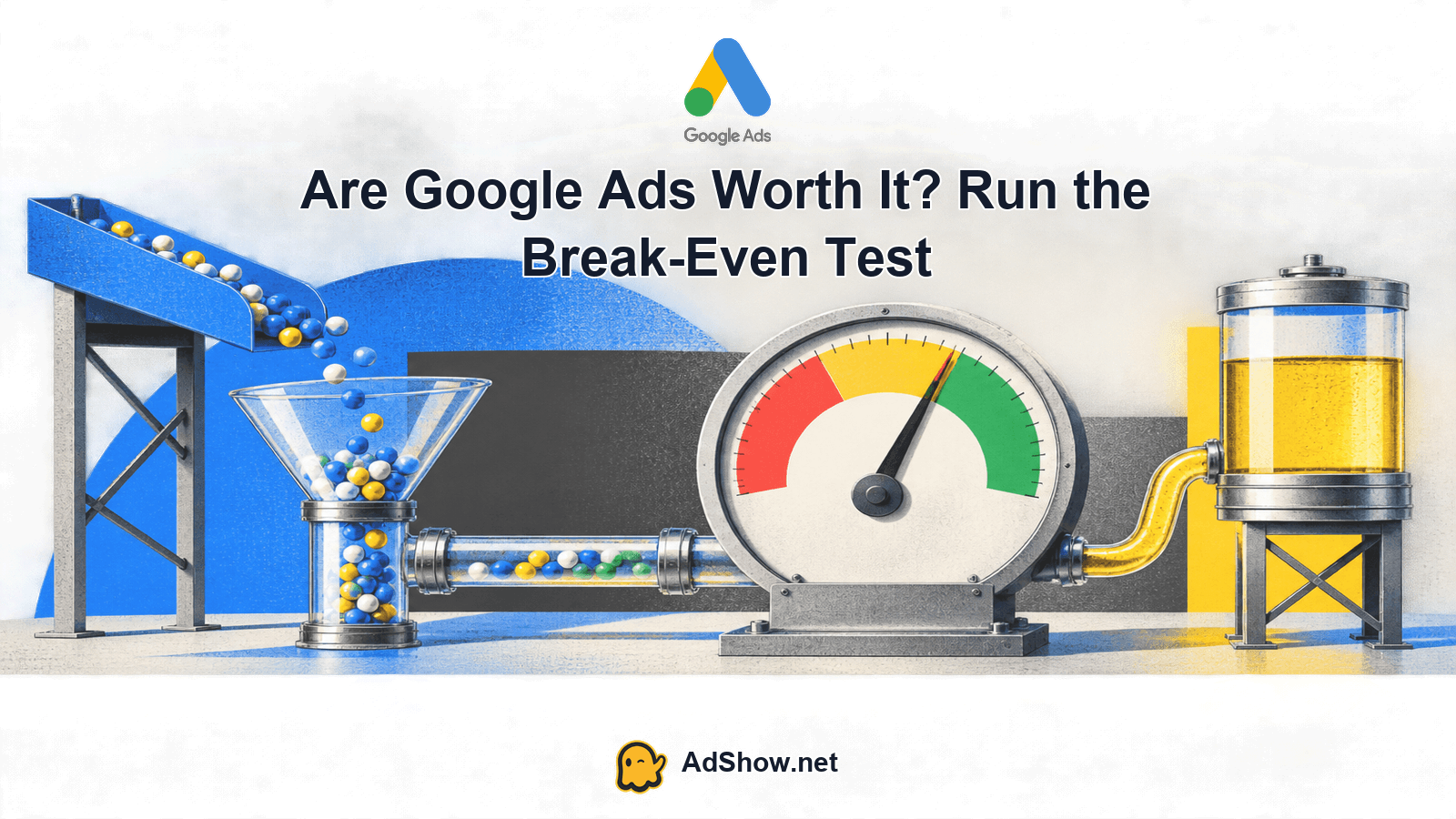
Table of contents
Are Google Ads worth it? Sometimes—but not simply because people are searching or clicks are available. Google Ads is worth testing when measurable search demand, gross profit and conversion economics can support the cost of acquiring a customer. Start with the business backward: calculate contribution margin, set an allowable customer acquisition cost, then derive the maximum affordable click. If that CPC is below what relevant auctions can plausibly deliver, do not fund a full campaign yet.
Start with contribution margin, not the keyword list
The first question is not which match type to use. It is how much one additional customer can contribute toward acquisition and overhead after the sale occurs. Use revenue collected, less cost of goods, payment fees, fulfilment, delivery, sales commissions, refunds or cancellations that are normal for the offer, and other variable fulfilment costs. For a service business, include the delivery labour or subcontractor cost and the cost of sales time where it is genuinely variable.
A simple starting equation is: contribution margin per customer = collected revenue − variable product, fulfilment and sales costs. If repeat purchases are part of the plan, include them only when your own cohort, CRM or accounting evidence supports the retention and margin assumption. Do not quietly turn an unproven hope of lifetime value into permission to overspend on the first order.
Use contribution, not headline revenue, to set the ceiling.
Separate gross profit from cash actually collected when payment plans, cancellations or refunds are material.
Include fulfilment and sales costs that increase with each acquired customer.
Treat repeat-purchase value as an evidence-based adjustment, not a default.
Set an allowable CPA before buying traffic
Your allowable customer acquisition cost (CPA) is the maximum you can pay for a new customer while preserving the return required by the business. A strict break-even ceiling is the contribution margin available before advertising. In practice, many operators set a lower target so the campaign leaves room for overhead, measurement error and profit.
For example: allowable CPA = contribution margin per customer × the share you can allocate to acquisition. If a sale contributes $240 and you can allocate 50% to acquisition, the target CPA is $120. The remaining contribution must cover the rest of the operating model. For a lead-generation campaign, replace the customer-level calculation with expected qualified lead value and the close rate: allowable cost per lead = allowable CPA × lead-to-customer rate.
Calculate the contribution from a first purchase or a defensible customer value period.
Choose the maximum share available for paid acquisition.
Set one allowable CPA for the test and document whether it is break-even, target-profit or a cash-flow ceiling.
Define which conversion counts: purchase, qualified appointment, accepted opportunity or another outcome tied to revenue.
Convert allowable CPA into a maximum affordable CPC
Once the conversion event and landing-page conversion rate are defined, calculate the click ceiling: maximum affordable CPC = allowable CPA × landing-page conversion rate. Use the rate for the relevant traffic and conversion definition, not a generic site-wide average. If the target CPA is $120 and 4% of qualified clicks become customers, the maximum affordable CPC is $4.80.
This is a decision threshold, not a bid recommendation. Google says keyword traffic estimates and bid-simulator outputs are estimates and do not guarantee performance. Each search enters a new auction, so the price and available impression opportunity can vary with query, competition, location, device and other auction factors. The official guidance on adjusting keyword bids and how the auction works is more useful than treating CPC as a fixed menu price.
A hypothetical worked example
Suppose an online store collects $180 per order. Product, payment and fulfilment costs total $105, leaving $75 contribution. The operator allocates 60% of that contribution to acquisition, so allowable CPA is $45. At a 5% landing-page purchase rate, maximum affordable CPC is $45 × 0.05 = $2.25.
Now test sensitivity instead of trusting one forecast. At a 4% conversion rate, the ceiling falls to $1.80. At 6%, it rises to $2.70. A one-percentage-point movement changes the affordable click by $0.45, or 25% versus the 5% baseline. If observed relevant CPC is around $3, the campaign misses the target at 4%, 5% and 6% unless margin, conversion rate or allowable CPA changes. That is a business problem to solve before scaling—not a reason to hide behind a larger budget.

Why average CPC and ROI figures do not answer it
An industry-average CPC cannot tell you whether your click is affordable. Two advertisers can bid on similar terms while having different margins, conversion rates, sales processes, geographic coverage and repeat-purchase behaviour. The same $4 click may be attractive to one company and destructive to another.
Published ROI claims have the same limitation. They may use different attribution windows, branded traffic, customer values, costs or conversion definitions. Auction estimates also do not prove that a particular landing page will convert. Google’s budget guidance explains that average daily budgets relate to how Google manages spend and charging limits; a budget is not a profitability forecast. Use the Google Ads cost guide to separate budget mechanics from the business's own affordable-acquisition threshold.
Recent PPC discussions illustrate the question, but not a benchmark. An anecdotal March 2026 discussion raised the difficulty of paid search for low-price products, while May and April 2026 discussions showed mixed experiences among service businesses and small advertisers. Those conversations are useful for spotting concerns and language, not for proving what your economics will do. Never use a competitor’s estimated spend as evidence that your campaign can work.
Signals that support a test—and signals to wait
Yes, test when: there is clear commercial search intent; the offer has measurable contribution margin; the calculated CPC is plausible for the intent cluster; tracking can connect clicks to revenue; and the business can handle the resulting demand.
Yes, test when: you have a credible landing page, a defined sales response process and enough cash to learn without needing the first few days to be profitable.
No or not yet when: you only know revenue, not contribution; the allowable CPC is below any plausible relevant traffic; conversion tracking is incomplete; the sales team cannot follow up; or the offer is still changing materially.
No or not yet when: success depends on unproven repeat purchases, broad low-intent traffic or an attribution model that cannot distinguish leads from customers.
Design a bounded test with rules written first
Begin with one intent cluster, such as searches for a specific service in a defined location or a product category with clear purchase language. Keep the landing page, offer and conversion definition stable long enough to learn. Avoid combining brand, research, competitor and high-intent terms into one result that conceals which demand is paying.
Install and verify the complete conversion path: ad click, form or checkout, qualified status, sale and revenue where available.
Set a test budget large enough to produce a meaningful sample relative to your conversion rate and sales cycle; do not call a handful of clicks proof of failure or success.
Record search terms, CPC, landing-page conversion rate, qualified rate, close rate, CPA and contribution by cohort.
Write stop rules before launch, such as pausing when spend reaches a defined fraction of allowable CPA without a qualified outcome or when search-term quality is persistently wrong.
Write continue rules, such as scaling only after conversion quality and customer economics remain within target across a defined observation period.
Harris Eugene’s operator note: A disciplined test should be allowed to expose a weak offer, poor qualification or slow sales follow-up. Do not change bids, landing pages, attribution and conversion definitions simultaneously, because that makes a loss impossible to diagnose. Keep the first decision memo simple enough that another operator can reproduce the calculation.
For services, measure lead quality and offline outcomes
A form completion is not necessarily a customer. Service advertisers should pass lead status back into their reporting where practical: reachable, qualified, booked, attended, quoted, won and collected. A campaign with a low cost per lead can be worse than one with a higher cost per lead if the cheaper enquiries are outside the service area, unable to buy or unreachable. If clicks are being recorded but enquiries are not, audit the path in Google Ads getting clicks but no leads before declaring the channel uneconomic.
Calculate the economics through the sales funnel. If one in five qualified leads becomes a customer and allowable CPA is $300, allowable cost per qualified lead is $60. If only half of recorded leads are qualified, the allowable cost per raw lead is $30. Include response time and sales capacity: a profitable lead stream can still damage operations if staff cannot contact prospects promptly or fulfil booked work.
Compare the test with your next-best use of money
Google Ads should compete with alternatives, not receive an automatic budget. SEO may compound but usually requires content, technical work and time before demand is dependable. Marketplaces can provide intent and infrastructure while taking fees and controlling customer access. Referrals may convert strongly but depend on relationships and volume. Meta ads can create demand and reach audiences that are not actively searching, but intent and conversion economics differ.
Compare each channel using the same contribution-based measures: qualified opportunities, customer CPA, payback period, capacity consumed and confidence in attribution. There is no universal winner. Search may deserve priority for urgent, specific demand; another channel may win when the offer needs demonstration, discovery or repeated exposure.
What an agency account can—and cannot—solve
An AdShow Google agency account can address access and operating workflow through a self-service dashboard with visible offers and pricing, account requests, wallet funding or top-ups and issue reports. Telegram can provide notifications and human guidance. Those functions may reduce administrative friction for an operator managing campaigns.
They do not change auction rank, policy standards or the underlying economics. An agency account cannot make an unaffordable CPC affordable, repair weak conversion tracking or turn poor leads into customers. Run the break-even test first. If demand, margin, conversion rate and operational capacity support the ceiling, fund a bounded test; if not, improve the offer or choose a better use of the budget.
If the economics support a controlled Google Ads test, review the available AdShow agency account workflow before launch. Explore Google Ads agency accounts
Questions from recent advertiser discussions
Is Google Ads profitable for a small business?
It can be, when contribution margin, conversion rate and sales capacity support an allowable CPA below the cost of relevant clicks. Business size alone does not decide profitability.
What is a good conversion rate for Google Ads?
There is no universal good rate. Use the conversion rate for your specific intent, landing page and conversion definition, then calculate maximum affordable CPC as allowable CPA multiplied by that rate.
How much should I spend before judging Google Ads?
Set the budget from the conversion rate, sales cycle and sample needed to make a decision. Define stop and continue rules before launch rather than judging from an arbitrary spend figure.
Can an agency account make Google Ads cheaper or more profitable?
An agency account can help with access and operating workflow, but it does not change auction rank, policy standards, conversion quality or unit economics.
Sources and scope
Official documentation defines platform behavior. Recent community discussions are used only to illustrate reported symptoms and questions; they do not prove the cause of an individual account outcome.
Google Ads: manage your spend — Official explanation of average daily budgets, charging limits and the relationship between budget and spend.
Google Ads: adjust keyword bids — Official guidance on estimating keyword traffic and using bid simulators, including the warning that estimates do not guarantee performance.
Google Ads: how the auction works — Official context for why each search produces a new auction rather than a fixed click price.
Recent PPC discussion: low-price product economics — March 2026 discussion illustrating how small order value can make paid-search break-even difficult; anecdotal business context, not a benchmark.
Recent PPC discussion: is PPC still worth it — May 2026 discussion showing mixed results across service businesses and the need to evaluate economics rather than rely on a yes-or-no claim.
Recent small-business discussion: Google Ads value — April 2026 discussion reflecting common small-business questions; generalized ROI claims in comments are not treated as evidence.