Best Card for Google Ads: Avoid Payment Failures
The best card for Google Ads is one compatible with your billing profile, payment setting and currency, with reliable authorization, sufficient limit and a tested backup.

August 16, 2026
Table of contents
The best card for Google Ads is not a particular issuer or card brand. It is an eligible card that matches the account’s billing country, currency and payment setting; supports online, recurring and authentication requests; has enough available limit; and can be backed up by another valid method. Check those conditions before launching or scaling. A card that works in one billing profile may fail in another, so no responsible recommendation can promise acceptance, uninterrupted delivery or universal performance.
Google’s official guidance confirms that available payment methods and settings vary by location, currency and account configuration. Treat card selection as an operational compatibility decision rather than a search for a supposedly favored issuer.
Why There Is No Universally Best Card for Google Ads
Advertisers often compare credit cards, debit cards, fintech products and prepaid cards as if Google published an issuer ranking. It does not. The Google Ads payment-method documentation instead focuses on whether a method is available for the account and whether it supports the applicable payment process. Authentication may be required, and prepaid cards have limitations, including a lack of support for automatic payments.
Prioritize compatibility with the billing profile over rewards or card branding.
Confirm online, recurring and 3DS or equivalent authentication support with the issuer.
Keep enough available credit or balance for both expected spend and billing variability.
Maintain a separate backup method rather than relying on one card.
Billing Country, Currency and Payment Setting Come First
Before comparing cards, identify the account’s billing country, billing currency and payment setting. Google distinguishes payment methods, such as a card or bank account, from payment settings, such as automatic payments, manual payments or monthly invoicing. The combinations available depend on the account. Review the official billing-options guidance instead of assuming a method offered in one country will appear in another.
Automatic payments require a method that can handle recurring merchant-initiated charges.
Manual payments are not available for every country, currency or account configuration.
Monthly invoicing is an account-level arrangement, not a card feature an advertiser can simply activate.
A mismatch between the card’s operating region and the billing profile may trigger issuer checks or failed authorization.
Use This Seven-Test Decision Framework
Apply these tests to the offer, traffic source, account and payment method before committing budget.
Legal eligibility: Confirm that the product, service, claims, landing page and target geography comply with applicable law. Legal availability does not automatically make an offer eligible for advertising.
Platform policy eligibility: Review Google Ads rules for the offer and creative. For health campaigns, do not use prohibited products, unsupported health claims, cloaking or attempts to evade review. Policy eligibility remains separate from legal eligibility.
Performance fit: Match demand to the channel. Search captures expressed intent, social introduces offers through discovery, and native or contextual placements reach users through content environments. A compliant offer may still be a poor economic fit for a channel.
Billing-profile consistency: Ensure the advertiser identity, legal details, billing country, currency and cardholder information are accurate and internally consistent. Do not manipulate profile details merely to expose another payment option.
Payment-setting compatibility: Verify whether the account uses automatic payments, manual payments or invoicing, then confirm that the intended method is supported for that exact setting.
Authorization readiness: Ask the issuer whether online advertising charges, recurring transactions, international processing when applicable, and 3DS authentication are enabled. Complete authentication only through legitimate issuer or Google prompts.
Capacity and continuity: Set a practical limit above normal billing needs, monitor utilization and prepare a valid backup method. A technically eligible card can still fail when its limit, balance or fraud controls interrupt authorization.
A method that passes all seven tests is a stronger operational choice than a card selected for points, popularity or anecdotal acceptance. Recheck the framework whenever spend, currency, ownership or campaign type changes.
If account access, funding visibility and issue reporting are also part of your decision, review AdShow’s self-service Google account options. Eligibility and campaign activity remain subject to Google policy. Explore Google agency ad accounts
What to Do When a Google Ads Card Is Declined
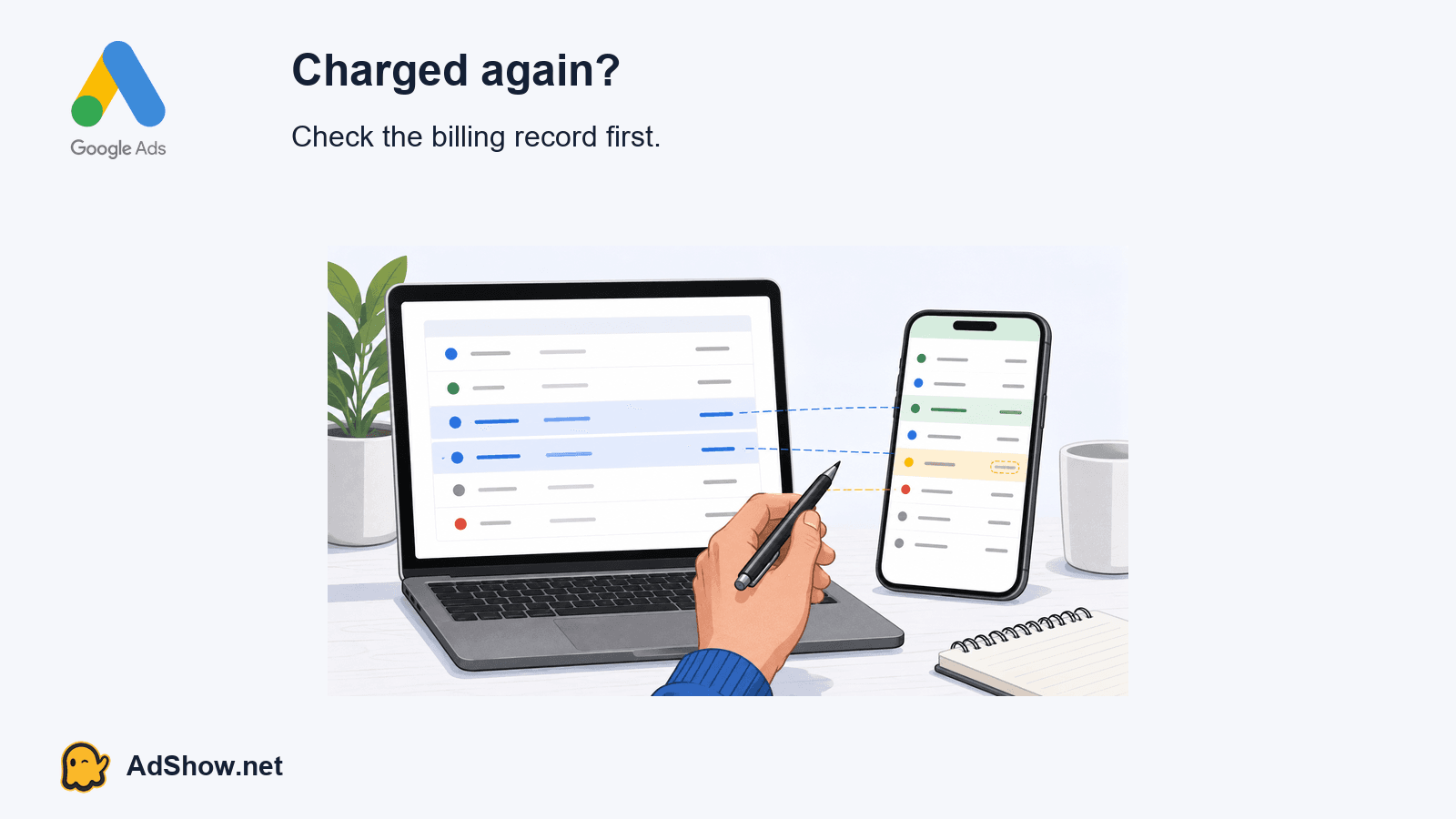
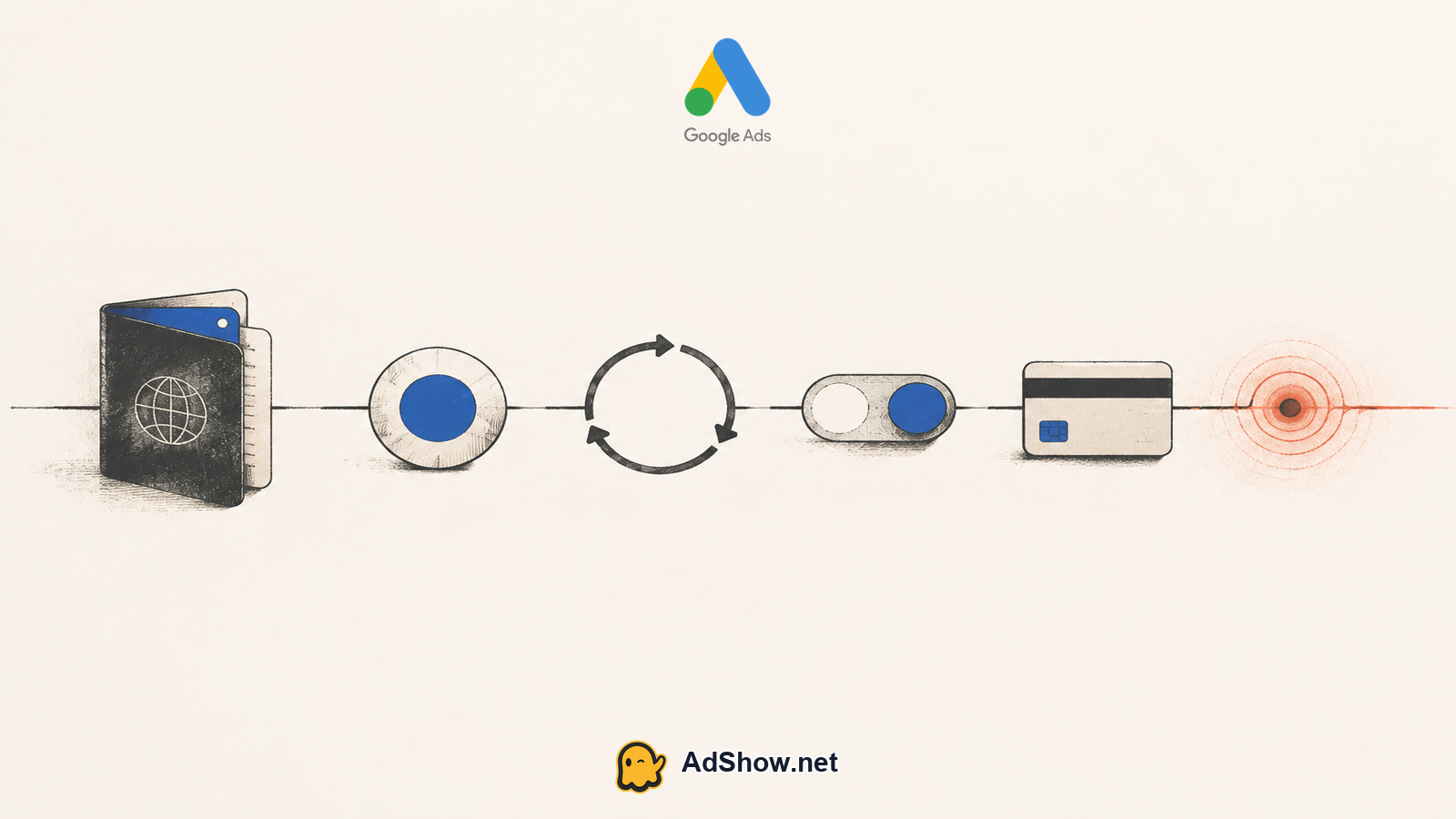
Do not repeatedly submit the same payment without diagnosing the failure. Google’s payment-method troubleshooting guidance directs advertisers to check account access, card details, available funds and issuer restrictions, and to add a backup method where available.
Confirm that you have the required billing or administrator access to change payment details.
Recheck the card number, expiry date, security code, cardholder name and billing address.
Inspect the available limit or balance, including pending authorizations and unrelated transactions.
Ask the issuer for the precise decline category and whether recurring, online or cross-border advertising transactions are permitted.
Complete any legitimate authentication request, then add or verify a separate backup payment method.
Escalate through Google support if the issuer confirms approval but the account continues to reject the method.
Harris Eugene’s operator note: Harris Eugene operator_note: Treat a payment failure as a systems problem, not immediate proof that the card brand is unusable. Check billing configuration, permissions, issuer authorization and available capacity in order. Changing several variables simultaneously makes the actual cause harder to identify.
Credit, Debit, Prepaid and Backup Cards
Card type affects cash flow and authorization behavior, but it does not guarantee acceptance. A conventional credit card may provide more spending headroom, while a debit card draws directly from available funds. Both still need to satisfy Google’s displayed options and the issuer’s controls.
Credit cards: useful when the approved limit comfortably covers expected charges, but utilization and issuer controls still matter.
Debit cards: workable where supported, provided sufficient funds remain available when Google attempts collection.
Prepaid cards: unsuitable for automatic payments under Google’s stated limitations; do not assume a reloadable product changes that rule.
Backup cards: should be independently funded and maintained, not an expired duplicate or another card sharing the same exhausted limit.
Match Payment Resilience to PPC Demand
Payment planning should reflect how campaigns generate demand. The best card for Google Ads is only useful if its available capacity matches the campaign’s spend pattern and the offer is appropriate for the selected channel.
Search intent: Users actively express a need through queries. Budget can accelerate quickly on high-volume or high-CPC terms, so monitor billing thresholds, pacing and available limit closely.
Social discovery: Meta, TikTok and similar platforms introduce offers to audiences that may not be searching. Creative testing can produce uneven daily spend, making clear card limits and funding alerts important.
Native and contextual demand: Taboola, Outbrain and comparable placements reach readers around content. Landing-page alignment, claims and placement quality require scrutiny in addition to payment capacity.
Microsoft/Bing and other search inventory: The intent model may resemble Google Search, but account rules, audiences and economics must be assessed independently.
Do not use payment resilience to scale an unvalidated campaign. Establish legal eligibility, policy eligibility and performance fit first; then provide enough funding capacity for controlled testing.
Agency Accounts Do Not Replace Billing or Policy Controls
AdShow is a self-service platform providing agency advertising accounts for Google Ads, Meta/Facebook, TikTok, Taboola, Outbrain, Microsoft/Bing, Snapchat and other major platforms. Its dashboard supports offer and pricing visibility, account requests, top-ups and issue reporting. This can centralize operations, but it does not promise account approval, card acceptance or uninterrupted campaigns. Platform policy, advertiser verification, landing-page quality and offer eligibility still apply.
Before requesting an account, document the advertiser entity, offer, target countries, expected spend and traffic strategy. Use accurate information, maintain funding records and respond promptly to verification or policy requests. Operational structure can improve clarity; it cannot convert a prohibited or misleading campaign into an eligible one.
If billing continuity matters more than card rewards, review how an agency ad account prepaid balance works and separate payment troubleshooting from Google advertiser verification failures.
Questions from recent advertiser discussions
Why is my card declined when my bank says it is valid?
Validity alone is not enough. Check billing details, available limit, recurring-payment support, authentication and Google account configuration. A June 2026 advertiser discussion describes card-data and issuer troubleshooting, but it is anecdotal and does not establish a universal cause.
Should I add a backup card to Google Ads?
Yes, where the account allows it. Google recommends a backup payment method as part of declined-payment troubleshooting. Keep it current, independently funded and compatible with the account’s billing country, currency and payment setting.
Can a high-spend advertiser switch from cards to monthly invoicing?
Possibly, but invoicing depends on account-specific eligibility and Google’s arrangements. July 2026 advertiser reports describe some high-spend accounts moving toward invoicing; those reports are anecdotal, not a general entitlement.
Will changing cards fix every Google Ads payment failure?
No. A replacement may help when the original issuer or limit is the cause, but failures can also involve account access, billing-profile data, authentication, payment settings or Google-side review. Diagnose the cause before making repeated changes.
Sources and scope
Official documentation defines platform behavior. Recent community discussions are used only to illustrate reported symptoms and questions; they do not prove the cause of an individual account outcome.
Google Ads payment methods — Official card eligibility, automatic/manual payment behavior, authentication and prepaid-card limitations.
Google Ads billing options — Official distinction between payment settings and payment methods by billing country and currency.
Google Ads payment-method troubleshooting — Official admin-access, backup-card and declined-payment guidance.
Recent advertiser card-decline discussion — June 2026 individual report of card-data/issuer troubleshooting; anecdotal and not a universal cause.
Recent large-advertiser billing discussion — July 2026 reports of some high-spend accounts being moved toward invoicing; account-specific and anecdotal.