4 Best Taboola Agency Account Providers Investigated (2026)
We investigated four Taboola agency account providers, comparing top-up fees, approval gates, dashboard workflows, refund risks and buyer fit.

August 10, 2026
Table of contents
Editorial disclosure: This comparison is published by AdShow, which provides self-service agency advertising accounts for Taboola, Meta, Google Ads, TikTok and other major platforms. AdShow is therefore both the publisher and one of the services reviewed. To make that conflict visible, we separate public claims, captured workflow evidence and first-hand observations throughout the article.
The short answer: which Taboola agency account provider fits which buyer?
AdShow is the strongest fit for a buyer who wants to see the available account offer and price, request an account, top up and report an issue from one dashboard rather than negotiate each action in chat. AdScaleLab has a real dashboard, but our test encountered manager approval and a processing fee that did not match the lowest headline figure a buyer might expect. Threasury is better suited to established, verifiable advertisers comfortable with application screening. Uproas markets aggressively around agency access, but its unusually strong promises and Trustpilot warning warrant extra verification before funds are sent.
Provider | Best fit | Workflow finding | Main question before funding |
|---|---|---|---|
AdShow | Buyers wanting a self-service operating layer | Pricing, requests, top-ups and issue reporting are organized in a dashboard | Which current Taboola offer and terms apply to my GEO and campaign? |
AdScaleLab | Buyers comfortable with a hybrid dashboard-and-manager process | Manager approval was required in our onboarding capture | What is my exact platform-specific fee, minimum and refund process in writing? |
Threasury | Established white-hat advertisers able to pass screening | Our submitted application was rejected and routed to chat for reconsideration | Which entity, website and documents are required before approval? |
Uproas | Buyers attracted to a sales-led service and broad marketing claims | Public reputation signals require additional due diligence | Can every promise be added to the signed service terms? |
This is a workflow comparison, not a claim that one provider can override Taboola policy. Taboola/Realize reviews ads and changes can require another review. No intermediary can truthfully guarantee approval, delivery, unlimited spend or immunity from suspension.
Why “Taboola agency account” needs a better definition
A direct advertiser can already apply to use Taboola's Realize platform. That means an agency account must create value beyond simply placing another login between the buyer and Taboola. In practice, buyers seek agency access for one or more of four reasons: onboarding help, funding convenience, consolidated account operations, or support when an account or campaign enters review.
The dangerous assumption is that “agency” means a different policy standard or special protection from enforcement. It does not. Taboola's own campaign guidance says ads are submitted for review and approval, commonly taking up to 24–48 hours, and edits may trigger another review. A provider may improve the operational path; it cannot erase the platform's content, landing-page or advertiser requirements.
We therefore ranked providers using questions that affect a media buyer after the sales call:
Can the buyer see pricing and minimum funding before committing?
Can an individual or small team start, or is a registered company dossier required?
Does the buyer control requests and top-ups in a dashboard, or must every action pass through Telegram or WhatsApp?
Is the advertised fee the effective fee shown at checkout?
What happens to unallocated wallet funds and account-level funds after a restriction?
Are support, refund and replacement terms written, conditional and auditable?
1. AdShow: best self-service workflow for Taboola agency account operations
AdShow approaches agency account access as an operations product. Instead of asking a buyer to message an account manager for a price, wait for a manual top-up confirmation and reconstruct the history from chat, the platform puts the market offer and routine actions into a dashboard.
A buyer can review the current Taboola agency account offer, register, request an account and manage operational actions from the same environment. Top-up notifications can also be delivered through Telegram, but Telegram is an alert channel—not the system of record. That distinction matters when several media buyers, finance staff and account operators share responsibility for spend.
What is genuinely different?
Visible commercial context: the buyer can inspect the market offer instead of beginning with “DM for price.”
Recorded workflow: account requests, top-ups and suspension reports are not scattered across private conversations.
Smaller-buyer accessibility: the workflow is designed for individual buyers and teams, while eligibility still depends on the selected product and campaign details.
Multi-platform operations: the same dashboard can support agency accounts for Taboola, Meta, Google Ads, TikTok and other platforms.
AdShow's limitation is the same one an honest provider should state: self-service does not mean self-approval. The advertiser, offer, creatives and landing page remain subject to platform and account terms. Current fees, funding protection and refund eligibility should always be read in the specific product terms and AdShow FAQ before money is allocated.
Verdict: Choose AdShow when operational transparency and speed matter more than having a salesperson mediate every step.
2. AdScaleLab: a real dashboard, but not a fully self-service Taboola account
AdScaleLab deserves credit for having more infrastructure than a one-page Telegram reseller. Its public Taboola offer advertises a fee “from 3%,” URL pre-approval and dashboard actions. On paper, that is close to the model many performance buyers want.
Our first-hand onboarding experience exposed the important qualifier: registering did not immediately unlock the dashboard. The screen stated that the account was “on hold pending manager approval” and directed the applicant to a Telegram manager. In other words, the software exists, but a chat-controlled gate still sits in front of it.
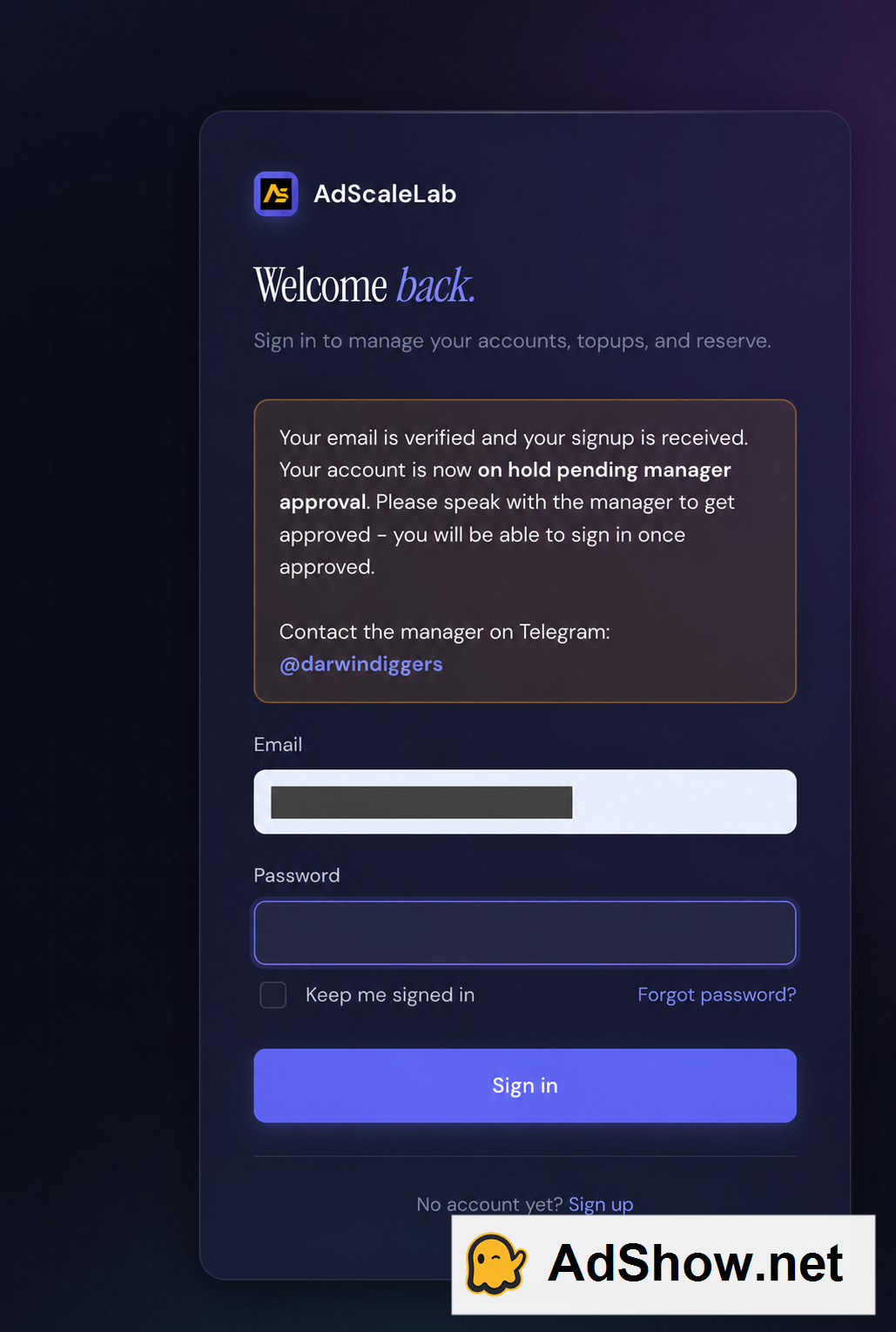
First-hand onboarding capture: access was placed on hold pending manager approval. Personal email was redacted; AdShow.net branding was added to identify the editorial source.
That gate is not automatically bad. A provider has legitimate reasons to screen advertisers. The conversion problem is the mismatch between a self-service impression and a manual process that becomes visible only after signup.
The “from 3%” problem: headline rate versus effective rate
In our use of AdScaleLab, we encountered a minimum 10% fee in the Taboola workflow. We also captured its dashboard showing a 10% processing fee on another selected advertising account. Because the visible account in that screenshot was Google Ads, the image does not independently prove that every Taboola customer pays 10%. It does prove why buyers must request an exact, platform-specific checkout quote instead of extrapolating from a “from” price.
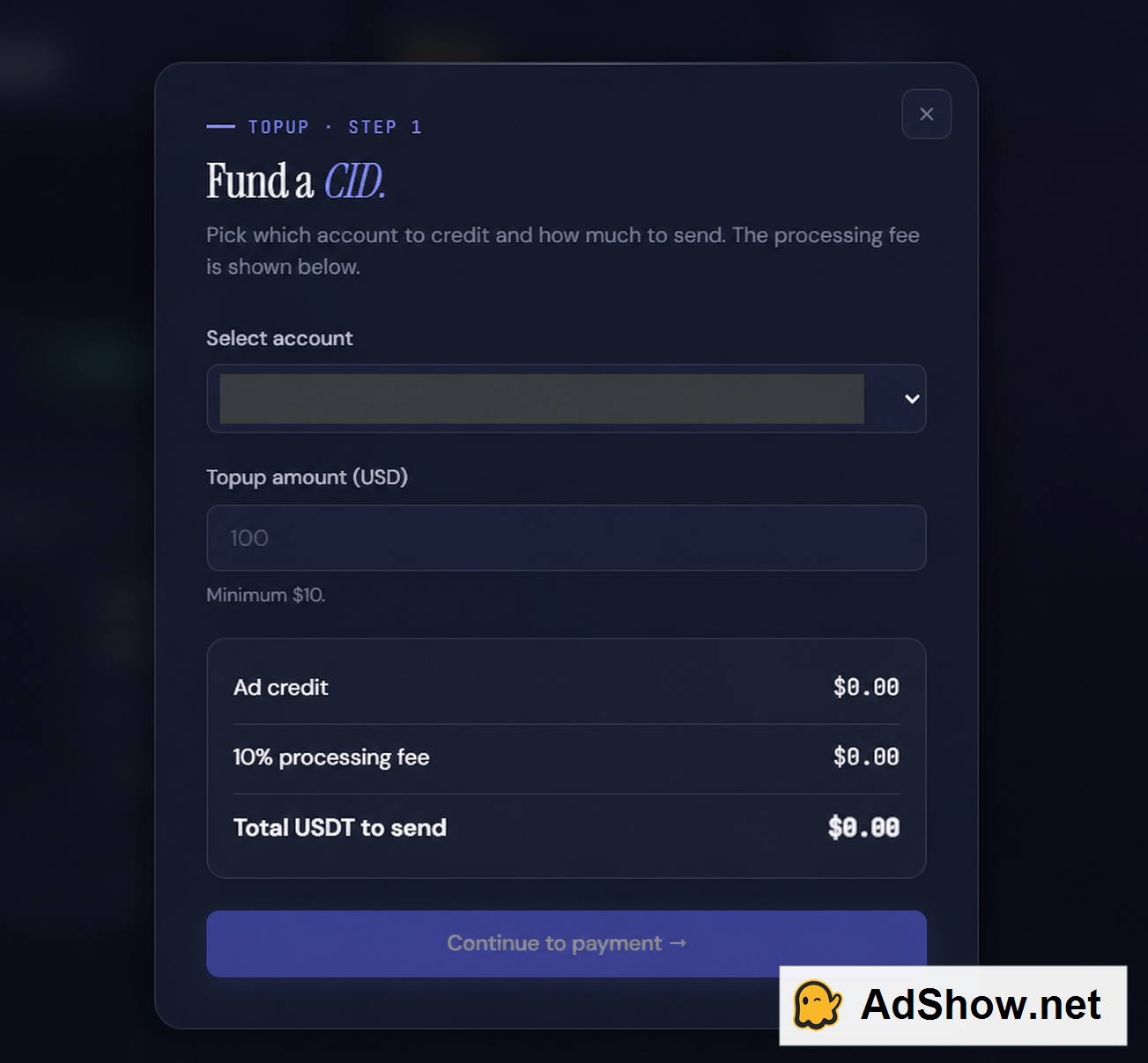
The captured funding dialog displayed a 10% processing fee. CID and account name were redacted. The selected account was Google Ads; the Taboola fee statement in this review comes from our separate first-hand Taboola experience.
AdScaleLab's public material also describes a minimum top-up after account opening. Buyers should ask whether an opening payment, reserve or minimum funding amount applies to their specific Taboola account, then save the answer in writing.
What do public complaints add?
At the time of review, AdScaleLab's Trustpilot profile included a small number of reviews and negative accounts involving communication and the return of remaining funds after account disruption. One reviewer described receiving only part of a remaining balance after a Taboola suspension. These are user allegations, not findings verified by AdShow or Trustpilot, and a small review pool cannot establish a general failure rate. They are still relevant enough to turn “What is your refund policy?” into five precise questions: which balance is refundable, who calculates it, what deductions apply, what evidence is issued and what is the target timeline?
Verdict: AdScaleLab may work for buyers who want a dashboard and accept manual approval. Do not fund based on the lowest advertised percentage alone; obtain the effective fee, minimum and balance-return rules for the exact account.
3. Threasury: structured screening that can exclude smaller or unverifiable buyers
Threasury represents a more traditional agency-access model. Its screening can be an advantage for established advertisers running clearly compliant offers: the provider knows who is entering its account portfolio and can reject applications that do not fit its risk profile.
The same control becomes friction for a solo buyer, a newly formed company or an advertiser whose website and documents are not yet easy to verify. In our test, Threasury received the application and then rejected it because details could not be verified, documents were incomplete or the use case did not fit. The next step was not an automated correction flow; the screen instructed the applicant to update information and contact the team on WhatsApp or Telegram.
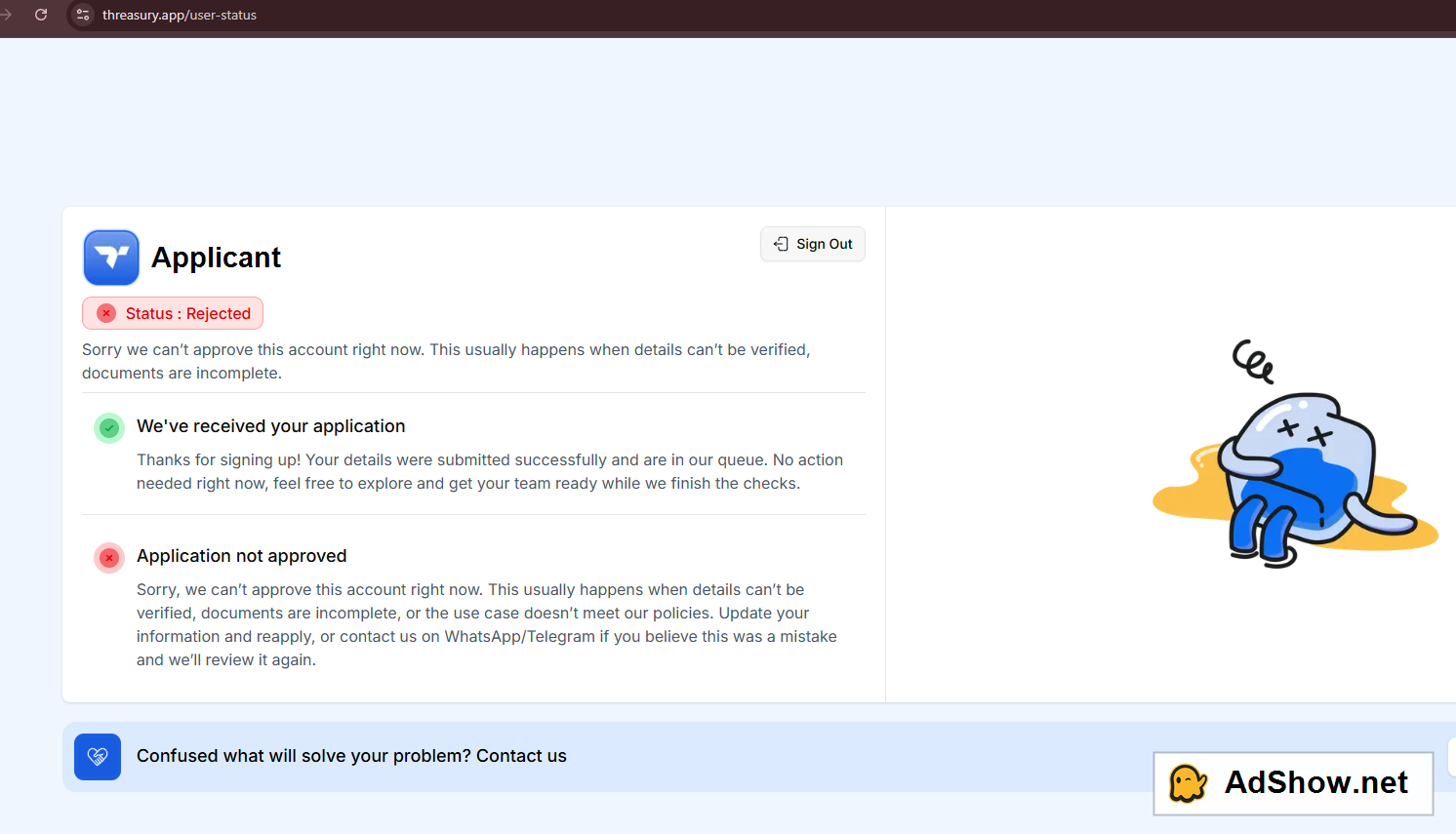
Our application-status capture. The applicant name was redacted. This demonstrates a provider-level eligibility gate; it does not mean every Threasury or Taboola application will be rejected.
This evidence is not Taboola-specific and should not be misread as a Taboola enforcement decision. It shows that access to the provider can fail before an advertising account is issued. That matters to searchers who interpret “buy a Taboola agency account” as immediate availability.
Verdict: Threasury may suit established white-hat advertisers prepared to disclose and verify their company and use case. Small buyers should ask for the eligibility checklist before investing time in the application.
4. Uproas: strong marketing claims require stronger written verification
Uproas is highly visible in agency-account searches and is frequently repeated in third-party “best provider” lists. Its positioning emphasizes fast access, high spending capacity and protection against disruption. Those phrases attract clicks because they address the exact fears of performance buyers.
But language such as “ban-free,” “no bans,” “unlimited” or “whitelisted” should never be accepted as a technical fact without a platform document defining it. Taboola still reviews campaigns, creatives and landing pages. A provider can offer operational support or a conditional replacement policy; it cannot make an advertiser exempt from Taboola enforcement.
The reputational signal also needs attention. Uproas's Trustpilot page currently states that its rating is unavailable because of a guideline breach and that a number of fake reviews were removed. This does not prove that the underlying service is fraudulent, nor does it validate every negative review. It does mean star ratings and testimonials should not substitute for a written contract, a real checkout quote and a small initial test.
Verdict: Treat Uproas as a sales-led option to investigate, not a promise to accept at face value. Ask the company to define account ownership, spend limits, replacement eligibility, refund deductions and response times in writing.
The five checks most “best Taboola agency account” lists omit
1. Compare effective cost, not the smallest percentage on the landing page
Add the setup fee, subscription, top-up fee, payment-network cost, currency spread, minimum deposit, reserve and any refund deduction. A 3% headline can cost more than a transparent 8% offer if the buyer discovers a large minimum or a different checkout rate after approval.
2. Separate provider approval from Taboola approval
A provider may approve the buyer, Taboola may approve the account, and Taboola may separately reject an ad or landing page. Ask which stage each promised timeline refers to.
3. Identify where the money sits
Provider-wallet funds, funds reserved for a request and funds already credited to an ad account are not interchangeable. A provider should explain the status of each balance and the conditions governing transfer or return.
4. Test the workflow before scaling
Request one account, make the smallest practical top-up, record the displayed fee and test the support path. Do not send a five-figure balance merely because the sales chat was responsive before payment.
5. Verify the operating value
If the provider's only function is relaying messages, ask why direct Realize access is not sufficient. A credible agency model should add measurable value through funding, organization, access operations, reporting or policy-aware support.
Our final ranking
AdShow — best overall for self-service operations and visible workflow.
AdScaleLab — best hybrid dashboard option, provided the effective fee and balance terms are confirmed.
Threasury — best for established advertisers comfortable with application screening.
Uproas — a high-visibility option that requires the most careful claim verification.
The ranking is not a claim that AdShow can prevent Taboola restrictions. It reflects the factor most provider lists ignore: how much of the account lifecycle remains visible and controllable after the buyer leaves the sales page.
Review the current AdShow Taboola agency account offer, then compare its displayed terms against the due-diligence questions above before registering and funding.
Questions media buyers ask in forums, groups and provider chats
These questions reflect recurring concerns found in media-buyer communities and sales conversations; the answers below are editorial guidance, not quotes from individual users.
Can a Taboola agency account avoid bans or guarantee approval?
No. Agency access does not remove Taboola's review and enforcement authority. Avoid any provider presenting “no ban,” “guaranteed approval” or “unlimited spend” as an unconditional platform property.
Why use an agency account if I can apply to Taboola Realize directly?
Use an agency provider only when it adds operational value you need: a suitable funding method, consolidated account management, a documented support path or help navigating onboarding. Direct access may be the better fit when those benefits do not justify the extra cost.
Is a “from 3%” top-up fee the price I will pay?
Not necessarily. “From” is a floor, not a quote. Ask for the exact fee, minimum, currency conversion and any subscription or opening payment for your platform, GEO and account before transferring funds.
Does having a dashboard make a provider fully self-service?
No. A dashboard can still sit behind manager approval, and top-ups or refunds may still require chat. Test the complete workflow from registration through funding and issue reporting.
What should I ask about refunds?
Ask how provider-wallet, reserved and account-level funds are treated; whether platform confirmation is required; what deductions can apply; who authorizes the return; and the expected timeline. Never assume every balance is automatically refundable.
Research note: Public pages and reputation profiles can change. Screenshots document the workflows observed at the time captured, not permanent guarantees about any company. Providers may contact AdShow with dated evidence of a material correction.