What Is Taboola? How Native Ads Work on the Open Web
Taboola distributes sponsored content and performance ads across open-web publisher inventory. Here is how Realize moves a campaign from setup to impression, click and conversion.

August 29, 2026
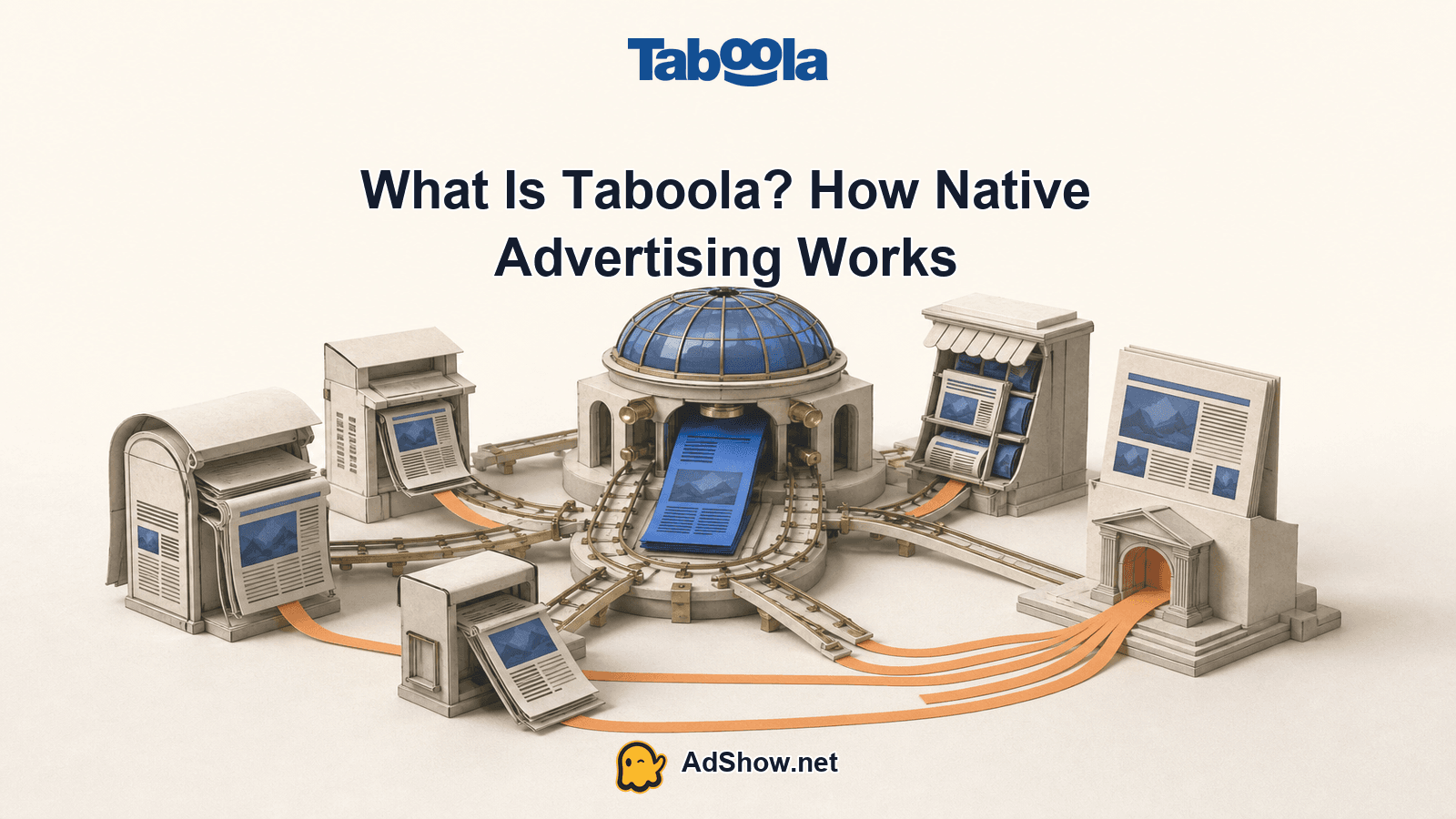
Table of contents
Taboola is an advertising and recommendation platform that distributes sponsored content and performance ads across publisher inventory on the open web. Advertisers now operate through Realize, the evolved Taboola ad platform. In practical terms, a campaign offers a story, product or action beside editorial content; a publisher supplies the audience and placement; and the reader decides whether the message earns a click. If you are considering access, the AdShow Taboola agency-account route can simplify an account request, current-offer review, funding or top-up, and issue reporting. It cannot change Realize policy, auction economics or a weak funnel.
What Taboola does for advertisers, publishers and readers
The value exchange is straightforward but not identical at every placement. An advertiser pays to reach people while they browse articles, videos and other publisher content. A publisher makes inventory available and may earn revenue from sponsored recommendations or performance advertising. The reader gets a relevant next step, although relevance is judged in the interruption of a browsing session rather than after an explicit search query.
Taboola describes its role as helping publishers and digital properties connect audiences with content and commercial recommendations. That makes the platform different from a search engine: the user may not have typed a request for your product. Your creative has to earn attention in context. A headline that works for an existing brand searcher may be too direct, too vague or simply mismatched for someone reading an unrelated article.
Where Realize fits in the current platform
Realize is the current Taboola advertising environment. Taboola’s migration documentation describes an expanded platform and a campaign hierarchy intended to organize objectives, reporting and creative delivery. It also covers native, display, vertical and carousel formats. These formats share an auction and reporting environment, but they do not create the same user experience.
Native ads are designed to fit the surrounding recommendation or content environment. The unit may resemble a content suggestion, but it remains sponsored advertising and must meet platform and publisher requirements.
Display ads use more conventional visual advertising placements. Their interruption pattern, available dimensions and creative demands differ from a recommendation tile.
Vertical formats are built for portrait-oriented inventory, which can be useful where the publisher experience and device support that presentation.
Carousel formats present multiple cards or creative elements in one unit, giving the advertiser more than one visual or message to test.
Do not assume that a format label predicts performance. Placement, device, publisher context, offer, creative promise and landing-page speed all affect the outcome. A native unit can produce curiosity without producing qualified buyers; a display unit can be a better fit for a known visual offer. The decision should follow the customer journey, not a belief that one format is automatically superior.
One promoted story, from account to conversion
Consider a campaign promoting an advertorial that explains a product before handing the visitor to an offer page. The path has several distinct layers. Confusing them makes reporting and troubleshooting harder.
Account: The advertiser gains access to Realize and confirms the business, billing and policy requirements that apply to the account. Agency access may simplify administration, but it does not remove review.
Campaign group: Related campaigns are organized under a shared objective and key performance indicator. Realize guidance recommends grouping campaigns that genuinely pursue the same outcome, rather than mixing incompatible goals.
Campaign: The advertiser chooses the objective, audience or targeting controls available for the campaign, budget, schedule and other delivery settings. This is where the buying plan becomes an executable instruction.
Creative: The advertiser supplies the image, headline, branding and destination. Several truthful variations are preferable to one highly polished guess because the platform needs legitimate alternatives to test.
Publisher impression: Realize serves an eligible ad into available publisher inventory. An impression means the ad was served or recorded as an opportunity in the reporting system; it does not mean the reader noticed or understood it.
Click: The reader selects the ad and is sent through the configured destination. A click is evidence of interaction, not evidence of purchase intent or profitability.
Landing page: The page must continue the promise made by the creative. If the advertorial says one thing and the offer page abruptly changes the product, price, audience or action, the handoff can lose intent.
Tracked conversion: A configured event records the action you care about, such as a lead or purchase. The conversion count is only useful if the event fires reliably, is attributed as expected and represents a commercially meaningful action.
Harris Eugene’s operator note: Test the advertorial-to-offer handoff before judging Taboola by CTR or CPC. A compelling first click can hide a broken promise, weak qualification or missing conversion event. Compare the ad claim, advertorial conclusion and offer-page action line by line; then verify that the intended event appears in Realize and in the destination analytics.

CPC, budget and reporting: the beginner's working model
CPC means cost per click: spend divided by recorded clicks. If a campaign spends 80 and records 100 clicks, the observed CPC is 0.80. That number describes buying efficiency, not the value of the traffic. The same CPC can produce very different results when one landing page converts and another does not.
Budget is the amount you make available for delivery under the campaign settings and schedule. Treat it as learning capacity as well as a spending control. A budget that is too small to generate useful observations may leave you judging noise; a larger budget cannot repair an offer that fails after the click. There is no universal minimum that makes every niche, objective or funnel viable.
Realize reporting distinguishes metrics such as served ads, impressions, clicks, CTR and tracked conversions. Read them as a sequence: delivery confirms whether the campaign can enter inventory; CTR shows whether the ad earns interaction; the landing page and analytics show what happens after the click; conversion evidence tests business value. For detailed cost and account problem-solving, use the existing Taboola pricing and account troubleshooting cluster. If clicks arrive without outcomes, see Taboola clicks but no conversions.
The readiness test before you launch
A Taboola test is more defensible when the funnel passes five checks:
The offer can survive interruption-based discovery traffic. It does not require a visitor to arrive already searching for the exact product.
The landing page continues the creative promise. The same problem, audience and next action remain clear after the click.
Tracking is installed and tested before launch. Confirm the event, value logic where relevant, attribution settings and analytics destination rather than assuming the pixel works.
Multiple truthful creative variations are available. Change the angle, image or wording without making claims the offer cannot support.
The budget is sufficient to learn relative to the conversion event and sales cycle. This is a planning judgment, not a universal spend threshold.
If the campaign is rejected, diagnose the review layer instead of rewriting randomly. The campaign rejection review guide separates account, creative, landing-page and offer concerns. If the account is disabled, use the 2026 disabled-account troubleshooting guide and follow the platform's process. Do not treat agency access as an approval bypass.
What Taboola is not
Taboola is not search intent. A reader browsing publisher content has not necessarily declared a need for your offer. It is not a guaranteed traffic-quality tier either: delivery can include different contexts, devices and levels of commercial readiness, so qualification must be measured through the funnel.
It is not an approval bypass. Platform policies still apply to the account, creative, destination and offer. Finally, it is not a substitute for funnel economics. Calculate the value of a lead or sale, allowable acquisition cost, refund or cancellation exposure where relevant, and the conversion rate needed to break even. A cheap click can still be an expensive customer.
When the agency-account route makes sense
The AdShow Taboola agency-account option is most useful when operational access is the bottleneck. The dashboard can expose current offers and pricing, support account requests, wallet funding or top-ups, and provide a route for issue reports. Telegram may provide notifications and human guidance. Those services can reduce administrative friction, but they do not alter Realize's rules, auction prices, tracking requirements, creative standards or the underlying economics.
Use the route after the readiness test, not instead of it. Current community questions about Taboola for ecommerce and health offers show continuing advertiser interest, but those posts are anecdotes and promotional or peer discussion, not evidence that a niche will work. Validate the offer, compliance position, tracking and handoff with your own evidence.
The practical answer for advertisers
So, what is Taboola? It is an open-web distribution and advertising platform that helps publishers monetize attention and helps advertisers place sponsored content or performance ads in discovery environments. Realize turns that opportunity into an operating sequence: account, campaign group, campaign, creative, impression, click, landing page and conversion evidence.
The strongest first test is not the one with the most dramatic headline or lowest CPC. It is the one where the reader can understand the promise, the landing page keeps that promise, the conversion event is trustworthy and the economics remain viable when the traffic is not search-driven.
Ready to review access and current account options? Start with the AdShow Taboola agency-account route, then validate the offer, tracking and funnel before funding a test. Explore Taboola agency accounts
Questions from recent advertiser discussions
Is Taboola the same as Realize?
Realize is the current Taboola advertising platform. Taboola remains the company and discovery-advertising brand, while advertisers use Realize for campaign setup, delivery and reporting.
Are Taboola ads only native ads?
No. The current Realize environment supports native, display, vertical and carousel formats. The available experience and performance can vary by publisher inventory, device, creative and campaign settings.
Does Taboola guarantee conversions or high-quality traffic?
No. Taboola provides distribution and reporting, not guaranteed outcomes. Conversion quality depends on the offer, targeting, creative, landing page, tracking and funnel economics.
Can an agency account bypass Taboola approval or policy?
No. Agency access can simplify account administration, funding and issue reporting, but Realize policy and review still apply to the account, creative, destination and offer.
Sources and scope
Official documentation defines platform behavior. Recent community discussions are used only to illustrate reported symptoms and questions; they do not prove the cause of an individual account outcome.
Taboola: company and discovery-platform overview — First-party description of Taboola's discovery role for publishers, digital properties and audiences.
Realize: Taboola Ads migration and current platform — Official explanation of the Realize migration, hierarchy, reporting and expanded native, display, vertical and carousel formats.
Realize: campaign setup for SMB advertisers — July 2026 first-party guidance on tracking, objectives, budget discipline, creative and campaign setup.
Realize: campaign groups — July 2026 first-party definition of campaign groups and why campaigns within a group should share an objective and KPI.
Realize: campaign reporting — Official definitions for served ads, impressions, CTR and tracked conversions in Realize.
Recent discussion: Taboola for ecommerce — February 2026 community question showing current advertiser interest; anecdotal and not evidence of performance or eligibility.
Recent discussion: native networks in 2026 — 2026 peer discussion comparing native networks and funnel fit; community opinion, not a controlled benchmark.