Taboola ClickBank Ads: Approval, Tracking and Break-Even Math
ClickBank offers can run on Taboola only after the exact offer, creative, landing page, destination and tracking pass review. Audit approval, click-ID continuity, net payout and break-even CPC before scaling.

September 1, 2026

Table of contents
Yes, ClickBank offers can be promoted with Taboola, but not automatically. The exact offer, merchant terms, ad creative, advertorial or landing page, destination URL, disclosures, traffic method and tracking setup must comply with current rules and pass review. A marketplace listing or an old partnership announcement is not blanket approval. Before scaling, audit four records: approved creative and lander, click-ID continuity, net payout after refunds, and break-even CPC. AdShow provides Taboola agency account access and account operations; it does not grant offer rights or bypass review.
What approval actually covers
There are several separate permissions in this funnel. ClickBank Marketplace availability means an offer can be found through the marketplace; it does not prove that the merchant allows Taboola traffic, direct linking, advertorials, paid search-style copy or every promotional angle. Merchant permission is a separate question. Taboola ad approval is another review, covering the ad, destination, claims, user experience and policy fit. Legal, regulated and restricted vertical rules can add another layer.
That distinction matters because an offer may be visible in ClickBank while its seller restricts traffic sources, requires pre-approval or prohibits certain claims. ClickBank’s current marketplace instructions explain how to search and evaluate offers, but marketplace ranking and availability are not a Taboola authorization. Check the offer’s current terms and obtain written merchant confirmation where the traffic method is unclear: ClickBank Marketplace search.
Offer permission: confirm the merchant allows Taboola and the intended path, including a presell or advertorial.
Taboola review: submit the exact creative, headline, image, destination and tracking redirect you intend to use.
Legal and vertical fit: review disclosures, health or financial claims, privacy obligations and any jurisdiction-specific restrictions.
User experience: provide functioning navigation, a clear commercial context and enough product, company and contact information.
Measurement permission: ensure the merchant or network can return the event and value needed to reconcile revenue.
The four-record pre-launch audit
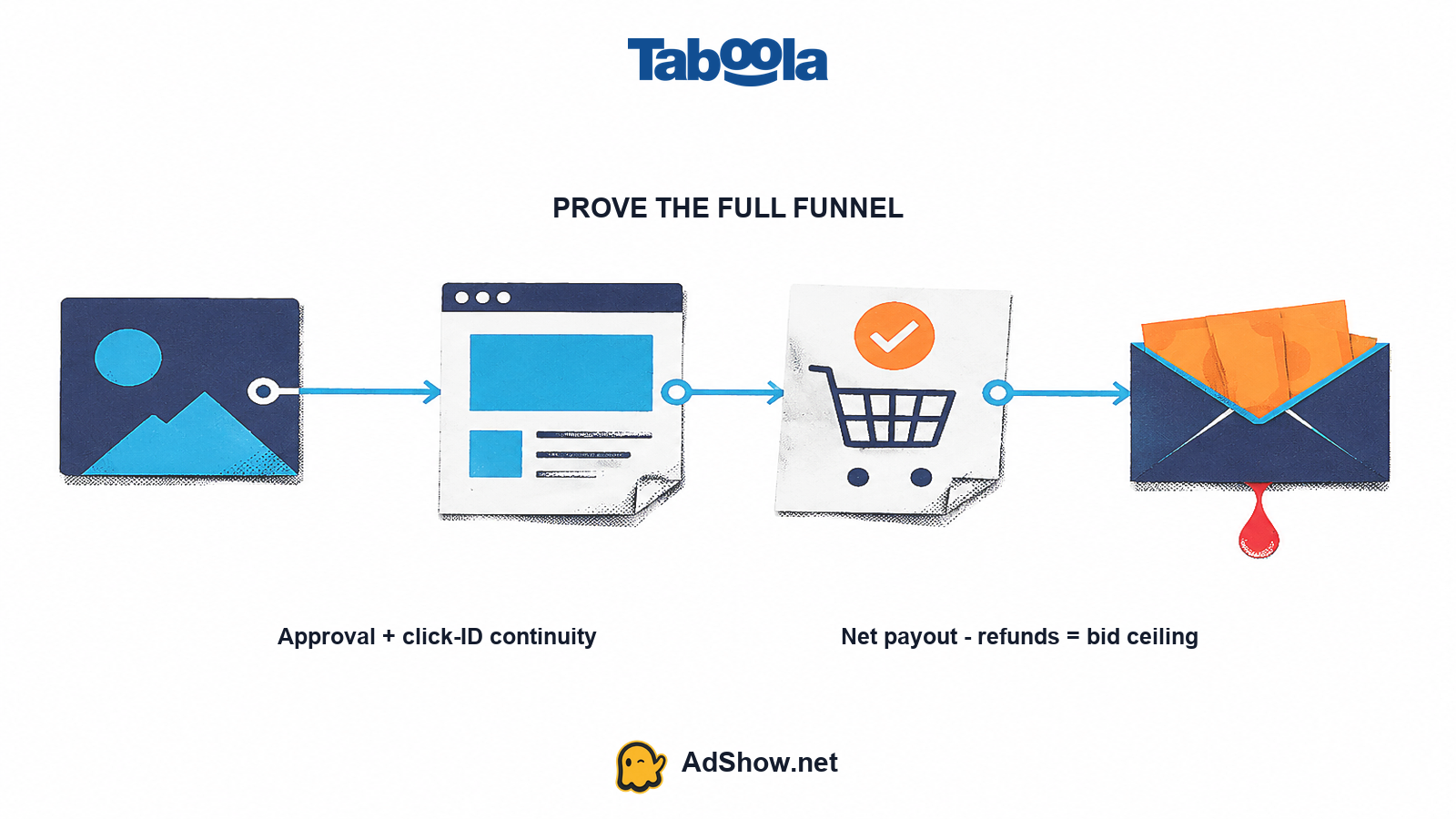
Treat launch approval as a file of evidence rather than a verbal assumption. Taboola’s affiliate advertising guidance is non-exhaustive, and the live policy and account review control, but its accessible guidance emphasizes clear advertorial disclosure, functioning pages, product or company information, contact details and avoiding false urgency. Do not copy a compliant-looking template and assume a different offer receives the same outcome.
Record one: save the submitted creative, advertorial URL, destination URL and approval status. Review every claim for substantiation, especially implied results, income, health outcomes, scarcity and time pressure.
Record two: test the mobile page from an ad click. Confirm the page loads, navigation works, the disclosure is visible, the advertiser identity is understandable, and contact or footer information is present.
Record three: document the redirect chain and the Taboola click-ID parameter. Open a real test click and verify that the identifier survives every redirect before the visitor reaches the merchant.
Record four: write down the commission basis, refund or chargeback assumptions, sale delay, currency, upsell treatment and loss cap. A dashboard’s gross commission is not necessarily cash available to fund the next test.
Harris Eugene’s operator note: Do not raise the bid until a real test order proves that the Taboola click ID, ClickBank event, currency and net payout can be reconciled. Keep the test URL, timestamp, event record and payout evidence together so a tracking gap is not mistaken for a losing offer.
Make the click ID survive the funnel
ClickBank’s Taboola S2S integration is best understood as a continuity problem. Taboola assigns a click identifier. Your tracking setup must preserve that identifier through the landing page, redirect and merchant handoff, then return the appropriate ClickBank event with its value and currency. The exact parameter names, fields and interface steps can change, so follow the current ClickBank S2S integration with Taboola article and the live fields in your account rather than relying on an old screenshot.
Pass the Taboola click ID into the first-party landing-page URL or tracking layer without stripping, renaming or overwriting it.
Preserve the value across tracking redirects, mobile variants, consent handling and the outbound merchant link.
Map the correct purchase or approved conversion event, not merely a button click or page view.
Send the event value and currency expected by the receiving platform, and document whether the value is gross, estimated or net.
Run a real click-path test: click the ad or test URL, inspect the landing URL, follow the redirect, place a permitted test order and reconcile the event in both systems.
A conversion can appear in a dashboard while the click ID is missing, duplicated or attached to the wrong campaign. Conversely, a sale may exist in ClickBank but fail to attribute to Taboola. Use the Taboola clicks but no conversions diagnostic when the numbers disagree, but first inspect the raw path and event logs. Harris’s operating note is simple: do not increase the bid until a test order proves that the click ID, event and net payout can reconcile.
Calculate break-even CPC from net economics
The useful calculation starts with money retained after expected refunds, not the headline commission. A practical model is: net commission after expected refunds multiplied by the landing-page-to-sale rate equals the maximum economic value per landing-page visitor. Then multiply that value by the measured click-to-landing rate to obtain the maximum break-even CPC. The result is a ceiling, not a target bid, because it excludes or only partially captures overhead, delayed conversions, attribution loss and testing risk.
Assume a hypothetical gross commission of $150 per sale.
Assume expected refunds and chargebacks reduce retained revenue by 20%, leaving a hypothetical net commission of $120.
Assume 2% of landing-page visitors purchase. Maximum economic value per landing-page visitor = $120 × 0.02 = $2.40.
Assume 85% of Taboola clicks successfully become measured landing-page visits. Maximum break-even CPC = $2.40 × 0.85 = $2.04.
If the campaign buys clicks at $2.04, it is only at modeled break-even before other costs and timing effects. A rational test bid would normally sit below that ceiling while the assumptions remain uncertain.
Every figure in that example is hypothetical and is not a performance forecast. Change the refund rate to reflect observed cohorts, use the actual click-to-landing rate rather than a platform average, and separate front-end commissions from upsells if upsells have different approval, delay or refund behavior. If a $150 gross commission becomes $90 after refunds and the true sale rate is 1%, the same funnel’s economic value is only $0.90 per landing visitor before the click-to-landing adjustment.
Why common dashboards can mislead
Taboola conversion reporting can define conversion rate, CPA and conversion value, but those fields do not automatically represent retained affiliate profit. A front-end CPA may look acceptable while refunds arrive later. Gross payout may include an upsell that is not yet settled. A dashboard conversion may be duplicated, delayed, attributed to another source or recorded without a usable click ID. Review the platform’s conversion reporting explanation alongside ClickBank transaction status and refund data.
Gross payout can overstate cash economics when refunds, chargebacks or reversals are material.
Reported conversions can overstate funnel health if the event is fired on a lead, checkout or thank-you page instead of a confirmed sale.
Front-end CPA can understate acquisition cost when delayed sales, tracking loss or post-sale refunds are excluded.
Upsells can make EPC look attractive while their approval rate, delay and refund profile differ from the initial product.
A small sample can produce an attractive ratio that disappears after the refund window closes.
Use a controlled launch, not blind direct linking
Start with a capped test that isolates one offer, one compliant creative family, one advertorial or landing-page version and a documented tracking path. Set a loss limit before traffic begins. Do not increase bids merely because clicks are cheap or because the first reported conversion produces a strong CPA. Wait for enough evidence to check click-ID continuity, event value, sale status and the relevant refund window.
An August 28, 2026 affiliate discussion about high-ticket native funnels stresses measuring the full chain from CPC through refunds and revenue per click. That is anecdotal community experience, not a benchmark or platform rule. A July 9, 2026 discussion about affiliate traffic alternatives similarly cautions that direct linking depends on merchant rules and conversion evidence. Use those conversations as prompts for questions, not as proof that a particular ClickBank offer will work.
Blind direct linking is especially fragile when the merchant has not approved the path or when the landing experience lacks context and disclosures. A presell can improve continuity and transparency, but it does not cure unsupported claims or a prohibited offer. For account operations and buying options, review best Taboola agency account providers, while remembering that account access does not cure creative, learning, tracking or lead-quality problems.
The operator’s launch checklist
Creative claim: every promise is supportable, specific and consistent with the offer page.
Disclosure: the advertorial or landing page clearly identifies commercial intent and avoids deceptive editorial presentation.
Mobile load: the page, navigation, outbound link and consent experience work on the devices used by the campaign.
Contact and footer: product, company, contact, privacy and relevant legal information are accessible.
Tracking redirect: the destination is the reviewed URL and does not unexpectedly change by device or geography.
Click ID: a real test confirms the Taboola identifier survives the complete path.
Purchase event: the correct event fires once and reports the intended value and currency.
Refund window: the model states when commissions become reliable enough for scaling decisions.
Loss cap: the campaign has a maximum test spend and a stop rule tied to evidence, not emotion.
The core question is not whether Taboola and ClickBank can technically connect. It is whether the exact funnel is authorized, reviewable, measurable and economically resilient after refunds. Keep the approval record, tracking proof and break-even worksheet together; update them when the merchant changes terms, the platform changes fields or the funnel changes its destination.
Need operational access for a compliant Taboola test? Review AdShow’s self-service agency account option and confirm the current requirements before funding a campaign. Explore Taboola agency ad accounts
Questions from recent advertiser discussions
Can I direct-link a ClickBank offer in Taboola?
Only if the merchant permits that traffic method and the exact destination passes Taboola’s current review. Direct linking is not automatically approved because an offer appears in the ClickBank Marketplace. Check merchant terms, disclosures, page functionality, claims and the destination’s tracking behavior before launch.
Does a ClickBank Marketplace listing mean Taboola will automatically approve the offer?
No. Marketplace availability, merchant permission, Taboola ad approval and legal or vertical eligibility are separate checks. An old partnership announcement also should not be treated as blanket approval for every offer, creative, landing page or traffic path.
Why are Taboola conversions missing even though ClickBank shows a sale?
Common causes include a stripped or overwritten click ID, a broken redirect, an incorrectly mapped event, a duplicate or delayed event, consent-related loss, or a mismatch between the ClickBank transaction and Taboola campaign. Test a real click path and compare the raw identifier, event, value and currency in both systems.
How do I calculate break-even CPC for a ClickBank campaign?
Multiply net commission after expected refunds by the landing-page-to-sale rate to get maximum economic value per landing-page visitor. Then multiply by the measured click-to-landing rate to get maximum break-even CPC. Treat the result as a ceiling and reduce it for operating costs, attribution loss, delayed sales and testing risk.
Sources and scope
Official documentation defines platform behavior. Recent community discussions are used only to illustrate reported symptoms and questions; they do not prove the cause of an individual account outcome.
Taboola affiliate advertising guidelines — Current accessible guidance emphasizes clear advertorial disclosure, functioning pages, product/company/contact details and no false urgency. It is non-exhaustive; the live policy and account review control.
ClickBank S2S integration with Taboola — Official support describes passing Taboola click IDs and mapping ClickBank events. Field names and interface steps should be checked in the current account.
ClickBank Marketplace search — July 2026 support explains offer discovery and marketplace ranking. Marketplace availability does not equal Taboola approval or merchant permission for every traffic method.
Taboola conversion reporting — Current help defines conversion, CVR, CPA and conversion-value reporting. Affiliate economics still require net commissions, refunds and delayed outcomes.
Recent high-ticket native-funnel discussion — August 28 2026 discussion emphasizes the full chain from CPC to refunds and revenue per click. It is community experience, not a benchmark.
Recent affiliate traffic-source discussion — July 9 2026 discussion cautions that direct linking depends on merchant rules and conversion evidence. Anecdotal advice, not platform policy.