Google Ads Keyword Strategy: Fewer Terms, Better Intent
A practical Google Ads keyword strategy starts with intent and landing-page fit, then uses weekly search-term triage to keep coverage useful without building bloated lists.

August 25, 2026
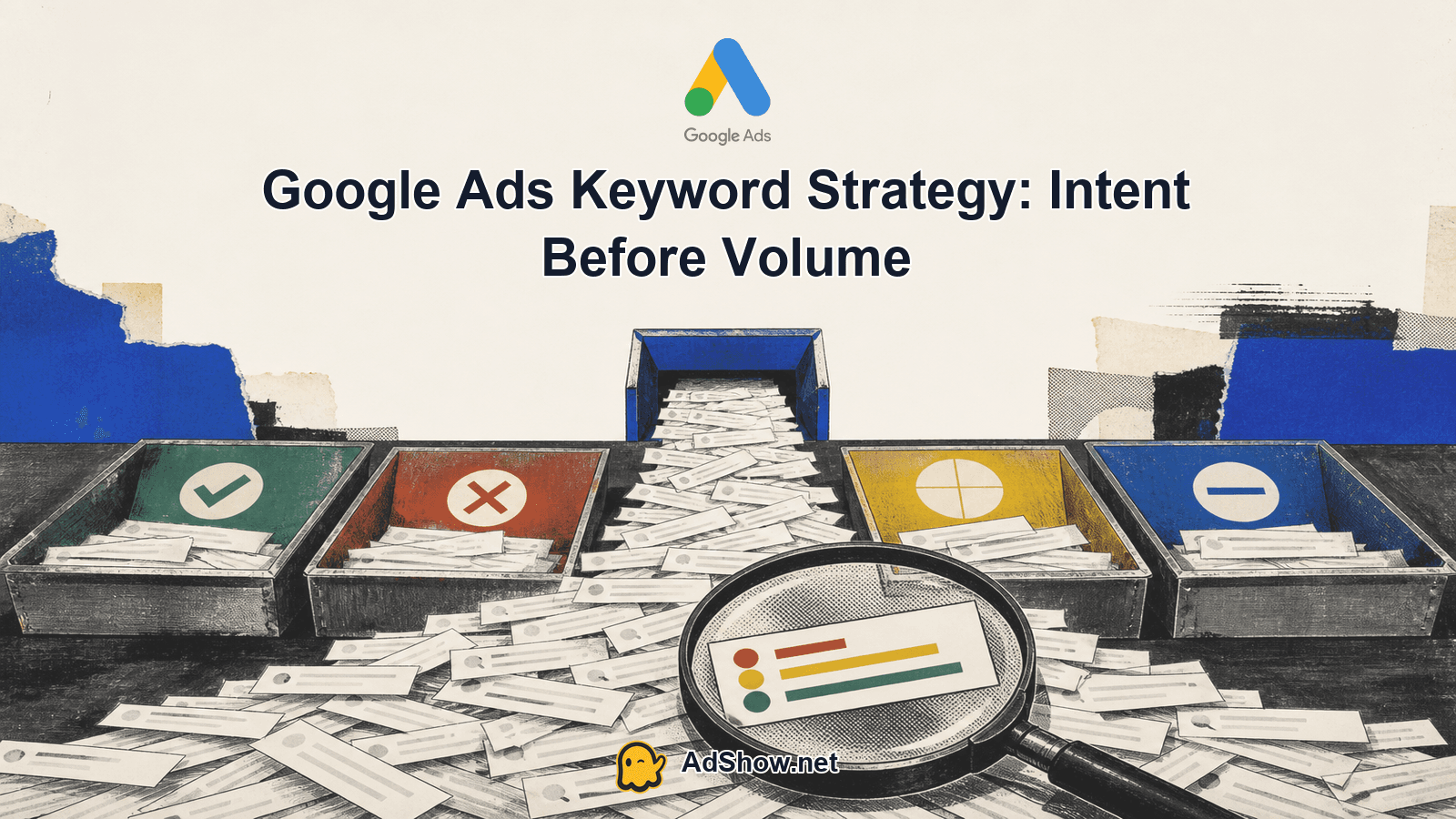
Table of contents
A strong Google Ads keyword strategy is not a contest to collect the most terms. Organize coverage by buyer intent and by the promise your landing page can fulfil. Then use the Search terms report each week to keep useful queries, exclude clear waste, split distinct intent into a new structure, or repair a mismatch between the ad and page. Google’s current matching behavior means broad coverage can include phrase and exact coverage, so exhaustive duplicate lists are usually unnecessary.
Start with intent, not a keyword count
There is no defensible universal number of keywords for an ad group, campaign or account. A local emergency plumber, a software subscription and a fashion catalogue have different buying journeys, query variation and landing-page requirements. A fixed target such as 20, 50 or 200 terms says little without context.
Instead, define the commercial job of each intent group. Examples include booking an appointment, requesting a quote, comparing plans, buying a specific product, finding a nearby store or researching a problem. Each group should have a clear landing-page promise: what the visitor will find, do or receive after the click.
Keep one intent together when the same ad and landing page make a credible promise to all of its queries.
Separate intent when the user’s problem, product, buying stage or required proof changes materially.
Remove terms that describe a service, audience or outcome the business cannot actually provide.
Treat keyword volume as a planning input, not as evidence of commercial value.
For example, “buy running shoes online” and “running shoes for flat feet” may both be relevant to an ecommerce store, but they can need different copy, filters and product recommendations. Conversely, several close variants may not deserve separate ad groups if the same page and message fit them all. The test is operational coherence, not the number of strings in the account.
Use broad, phrase and exact with their current roles
Google describes broad match as the default and widest matching option. It can match searches related to the keyword’s meaning, including searches that do not contain the same words. Phrase match reaches searches that include the meaning of the keyword, while exact match offers the greatest control among the three but can still match close variations and searches with the same meaning or intent. These are not old-style literal filters.
Google’s current guidance also states that broad match includes coverage that phrase and exact can provide. That makes exhaustive duplication a poor default: adding the same concept in every match type does not automatically create better control. It can create more maintenance, more reporting fragments and more opportunities for contradictory negatives.
Use broad match where the conversion goal, measurement and landing-page relevance are strong enough to evaluate related intent.
Use phrase or exact when a concept needs a tighter test, a more constrained budget allocation or clearer reporting separation.
Compare the actual search terms and conversion quality rather than assuming a match type is profitable from its label.
Add distinct keywords only when they improve coverage, control or intent separation—not merely because a synonym exists.
This does not mean broad match is appropriate for every account. Limited conversion data, weak tracking, a highly restricted offer or poor query tolerance may justify a narrower starting structure. The evidence from a search-term report can support a decision for a particular account; it cannot prove that one match type is universally superior.
Build around the landing-page promise
A keyword is useful only when the rest of the path makes sense. Map each intent group to the page, offer and action that follow the click. If the ad says “same-day boiler repair” but the page describes general plumbing services and offers no booking route, adding more repair keywords will not solve the underlying problem.
Create a simple promise check for every group: what does the query imply, what does the ad claim, and what does the page deliver? A mismatch can look like a keyword problem because the traffic feels poor, but the repair may belong in the ad, page, offer or tracking setup. Google Ads keyword matching determines eligibility; it does not make an unsuitable page persuasive.
Harris Eugene’s operator note: Twenty coherent keywords can outperform two hundred mixed-intent keywords when the smaller set shares one offer, one landing-page promise and one conversion definition. That is a structural judgment, not a performance guarantee. The larger list may contain more theoretical reach, but it also makes search-term review, ad relevance and budget diagnosis harder.
Run a weekly search-term triage
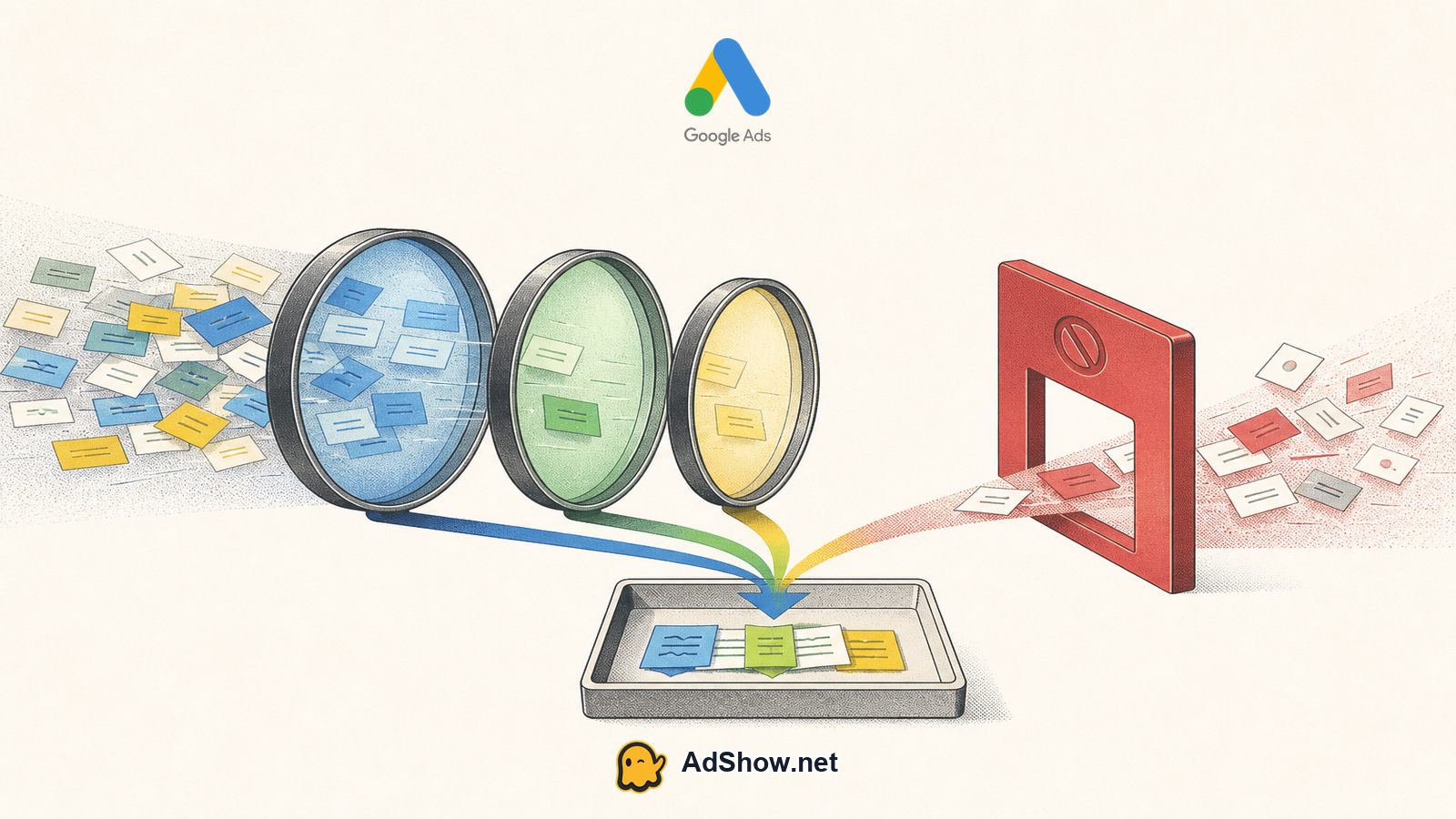
The Search terms report shows the queries that triggered ads and gives you evidence for refinement. Review it on a consistent weekly cadence, using a window that is large enough to avoid reacting to one-off noise. For low-volume accounts, a fortnightly review may produce a more usable sample, but the decision categories remain the same.
Keep: retain the query when it fits the buyer intent, the offer and the landing page. If it is commercially important and repeatable, consider whether it deserves its own keyword or ad-group treatment.
Exclude with a negative: add a negative when the query is clearly irrelevant, impossible to fulfil or outside the agreed commercial scope. Record why, especially for terms that could be ambiguous later.
Split into a new intent or ad group: separate the query when it is relevant but needs a different product, audience, buying stage, message, budget or landing page.
Repair the landing-page promise: keep the query under review when it is relevant but the click path is weak. Fix the ad, page, offer or tracking before concluding that the keyword itself is bad.
Use conversion evidence carefully. A query with no conversion after a handful of clicks is not automatically waste; a query producing leads is not automatically valuable if those leads are unqualified. Where possible, review downstream quality, revenue, margin or sales acceptance. Hypothetical example: if ten leads cost $300 and only one becomes a $100 sale, the account should not treat “lead” as the final success signal without checking the economics. That calculation illustrates a decision rule, not a market average.
Use negative keywords with restraint
Negative keywords are useful for removing clear mismatches, but they are not a substitute for understanding intent. Google documents separate negative match behavior, so check whether the negative is broad, phrase or exact and what variations it will block. A negative based on one ambiguous word can remove legitimate demand as well as unwanted traffic.
Be especially careful with shared negative lists. A term that is irrelevant to one campaign may be valuable in another. A shared list applied across brands, locations, product lines or funnel stages can silently suppress valid queries. Keep negatives close to the scope where the decision was made unless the exclusion is genuinely universal.
A June 2026 Reddit discussion about how many negatives are too many is anecdotal community evidence, not an official Google limit. Its practical symptom is familiar: uncontrolled list growth can make it difficult to remember why a term was blocked. Maintain notes, review old exclusions and remove negatives that no longer reflect the offer or structure.
Treat competitor-name queries as a separate decision
Competitor-name searches can indicate comparison intent, but they are not automatically profitable. A user searching for another brand may be loyal to it, looking for support, comparing prices or trying to reach a specific site. Your ad and landing page must give a credible reason to switch or compare without making unsupported claims.
Create a distinct test if competitor terms are allowed by the business and jurisdiction. Separate budgets, monitor assisted and final conversions, and check lead quality. Do not assume that a low click price, a high click-through rate or a visible impression is evidence of incremental profit.
Legal and policy risk also needs review. Trademark treatment, ad text rules and local requirements can vary by jurisdiction and circumstance. Avoid implying affiliation, copying distinctive branding or making comparative claims that cannot be substantiated. Google Ads eligibility does not settle every legal question, and an approved ad is not a legal opinion.
What to do when clicks do not become business
Search-term triage should connect to the rest of account operations. If queries are relevant but leads are missing, inspect form friction, call tracking, page speed, offer clarity and sales follow-up. If clicks arrive but calls do not, review phone visibility, call assets and whether the query implies an urgent action. These are not problems that a longer keyword list can reliably fix.
Useful internal checklists include Google Ads clicks but no leads and Google Ads clicks but no calls. They support diagnosis; they do not establish that a particular keyword, match type or landing page will produce a given result.
Keep the operating system simple
Document the purpose of each campaign, the landing page it uses, the conversion that matters and the negative-list scope. During the weekly review, save the decision and reason for notable queries. This creates a feedback loop that is more durable than repeatedly expanding a spreadsheet of synonyms.
If your account setup requires agency access, AdShow provides self-service agency advertising accounts for Google Ads and other major platforms. Its dashboard supports account requests, pricing visibility, wallet funding or top-ups and issue reports; Telegram can provide notifications and human guidance. Verify the live offer and applicable terms before relying on any account arrangement.
Agency-account access remains subject to Google’s policies and does not fix auction costs, tracking, creative, offer quality or funnel problems. AdShow can support account operations; it cannot guarantee approval, cheaper CPCs, performance or policy outcomes.
Explore the current Google Ads agency-account offer through AdShow, then keep keyword decisions grounded in intent, evidence and landing-page fit. View Google Ads agency accounts
Questions from recent advertiser discussions
How many keywords should one Google Ads ad group contain?
There is no reliable universal count. Use enough terms to cover one coherent intent and landing-page promise, then stop adding duplicates that do not improve coverage or control.
Should I use broad, phrase or exact match?
Choose based on data quality, conversion tracking, budget and the control required. Broad can include phrase and exact coverage, while phrase and exact may suit tighter tests or more constrained structures.
When should I add a negative keyword?
Add one when a query is clearly irrelevant, impossible to fulfil or outside the agreed offer. Check negative match behavior and avoid applying an ambiguous exclusion across unrelated campaigns.
Are competitor keywords worth testing?
They can be tested as a separate intent, but profitability is not automatic. Measure incremental business value, review lead quality and check trademark, advertising and comparative-claims requirements.
Sources and scope
Official documentation defines platform behavior. Recent community discussions are used only to illustrate reported symptoms and questions; they do not prove the cause of an individual account outcome.
Google Ads: keyword matching options — Official current guidance on broad, phrase and exact match, including that broad match includes phrase and exact coverage and exhaustive variants are unnecessary.
Google Ads: how keyword matching works — Official explanation of how keywords, meaning and user intent influence matching.
Google Ads: search terms report — Official guidance for reviewing the queries that triggered ads and refining keyword decisions.
Google Ads: negative keywords — Official explanation of negative keyword behavior and match considerations.
Recent PPC discussion: how many negatives are too many — June 2026 practitioner discussion illustrating the risk of uncontrolled negative-list growth; anecdotal, not an official limit.
Recent PPC discussion: 100-keyword ad groups — January 2026 discussion about excessive keyword breadth and mixed intent; community experience rather than a universal rule.