What Is a Good CTR for Google Ads? Read It Correctly
A good Google Ads CTR is competitive for its network and intent while producing qualified conversions at an acceptable cost. Here is how to diagnose it.

August 29, 2026
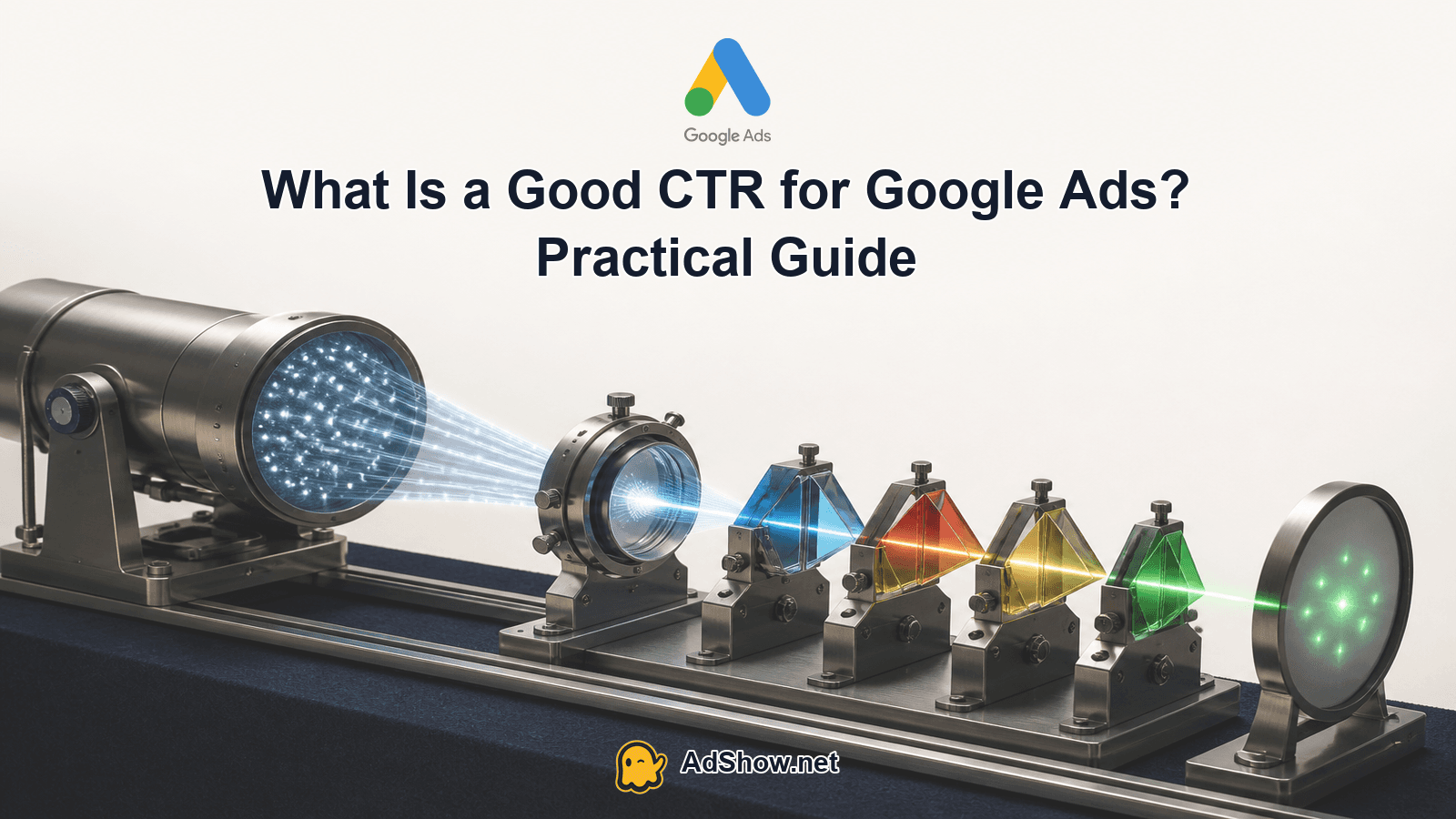
Table of contents
A good Google Ads CTR is one that is competitive for the specific network, query intent, industry and objective while still producing qualified conversions at an acceptable cost. There is no universal winning percentage. Google itself describes a good CTR as relative to what you advertise and the network carrying the ad. A high rate can signal strong relevance—or simply attract people who were never likely to buy.
CTR is a rate, not a verdict
Click-through rate is calculated as clicks divided by impressions. If an ad receives 120 clicks from 3,000 impressions, its CTR is 120 ÷ 3,000 = 4%. The calculation is simple; the interpretation is not. A 4% CTR on tightly matched non-brand Search traffic may mean something very different from 4% on broad Display prospecting.
As a cross-industry reference, the 2025 LocaliQ/WordStream search benchmark reported an average CTR of 6.66% across more than 16,000 campaigns and 23 industries. Treat that figure as context, not a target, guarantee or Display benchmark. The campaigns, industries, queries, bidding strategies and conversion goals behind your account may differ substantially.
Compare like with like
Search, Shopping and Performance Max surfaces, Display, and video should not be placed in one CTR league table. Search often captures an explicit query, while Display and video interrupt browsing or viewing. Shopping CTR reflects product imagery, price, brand recognition and feed quality. Performance Max can distribute across several Google surfaces, so its blended rate may hide meaningful differences by placement and intent.
Start with the campaign type and network before asking whether CTR is good. Then separate brand from non-brand traffic, high-intent terms from research queries, and prospecting from remarketing. A brand campaign can produce an unusually high CTR because the user already knows the business; that does not make the same percentage a fair expectation for a generic category term.
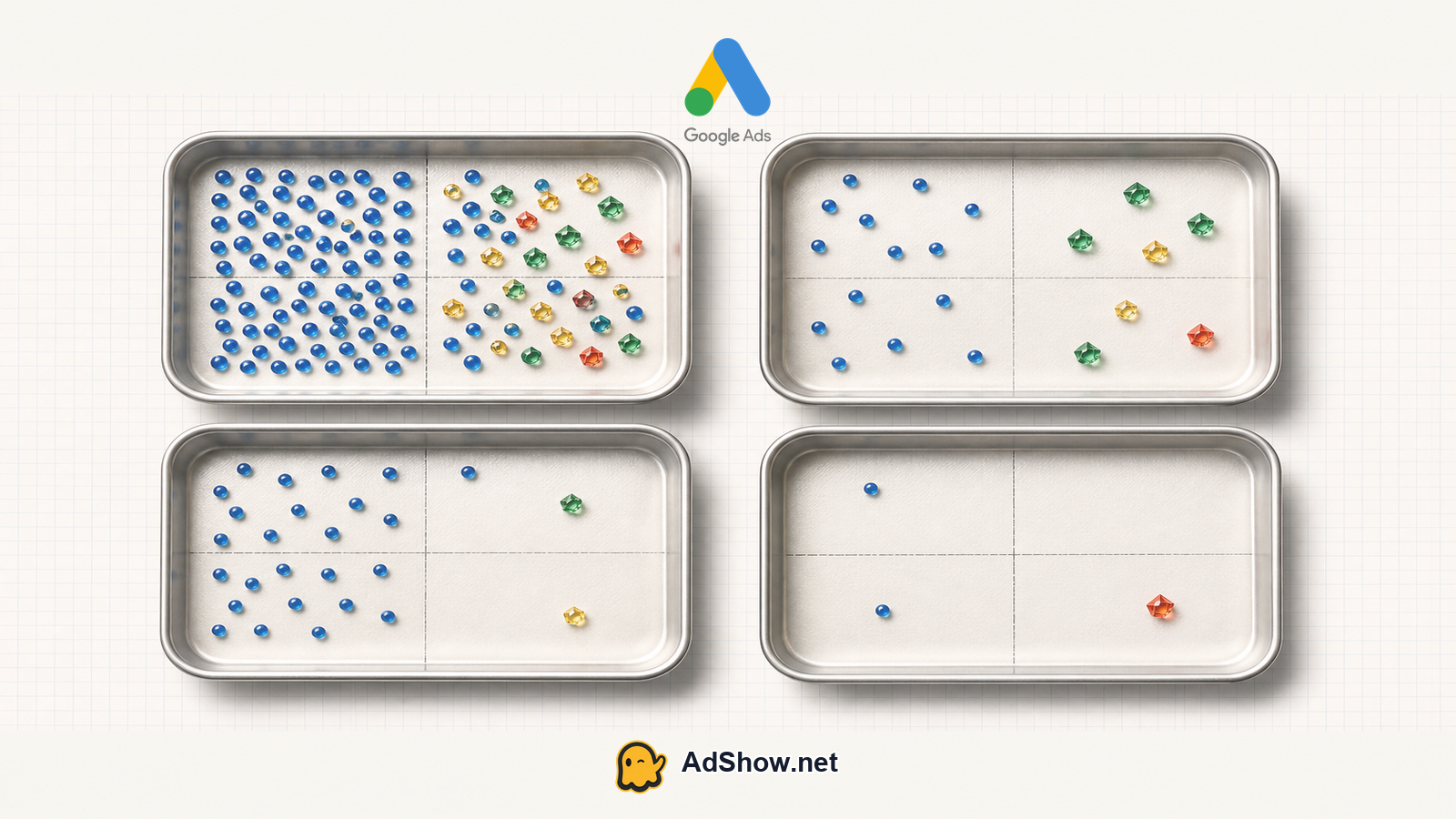
Use four CTR and conversion quadrants
CTR becomes useful when paired with conversion rate, lead quality, revenue or another business outcome. Diagnose the account in four broad quadrants:
High CTR / high conversion: This is the healthy pattern. Check cost per qualified conversion, conversion value and impression share. If economics are sound, protect the message and consider whether lost eligible traffic is worth pursuing.
High CTR / low conversion: The ad is winning attention, but the click may be poorly qualified or the landing experience may be weak. Inspect search terms, match type, targeting, offer language, form friction, tracking and the gap between headline promise and page content. The consequence can be wasted spend despite an impressive dashboard CTR.
Low CTR / high conversion: Do not automatically rewrite the campaign. The traffic that does click may be valuable. Check ad position, impression share, device mix, query volume and whether the offer is specific enough. A controlled relevance or coverage test may increase scale, but protecting conversion quality comes first.
Low CTR / low conversion: Treat this as a broader diagnosis. Review query-to-ad relevance, search terms, targeting, landing-page experience, offer strength, tracking and auction competitiveness. Continuing to buy the same traffic without identifying the constraint usually compounds inefficiency.
What moves CTR up or down
Brand and non-brand intent are the first major split. Someone searching for your company name is closer to a known destination than someone searching for a broad service. Match type also matters, but the label alone is not enough: inspect the actual search-term report and connect it to a deliberate Google Ads keyword strategy. Broad matching, close variants and automated expansion can introduce useful demand or dilute intent, depending on signals, controls and the offer.
Ad position affects visibility and click propensity, but position is not a standalone quality verdict. Compare impression share, top-of-page or absolute-top exposure where relevant, auction changes and competitor pressure. Segment by device and geography as well. A mobile user in one region may respond to a call-focused offer, while a desktop user elsewhere may need detailed proof or pricing information.
Offer specificity often matters more than cosmetic copy changes. “Fast emergency roof repair in Leeds” gives a different reason to click than “Roofing services.” Make one message variable explicit—such as location, urgency, price framing, service type or proof—then evaluate qualified outcomes rather than CTR alone.
Two recent questions, handled carefully
A July 2026 Reddit post described a sudden CTR drop while impressions roughly doubled and clicks stayed comparatively steady. That is an account-specific anecdote, not a platform-wide benchmark. Its diagnostic value is the pattern: first check whether query coverage, match behavior, placements, campaign settings or auction conditions expanded the denominator before concluding that the ad itself deteriorated.
An August 2026 small-business Reddit question asked for a universal “good CTR.” It is also anecdotal and too context-light to establish a target. The question reflects a common reporting problem: a percentage is easy to compare, but the business consequence depends on intent, conversion quality, value and cost. Use community posts for vocabulary and concerns, not as official evidence.
A practical CTR audit sequence
Segment by network, campaign type, brand versus non-brand, device, geography and major intent group. Do not diagnose a blended account average first.
Inspect search terms and placement data. Look for expansion into weaker queries, irrelevant themes, low-value locations or inventory that changed the impression mix.
Compare conversion quality and value, not only conversion count. Separate qualified leads, sales, repeat value and revenue where the business can measure them.
Review impression share, auction insights and recent setting or budget changes. A CTR shift may reflect who saw the ad, where it appeared or how much eligible demand was entered.
Test one message variable at a time. Match the ad to the query and landing page, then record both CTR and downstream quality.
Wait for adequate data before judging the change. Avoid reacting to a handful of clicks, a short learning period or a major traffic-mix change as though it were a stable trend.
This sequence also prevents a common mistake: changing ads before checking whether the impression pool changed. If impressions rise because targeting expanded, a lower blended CTR may be acceptable when qualified conversion volume and value improve. If Google Ads gets clicks but no qualified leads, the “better” CTR is not better for the business.
CTR, Quality Score and Ad Rank
CTR does not directly set CPC. In Google’s auction, historical and predicted interaction signals contribute to expected CTR, which is one component considered in Ad Rank alongside factors such as ad relevance, landing-page experience, bid and auction context. Google’s Quality Score reporting is a diagnostic aid built around expected CTR, ad relevance and landing-page experience; it is not a substitute for profitability analysis.
That distinction matters operationally. Improving relevance may help expected CTR and auction performance, but chasing clicks with a broad promise can lower conversion quality. Read CTR beside cost per qualified conversion, conversion value, impression share and the actual search terms that generated demand.
Harris Eugene’s operator note: Harris Eugene’s operator view: the best CTR is not the highest percentage. It is the highest rate the business can buy without diluting intent and downstream value. In practice, that means accepting a lower CTR when it filters out weak clicks, and pursuing a higher one only when the added traffic remains qualified and economically useful.
Where AdShow fits
AdShow provides a self-service route to agency advertising accounts, including Google Ads, with dashboard access to current offers and pricing, account requests, wallet funding or top-ups and issue reports. Telegram may provide notifications and human guidance. Agency access does not improve CTR by itself and does not change auction economics, tracking, creative quality, offer strength or funnel performance. Those remain the advertiser’s responsibility and are subject to Google’s policies.
If you need an agency-account route for Google Ads, review the available AdShow options and then evaluate performance using the network, intent and conversion-quality checks above. Google Ads agency accounts
Questions from recent advertiser discussions
Is 6.66% a good CTR for Google Ads?
It is a 2025 cross-industry Search reference from LocaliQ/WordStream’s analysis of more than 16,000 campaigns, not a target or guarantee. Compare your rate with similar network, intent, industry and campaign segments.
Should brand and non-brand CTR have the same target?
No. Brand queries usually express stronger existing intent, while non-brand queries vary from research to urgent purchase demand. Report them separately before setting expectations.
Can a high CTR still mean a campaign is failing?
Yes. High CTR with low qualified conversion rate, weak lead quality or poor conversion value can indicate misleading messaging, weak targeting, an unsuitable offer or a landing-page problem.
How long should I wait before changing an ad because of CTR?
Wait until the segment has adequate impressions, clicks and conversion data for a meaningful comparison. Also check whether query mix, placements, budget, device or auction conditions changed before editing the ad.
Sources and scope
Official documentation defines platform behavior. Recent community discussions are used only to illustrate reported symptoms and questions; they do not prove the cause of an individual account outcome.
Google Ads: CTR definition — Official definition, formula and statement that a good CTR is relative to the offer and network.
Google Ads: Quality Score components — Official context for expected CTR, ad relevance and landing-page experience as diagnostic components.
Google Ads: how the auction works — Official auction context for Ad Rank and why CTR should not be interpreted in isolation.
LocaliQ 2025 search advertising benchmarks — Primary benchmark analysis of thousands of Google and Microsoft search campaigns; the 6.66% cross-industry average is context, not a target.
LocaliQ benchmark methodology and report — Report scope covering more than 16,000 campaigns across 23 industries.
Recent discussion: sudden CTR drop — July 2026 account-specific report where impressions expanded while clicks stayed steady; anecdotal but useful diagnostic vocabulary.
Recent question: what is a good CTR — August 2026 small-business question illustrating demand for a universal CTR target; anecdotal and too context-light to set a benchmark.