Buy Google Ad Account With Lower Suspension Risk? 12 Checks Before You Pay
Want to buy a Google ad account with lower suspension risk? Check ownership, verification, billing, balance, provider terms and 12 red flags before paying.

August 12, 2026
Table of contents
Short answer: buying access to a Google Ads account does not make an advertiser immune to suspension. The safer purchase is not the oldest, most expensive or most aggressively marketed account. It is an agency-account arrangement with clear ownership, legitimate business access, compatible billing, documented balance handling and a provider that reviews the website and campaign before launch.
If a seller promises a “no suspension,” “bulletproof,” “fully warmed” or “zero-risk” Google Ads account, treat the promise as a risk signal—not a product feature.
The account itself is only one dependency. Business identity, payment details, website behavior, campaign policy and provider operations all affect continuity.
Need a Google Agency Ad Account Without Running Everything Through Chat?
AdShow provides self-service Google agency ad accounts for media buyers who want a stronger operational setup from the beginning. Through the AdShow dashboard, users can view market pricing, request an account, submit top-ups, monitor account operations and report a suspension without rebuilding the entire transaction history from Telegram or WhatsApp messages.
The platform also sends Telegram notifications when a top-up is completed, giving buyers a visible workflow for account delivery and funding. Explore the current account options and pricing on the AdShow Google agency ad account page.
A Google agency account can improve provisioning, funding visibility and support. It does not exempt an advertiser, website or campaign from Google Ads policies.
Why people search “buy Google ad account”
Most buyers are not looking for another login screen. They are trying to solve an operational problem:
A new Google Ads account was suspended during or shortly after setup.
Advertiser verification failed because business, identity and payment details did not align.
A campaign is eligible but spending is restricted or not delivering.
The advertiser needs accounts for multiple clients, markets or business units.
The team wants predictable top-ups, invoices, reporting and replacement procedures.
The buyer fears losing campaign momentum or money after a suspension.
That last fear drives much of the market. It also makes buyers vulnerable to sellers who attach words such as verified, aged, unlimited and low risk to an account without explaining what those labels actually guarantee.
Can a purchased Google Ads account really have lower suspension risk?
It can provide a cleaner operating framework, but it cannot override Google Ads policy. An agency relationship may improve onboarding, billing coordination, account provisioning and support. It does not make a non-compliant offer, misleading website, inconsistent advertiser identity or prohibited campaign acceptable.
Google states that it may evaluate the advertiser, ads, website, payment information, linked accounts and verification data. Its current circumventing systems guidance also warns against creating additional accounts to evade an unresolved suspension.
Practical rule: an account can reduce operational friction; it cannot erase the history or policy condition of the advertiser behind it.
First decide what “buying an account” means
The phrase is used for very different products. Ask the seller to classify the offer before discussing price.
1. Purchased login credentials
You receive an email address, password or an existing Google identity. This creates major ownership and recovery risk. The original creator may retain recovery methods, and the identity, business information or payment history may have no legitimate connection to you.
2. Aged or previously spent account
The seller markets account age or historical spend as proof of trust. Age alone does not make a new advertiser, website, payment profile or campaign compliant. A sudden change in business identity, country, domain or offer can create more inconsistency—not less.
3. Agency-managed access
An agency or provider grants your business access to an account provisioned through its operating relationship. This can offer a more structured workflow, but the buyer still needs written answers about permissions, billing, verification, balance, suspension reporting and offboarding.
4. A new account created for your real business
The account is provisioned for the advertiser using genuine business details and a reviewed destination. This is usually easier to defend operationally than inheriting an unrelated identity—provided the setup is accurate and the underlying business is eligible.
The 12 checks that matter before paying
1. Confirm the access model
Will your Google user be invited, or will the provider send credentials belonging to someone else? Prefer permission-based access with named users. Do not build a business around a login the seller can silently recover.
2. Identify the real account owner
Ask who controls the account at the provider level, who can remove users and what happens when the service ends. “You have admin access” is incomplete if another party retains superior control.
3. Map the advertiser identity before verification
Write down the legal business, trading name, website owner, person submitting documents and payer. Google advises advertisers to keep verification information current and consistent with submitted documents. False information can lead to suspension.
4. Check country and payment-profile compatibility
Country, billing address, payment profile and registration documents should tell one coherent story. A cheap account in an unrelated jurisdiction can become expensive when verification begins.
5. Ask whether the destination has been reviewed
A useful provider should ask what you advertise and where the click goes. Review the offer, claims, company details, checkout, privacy pages, redirects, tracking templates and mobile behavior. An account delivered without looking at the destination is not meaningful risk control.
6. Check for unresolved account relationships
If the same business or domain has a suspended account, opening another account may be interpreted as evasion. Google recommends resolving suspensions and explaining legitimate multiple-account structures. A provider cannot safely “wash” the same unresolved advertiser through a new account.
7. Understand where your money sits
Separate provider-wallet balance, requested top-up, credited Google Ads balance, spent media and refundable funds. Ask what each number means, when it updates and what records are available.
8. Read the suspension and replacement terms
Does “replacement” apply to every suspension, only provider-side incidents or only eligible policy-compliant advertisers? Does replacement include the old balance? Is appeal support included? Get the conditions before funding—not after delivery stops.
9. Check the top-up workflow and real fee
Do not rely on a headline percentage. Confirm the account fee, top-up fee, exchange-rate spread, payment-processing charge, minimum funding level, withdrawal fee and subscription cost. The lowest advertised fee is not always the lowest total cost.
10. Test the support path
Ask one specific pre-sale question about verification or balance handling. The quality and precision of the answer is evidence. A seller who only replies “safe account, no worry” has not demonstrated a suspension workflow.
11. Verify the audit trail
You should be able to see account requests, top-ups, status changes and support cases. Operations conducted entirely through disappearing chat messages are difficult to reconcile when several accounts or team members are involved.
12. Define a compliant exit
Ask how access is removed, how remaining eligible funds are handled, which reports can be exported and what happens to campaigns and conversion assets. A purchase is incomplete without an offboarding answer.
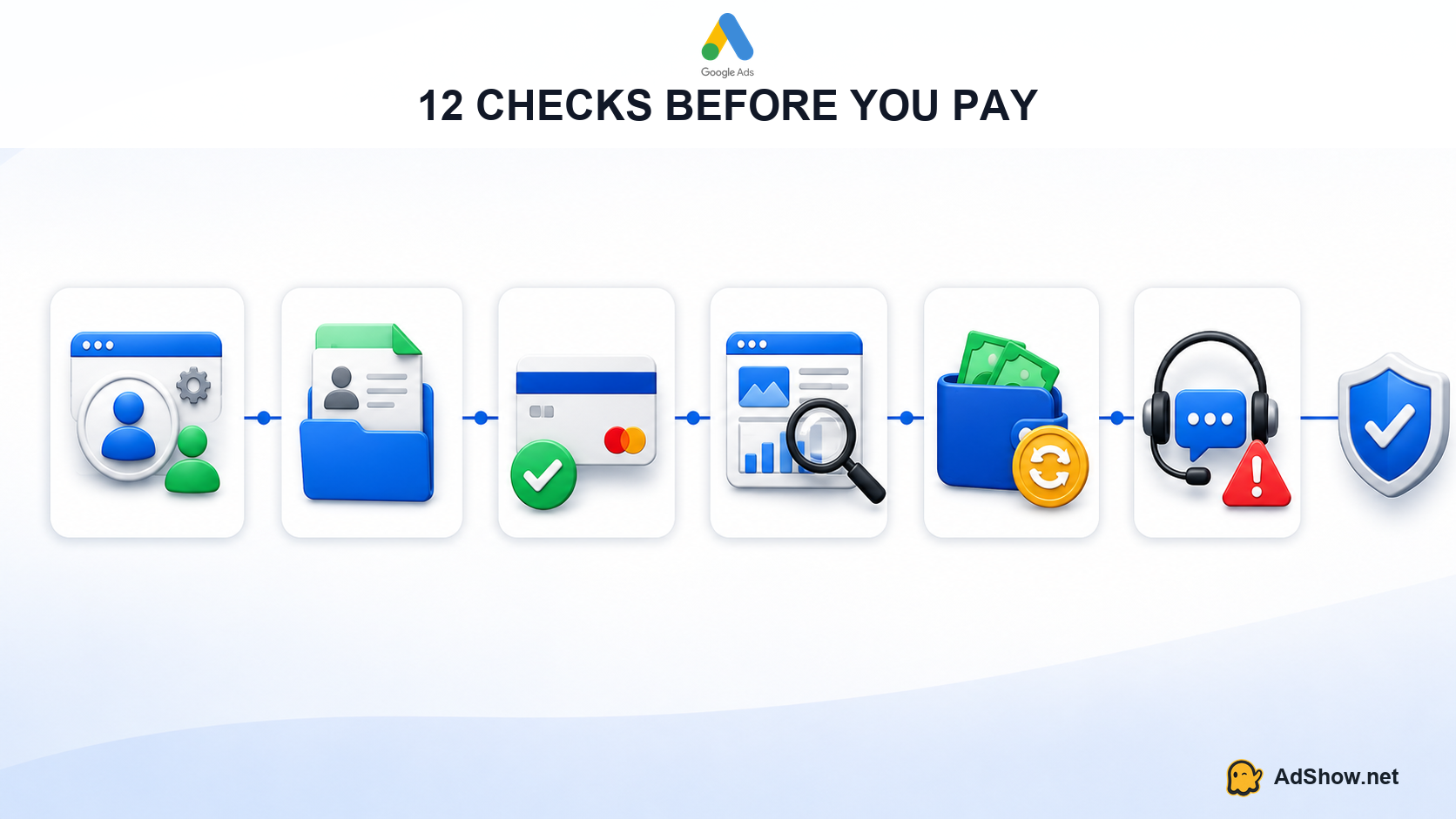
Before funding, verify access, advertiser identity, payment consistency, destination quality, balance records and the provider’s suspension workflow.
What “low suspension risk” should mean in practice
A credible lower-risk process is a collection of controls:
The advertiser and payer are identifiable.
The website represents the real business and matches the ad.
Verification documents are genuine and internally consistent.
Previous suspensions are investigated rather than hidden.
Campaign claims and restricted categories are reviewed before launch.
User permissions are granted instead of transferring questionable identities.
Funding and balance records remain visible.
Suspension reporting and escalation have a defined workflow.
It should never mean “Google cannot suspend this account.” Google controls enforcement, and even established accounts may be restricted or suspended when it identifies policy, verification, billing or security concerns.
Red flags in Google Ads account listings
“100% no suspension”: no seller controls Google's enforcement.
“Create a new account after every ban”: this may aggravate a circumventing-systems problem.
“No verification ever”: Google says all advertisers will eventually be required to complete advertiser verification.
“Aged means trusted”: historical age does not validate a new business or destination.
“Unlimited spend from day one”: ask for the exact account and campaign constraints rather than accepting a slogan.
“Pay only in crypto, no invoice, chat only”: the operating trail may be weak if a balance dispute occurs.
“Use our documents”: submitting false information during advertiser verification can result in suspension.
Why a new account can still be suspended immediately
Recent advertiser reports repeatedly show that “new” does not mean “clean.” A May 2026 r/PPC discussion described a suspension connected to advertiser verification and concern that a new account could be linked to the unresolved advertiser. Another discussion from August 2026 asked about starting again after a project was banned; participants warned that reusing the same destination and business signals could reproduce the problem.
These posts are individual experiences, not proof of Google's detection methods or a universal outcome. The reliable principle comes from Google's published policy: creating additional accounts to get around an unresolved suspension is not allowed.
If your real problem is already a suspension, use a root-cause workflow before buying anything. AdShow's guide on what to do when a Google Ads account is suspended explains the initial evidence and appeal sequence. For the policy most frequently misunderstood by repeat-account buyers, read the circumventing systems suspension guide.
Purchased credentials vs self-service agency access
Purchased credentials optimize for immediate possession. Self-service agency access should optimize for ongoing operations. For a serious media buyer, the important events happen after delivery: requesting the account, funding it, adding users, monitoring balance, reporting suspension, reviewing status and reconciling funds.
AdShow puts those operations in a dashboard with visible market pricing rather than requiring the buyer to manage the entire lifecycle through chat. AdShow provides account requests, top-up workflows, suspension reporting and Telegram top-up notifications. The underlying campaigns must still comply with Google Ads policies.
If you are comparing the market rather than choosing immediately, the separate Google Ads agency account provider investigation evaluates provider onboarding, documentation, dashboard access, pricing visibility and support models. Keeping that comparison separate prevents this buyer guide from becoming a disguised ranking page.
A safer order of operations
Document the real business, payer, website owner and account users.
Audit any previous Google Ads suspensions or unpaid balances.
Review the destination, offer, tracking and policy-sensitive claims.
Compare providers using the 12 checks above.
Obtain written pricing, funding, refund and suspension terms.
Request the account using consistent business information.
Complete advertiser verification honestly when requested.
Launch a controlled first campaign instead of changing every variable at once.
Record every top-up, status change and support case.
For pre-launch prevention, AdShow's report on 10 mistakes that can suspend a Google Ads account is a useful companion checklist.
Questions collected from recent advertiser discussions
These questions summarize recurring concerns in recent PPC discussions and Google Ads support material. Public posts describe individual cases; Google alone determines the status of a specific advertiser and account.
Where can I buy a Google ad account with low suspension risk?
Choose a provider that offers permission-based agency access, transparent pricing, visible funding records, destination review and documented suspension handling. No provider can guarantee that Google will never suspend an account.
Is an aged Google Ads account safer than a new account?
Not automatically. Account age cannot compensate for inconsistent ownership, a new unrelated business, mismatched payment details, a problematic destination or policy violations.
Can I buy another account after Google Ads suspends me?
Buying another account does not resolve the original cause. Google prohibits creating additional accounts to evade an unresolved suspension. Investigate and appeal the original enforcement before launching the same advertiser elsewhere.
Does a Google agency ad account avoid advertiser verification?
No universal exemption exists. Google may require verification based on the advertiser, billing setup, behavior, industry and other factors. Submit genuine and consistent information whenever verification is requested.
What happens to my balance if the account is suspended?
It depends on where the funds are recorded, the account status, platform decisions and the provider's written terms. Distinguish provider-wallet funds, pending top-ups, credited media balance and already-spent funds before paying.
Final verdict
Do not buy the account with the strongest “no ban” claim. Buy the operating arrangement you can verify. Clear permissions, consistent identity, reviewed destinations, transparent money movement and documented suspension support are more valuable than age, screenshots of historical spend or an unverifiable promise of immunity.
The account is infrastructure. Lower suspension risk comes from the advertiser, website, payment profile, campaigns and provider workflow telling the same legitimate story.