What Is Google Ads? How the Auction Actually Works
Google Ads is paid access to auctions across Google inventory—not guaranteed traffic or leads. Here is how one search becomes an ad, click, conversion and charge.

August 27, 2026
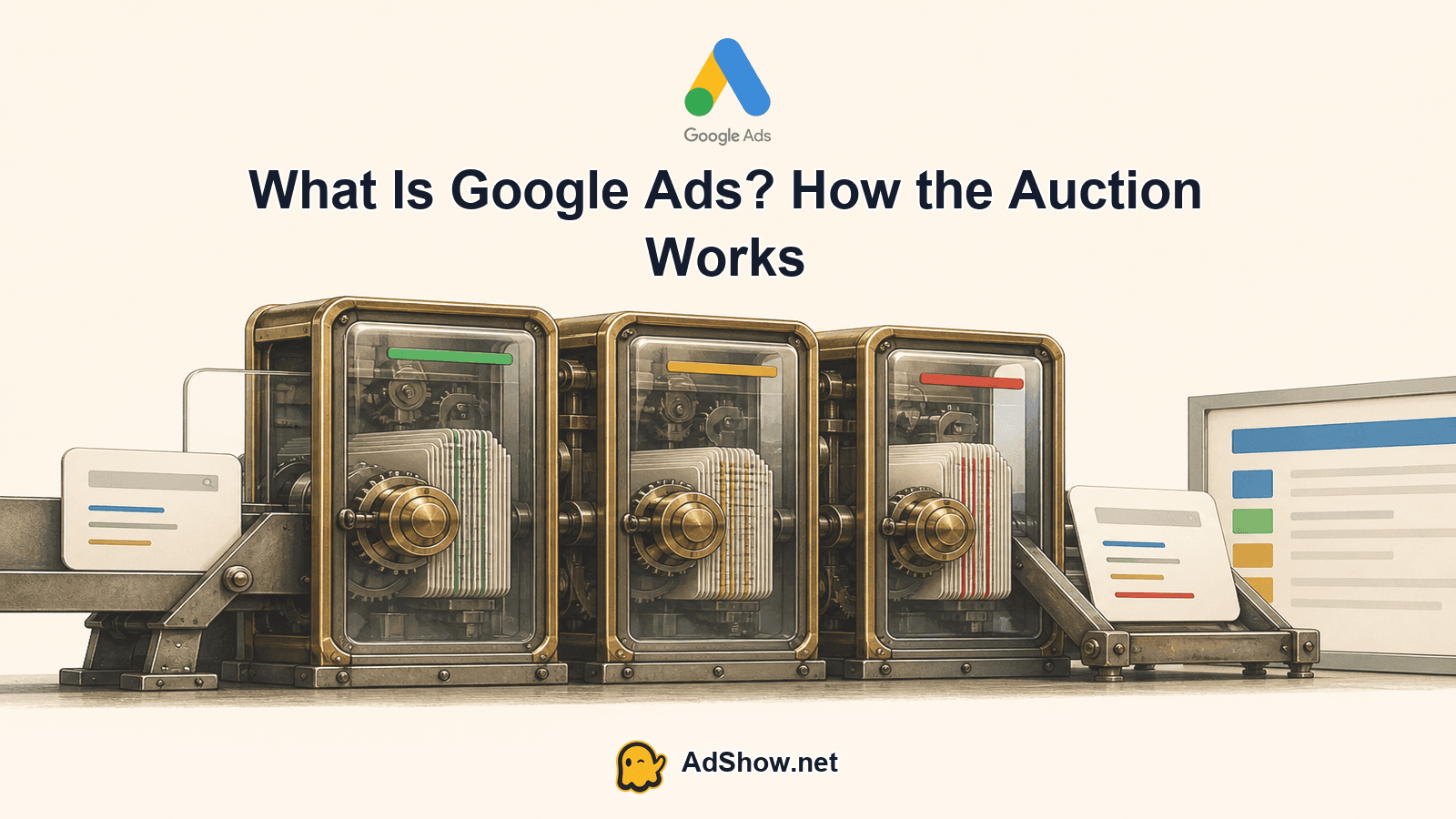
Table of contents
Google Ads is Google’s paid advertising system. In plain English, an advertiser pays to enter auctions for opportunities across Google inventory, such as search results, Shopping placements, YouTube and partner surfaces. That payment buys access to an auction; it does not buy guaranteed traffic, clicks, leads or sales. To see what Google Ads actually does, follow one search query from the moment a person types it to the moment an advertiser is billed.
1. The query starts the process
Suppose someone searches for “emergency boiler repair near me.” Google first interprets the query and its context. The system may consider the words, spelling, location, device, time, language and other signals relevant to the search. It then checks which eligible keywords and campaigns could match that query. A keyword is not a reservation for a fixed position. It is one of the advertiser’s inputs into a matching system.
Google’s current matching process can use more than literal word repetition. Keyword match type, meaning, landing-page content and the wider context can affect eligibility. The practical consequence is that a keyword can be technically present in an account while the ad still does not enter a particular auction. Advertisers should inspect the actual search terms and the keyword or campaign that received the match, rather than assuming that a keyword list predicts every impression. Google describes this sequence in its documentation on how keyword matching works.
2. Eligibility comes before ranking
Before ranking ads, Google filters out options that cannot participate. Checks can include campaign status, budget availability, bid settings, targeting, keyword and ad relevance, landing-page quality, policy approval and the search context. An ad can therefore fail to show without losing an auction to a competitor. It may not be eligible in the first place.
Policy or approval limits can prevent an ad, asset or destination from serving.
Targeting can exclude the search because of location, language, schedule, audience or device settings.
A low budget or bid may restrict delivery, especially where competition is strong.
Poor relevance or a weak landing page can reduce eligibility, expected performance or both.
Ad previews and isolated searches are not reliable proof of normal delivery; use campaign diagnostics and reporting.
Google’s guidance on why an ad may not show lists budget, bid, relevance, competition and policy as common delivery constraints. This is where diagnosis should begin: was the ad eligible for the query, or did it reach the auction and lose?
3. Google assembles the ad and calculates Ad Rank
For a responsive search ad, Google can assemble a combination of the headlines and descriptions supplied by the advertiser. The system chooses an eligible combination for that auction, subject to the assets, pinning and other settings in the ad. This means the final message shown to the user may be one of several valid combinations, not a single permanently fixed advert.
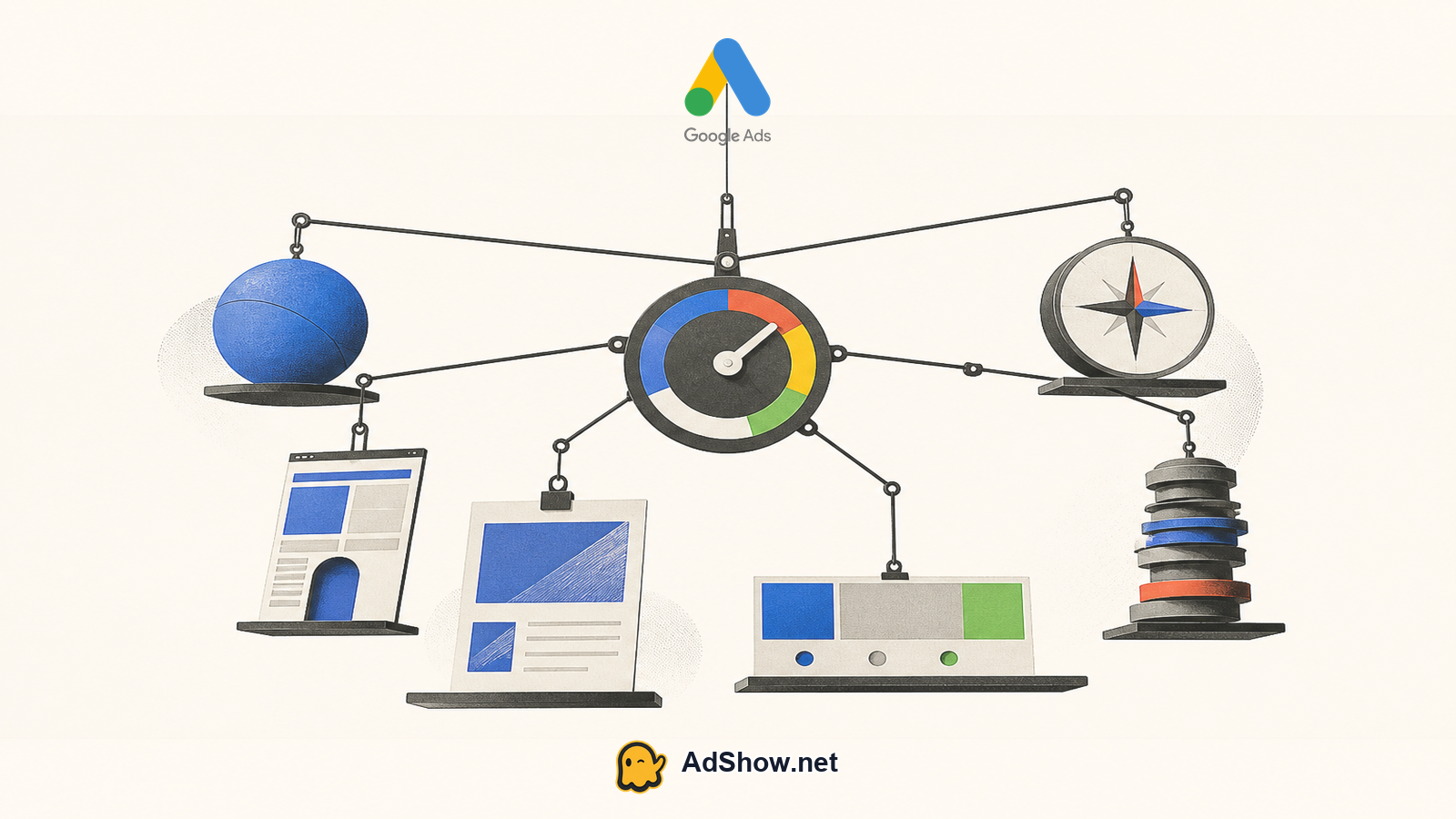
Google then calculates Ad Rank to determine whether an ad can appear and where it may appear. Ad Rank is not simply the advertiser’s maximum bid. Google identifies bid, ad and landing-page quality, the expected effect of assets, thresholds, competition and the context of the search as relevant factors. Its Ad Rank documentation explains why two advertisers with similar bids can receive different outcomes.
Quality is not a single promise of cheap clicks. It includes factors such as expected click-through rate, ad relevance and landing-page experience. Assets can make an ad more useful and may affect its ability to compete. Thresholds can also matter: an ad may need to meet a minimum standard to show in a position, regardless of how much the advertiser is willing to bid.
4. The auction decides the opportunity, not the sale
An auction runs for each eligible search opportunity. Google compares the Ad Rank of eligible ads and decides whether they can show, which positions are available and which ad receives each position. The highest bid does not automatically win because bid is only one input. A lower bid paired with stronger relevance, a better destination and stronger expected user response can outrank a higher bid with weaker quality. The result also depends on the search context and the competition present at that moment.
Consider this illustrative example, not a representation of Google’s published scoring formula. Three eligible advertisers enter one search auction:
Advertiser A: maximum bid of $6.00, estimated quality factor 5, illustrative Ad Rank 30.
Advertiser B: maximum bid of $4.00, estimated quality factor 9, illustrative Ad Rank 36.
Advertiser C: maximum bid of $3.00, estimated quality factor 7, illustrative Ad Rank 21.
In this simplified illustration, B can rank above A despite bidding less because its combined auction inputs are stronger. The actual amount charged is also not necessarily the maximum bid. In a cost-per-click setup, an advertiser generally pays when someone clicks, and the amount can be below the maximum bid. The exact outcome depends on the auction, settings and billing arrangement; a bid is a ceiling or strategy input, not a guaranteed price.
5. The click is only the next measurement point
If the user chooses the ad, Google records a click and sends the visitor to the configured landing page. The advertiser may then be charged under the campaign’s charging model and account billing setup. A click proves that the ad won enough visibility to attract a visit. It does not prove that the visitor contacted the business, bought anything or generated profit.
Check the search term that triggered the ad and whether it reflects genuine intent.
Check the landing page for message match, speed, mobile usability, availability and a clear next action.
Check that the conversion action fires once, on the intended event, and is assigned to the right campaign.
Separate reported conversions from qualified leads, completed sales and revenue in the business system.
Compare cost per qualified outcome or profit contribution with CPC; use CPC as a diagnostic, not the final business metric.
Conversion measurement can use Google Ads tags, imported analytics events, calls, forms, purchases or other configured actions. The platform can optimize toward the signal it receives, so a duplicated, delayed or low-quality conversion event can steer automation in the wrong direction. The path from query to conversion must be checked end to end.
Harris Eugene’s operator note: **Harris Eugene operator note: A sound campaign diagnosis starts with the query and follows the conversion path. CPC alone cannot tell you whether the problem is poor intent, weak ad-to-page continuity, broken tracking, unqualified leads or an uneconomic offer. If clicks are rising but qualified outcomes are not, changing bids before checking search terms, landing pages and conversion integrity can hide the real constraint.**
6. The formats reach different user moments
Google Ads is a platform spanning several inventories, but the useful distinction is the user moment each one reaches:
Search reaches a person actively expressing intent through a query. It is often the clearest route from a stated problem to a commercial offer.
Shopping reaches users comparing products, prices and merchants through product-led results.
Display reaches people while they browse websites and apps, usually before they have stated the same intent in a search.
YouTube reaches people while they watch or discover video, where attention and demand may need to be created or shaped.
Performance Max uses automation across eligible Google inventory to pursue the advertiser’s selected goal, with the system deciding more of the placement mix.
These are not interchangeable traffic sources. The same offer, creative and conversion event can behave differently depending on whether the user is searching now, comparing products, consuming content or being re-engaged. Google Ads keyword strategy is most directly relevant to Search; other campaigns require their own audience, asset and measurement decisions.
7. What the advertiser controls—and what Google decides
Advertisers control the business inputs: campaign objective, budget, bid strategy, locations, schedules, audiences where available, keywords or product data, ad assets, landing pages, exclusions, conversion definitions and account-level payment arrangements. They also control the offer itself. If the price, availability, margin or follow-up process is weak, better auction mechanics cannot make the economics work.
Google decides or automates much of the delivery: query interpretation, matching, ad combination, auction participation, Ad Rank, placement, pacing and—in automated campaigns—how available inventory and signals are used toward the selected goal. The boundary is a current source of advertiser concern; a June 2026 Reddit discussion about increasing automation is anecdotal evidence of that concern, not documentation of how the platform works.
This division explains why a campaign can feel less manually predictable without being uncontrolled. The advertiser sets the inputs and constraints. Google makes auction and delivery decisions inside them. Review recommendations, search terms, asset performance, change history, diagnostics and conversion quality before assuming that more automation or more manual settings will solve the issue.
8. What an agency account changes
An agency advertising account changes access and operations, not the underlying Google Ads auction. Depending on the provider and arrangement, it may give an operator a different account setup, a managed funding route, dashboard-based requests and issue reporting, and operational guidance. AdShow provides self-service access to agency advertising accounts, with visible offers and pricing, account requests, wallet funding or top-ups and issue reports; Telegram can provide notifications and human guidance. Details should be checked for the specific offer and platform.
An agency account does not change Google’s policy standards, eligibility checks, Ad Rank inputs, conversion-tracking requirements or the profitability of an offer. It does not guarantee approval, delivery, lower CPCs, leads or protection from account-level decisions. The operator still needs compliant ads, a functioning destination, reliable measurement and viable unit economics. See Google agency ad account vs individual for the operational distinction.
9. The practical definition
So, what is Google Ads? It is a paid auction system that matches advertiser inputs with user moments across Google inventory. A query or audience signal creates an opportunity; eligibility determines who can compete; ad assembly and Ad Rank shape the result; the auction determines visibility; the click creates a visit; conversion tracking records the chosen outcome; and billing applies according to the campaign and account setup. The advertiser pays for access to that process—not for a guaranteed business result.
For hands-on operators, the reliable workflow is to inspect the chain in order: query, eligibility, ad, landing page, auction metrics, click quality, conversion event and business outcome. That sequence is more useful than treating CPC, impressions or platform recommendations as a complete diagnosis. If the account is getting clicks but no leads, use the full path rather than assuming the auction is the only problem: Google Ads getting clicks but no leads.
If you need a Google Ads agency account for operational access and funding workflows, review the available setup and account-request options before launching. Explore Google Ads agency accounts
Questions from recent advertiser discussions
Does the highest Google Ads bid always win?
No. Bid is one Ad Rank input. Ad and landing-page quality, assets, thresholds, competition and the search context can allow a lower bid to outrank a higher one.
Do Google Ads guarantee clicks or leads?
No. Google Ads provides access to eligible auctions. Delivery, clicks and conversions depend on eligibility, competition, relevance, the offer, the landing page and measurement.
Why can an approved Google ad stop showing?
Budget, bid settings, targeting, changing competition, search context, relevance, policy status or other eligibility conditions can limit delivery. Check diagnostics and reporting rather than relying on a manual search.
Does a Google Ads agency account improve Ad Rank?
No. An agency account can change access, funding and operational workflows, but it does not change Google’s policy standards, auction ranking, conversion tracking or offer economics.
Sources and scope
Official documentation defines platform behavior. Recent community discussions are used only to illustrate reported symptoms and questions; they do not prove the cause of an individual account outcome.
Google Ads: how keyword matching works — Official sequence covering query interpretation, keyword eligibility, responsive-ad assembly, bids, Ad Rank and the auction.
Google Ads: how the ad auction works — Official explanation that an auction runs for each eligible search and uses Ad Rank to determine whether and where ads appear.
Google Ads: factors that determine Ad Rank — Official description of bid, ad and landing-page quality, assets, thresholds, search context and competition.
Google Ads: why an ad may not show — Official guidance on budget, bid, relevance, competition and policy eligibility as possible delivery constraints.
Recent advertiser discussion: increasing automation — June 2026 discussion illustrating advertisers' concern about the boundary between their controls and Google's automation; anecdotal, not platform documentation.