Banner Ads Get Impressions but No Clicks? Fix These 7 Creative Problems
Banner ads can generate plenty of impressions and still receive almost no clicks when the problem is creative clarity, visibility, message match, or measurement. Use this seven-check diagnosis before changing bids, targeting, account settings, or launching another version.

August 22, 2026
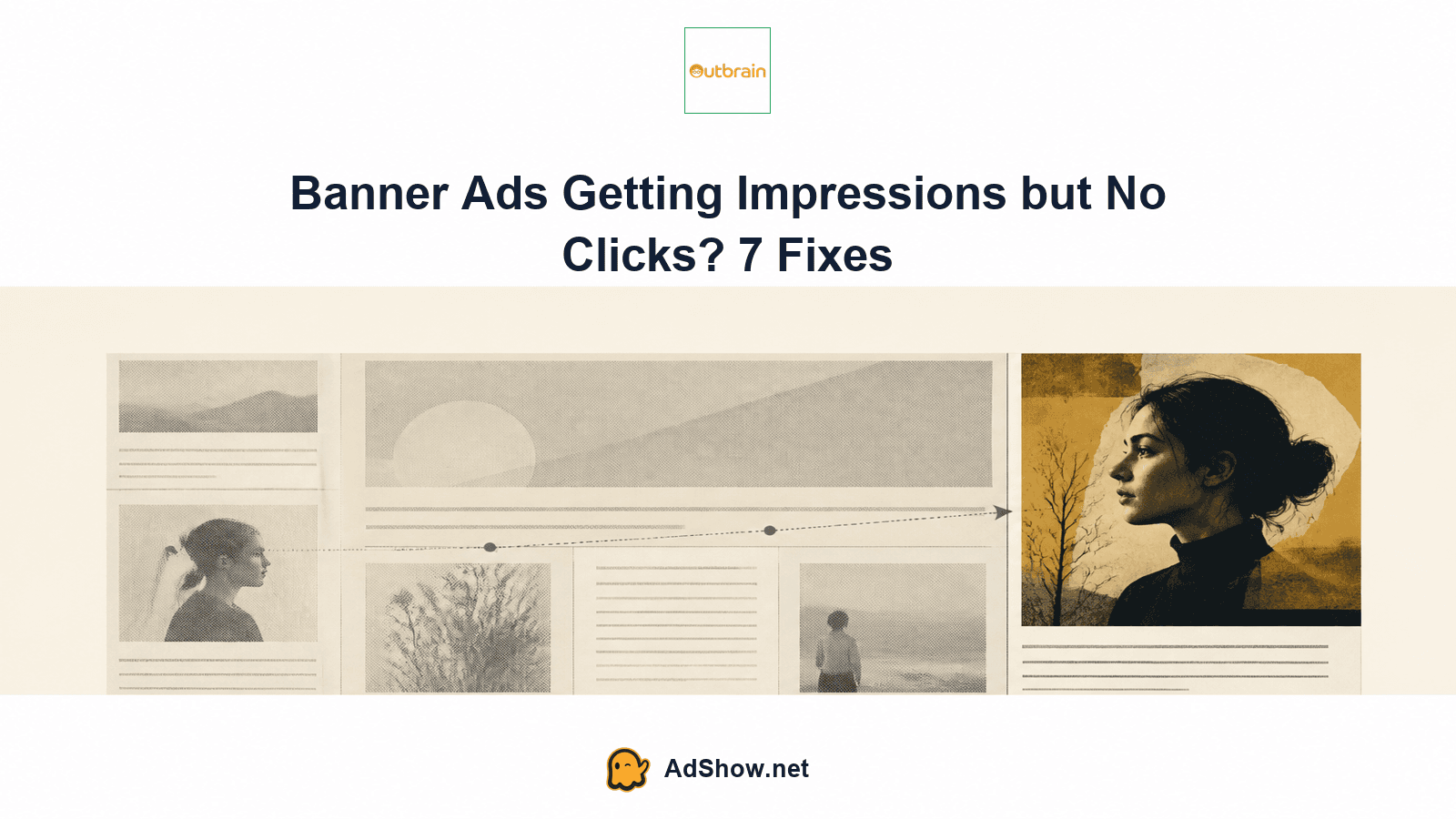
Table of contents
Banner Ads Get Impressions but No Clicks? Fix These 7 Creative Problems.
Start with the ad itself, not the bid. If impressions are arriving but clicks are missing, first confirm that the banner is visible, understandable, relevant to the audience, and technically clickable. A higher bid may buy more exposure, but it cannot repair a weak message, a hidden button, a misleading image, or broken tracking.
The fastest diagnosis: inspect the ad before changing delivery settings
Review the ad in the actual placements where it is being served. Do not judge only from the design file or the preview in the ad platform. Check the rendered version on mobile and desktop, where applicable, and inspect several sizes. Look for clipping, unreadable text, missing images, low contrast, slow-loading assets, and a CTA that is difficult to identify.
Then separate three different problems: no real interaction, interaction that is not recorded, and interaction that is recorded but reported differently from what you expect. Open the ad yourself using a controlled test, confirm that the intended landing page loads, and verify that the click URL contains the expected tracking parameters. Only after those checks should you decide whether the issue is creative performance or campaign configuration.
1. Check whether the ad is actually visible and legible
An impression does not guarantee that the user noticed the message. Inspect the first visual frame, text size, contrast, spacing, and hierarchy. Ask someone unfamiliar with the campaign to identify the product, offer, and next step in a few seconds. If they cannot, the banner is asking too much cognitive work from a low-attention placement.
Check that important text is not close to the edge or hidden by responsive cropping.
Confirm that the logo does not dominate the space while the offer becomes secondary.
Test the design against light and dark page backgrounds where the placement allows variation.
Remove decorative elements that compete with the headline or CTA.
For responsive formats, review every available combination rather than assuming the platform will preserve your preferred layout. Google Ads explains that responsive display ads combine supplied assets across formats, so asset variety and format suitability matter. A strong master design can still produce a weak rendered combination if the individual headlines, descriptions, images, or logos do not work independently.
2. Check whether one clear action is visible
A banner should make the desired action obvious. Inspect the CTA label, its contrast, its position, and the amount of surrounding space. “Learn more” may be appropriate for education, but it can be vague when the user is expected to compare plans, request a quote, download a guide, or start a trial. The wording should describe the next step without overstating what happens after the click.
Also check for competing clickable-looking elements. Multiple buttons, unrelated badges, and several different offers can dilute attention. If the banner promotes a discount, the CTA should support that message. If it promotes a guide, the action should signal access to the guide. Do not add urgency, price claims, or guarantees unless the landing page and offer genuinely support them.
3. Check message match between the banner and landing page
A user clicks when the promise is clear enough to justify leaving the current page. Compare the banner with the destination page line by line: audience, product, offer, pricing language, timing, and requested action. If the banner says “See business plans” but the landing page opens with a generic homepage, the creative may be creating uncertainty before the click.
Inspect the first screen of the landing page as part of the creative review. The same product name, benefit, and visual cue should appear quickly enough to confirm that the click was intentional. This is also where you can distinguish a true low-CTR problem from a reporting problem: if test clicks reach the correct page but the platform records none, investigate tags, redirects, consent behavior, and attribution settings before rebuilding the ad.
4. Check whether the image supports the headline
The image and headline should make sense together without forcing the user to reconcile two unrelated ideas. Outbrain’s creative guidance emphasizes honest image and headline combinations and engagement. Use that principle as a practical test: would a reasonable user interpret the visual and wording as one consistent claim?
Replace generic stock imagery when it does not explain the product or situation.
Avoid an attractive image that draws attention but provides no reason to click.
Check whether the subject is cropped out of key sizes or points away from the text and CTA.
Make sure product screenshots remain readable after compression and resizing.
Do not treat visual novelty as a substitute for relevance. A new color or image may increase noticeability while leaving the underlying reason to click unchanged. Compare concepts by the job they perform: demonstrate the product, show the outcome, identify the audience, explain the offer, or create a credible point of curiosity.
5. Check whether the creative fits the audience and placement
A banner can be well designed and still be wrong for the people seeing it. Inspect the context in which the impressions occur: device, placement type, content environment, geography, language, and stage of intent. A prospect encountering your brand for the first time may need a simple problem-and-benefit message, while a returning visitor may respond better to a specific product reminder.
Do not change targeting immediately to solve a message problem. First ask whether the current audience could understand the ad if it were shown clearly. If the answer is no, improve the audience-specific framing. For campaigns using time-sensitive demand, review delivery by hour and day before rewriting every asset. The native ads dayparting guide can help structure that review without treating dayparting as a replacement for creative diagnosis.
6. Check whether the creative has enough meaningful variation
One banner rarely answers every user’s reason for clicking. Review the asset set for genuine variation in angle, not just color changes. Useful variations may include a product demonstration, a customer problem, a concrete benefit, a comparison point, or a different objection. Keep the offer and destination consistent while testing one meaningful difference at a time where possible.
TikTok’s 2Q Creative Framework positions both creative quantity and quality as levers for CTR and conversions. The practical lesson is not to flood an account with random versions. It is to maintain enough distinct, usable concepts to learn which message works for which audience and placement. Record the concept, headline, visual treatment, CTA, format, and destination for each asset so performance data remains interpretable.
7. Check for fatigue, repetition, and stale offers
If clicks declined after the campaign initially ran, compare newer delivery with earlier delivery. Inspect frequency where the platform reports it, the age of the creative, repeated exposure to the same audience, and whether the offer is still timely. Fatigue is more likely when the same visual and opening claim have been shown repeatedly without a fresh reason to act.
Refresh the weakest element first instead of replacing everything at once. You might retain the proven landing page and audience while changing the opening image, or keep the visual while testing a clearer benefit. This preserves a reference point. If every variable changes together, a later improvement will not tell you which change helped.
Harris Eugene’s operator note: Operator note: Do not infer a creative failure from impressions and zero reported clicks until you have tested the rendered ad, the destination URL, and the reporting path. Platform previews, browser behavior, redirects, consent controls, and attribution windows can produce different observations. Document the test conditions and compare like with like before making a budget decision.
What to inspect before changing bids, targeting, or account setup
Render the ad in the main sizes, devices, and placements receiving impressions.
Confirm that the headline, image, offer, and CTA communicate one clear next step.
Open the destination from a controlled test and check redirects, load behavior, and tracking parameters.
Compare the banner promise with the first visible section of the landing page.
Break down delivery by placement, device, geography, audience segment, and time period where data is available.
Compare each creative concept separately rather than judging an asset group as one undifferentiated unit.
Only after these checks decide whether to change the creative, bid, targeting, budget, or account configuration.
If impressions are present but no clicks remain after the technical checks, the strongest next move is usually a controlled creative test: one clear audience problem, one credible benefit, one supporting visual, and one visible CTA. Keep the destination and measurement method stable. If the account is active but not spending at all, that is a different diagnosis from receiving impressions with no clicks; the Taboola account troubleshooting guide addresses that separate situation.
For buyers comparing managed account options, AdShow lists agency ad accounts for platforms including Outbrain and Taboola through its dashboard and marketplace. Account access does not replace creative testing, tracking validation, audience analysis, or platform review.
Frequently asked questions
Questions from recent advertiser discussions
Can a low click-through rate be caused by the bid?
A bid can affect delivery and impression opportunities, but it does not fix an unclear or invisible ad. First inspect rendering, message match, CTA visibility, placement context, and click tracking. Change the bid only after confirming that the ad is capable of earning a click and that clicks are being recorded correctly.
Should I pause a banner that has impressions but no clicks?
Do not pause it solely on the basis of a dashboard report before checking the rendered ad and test URL. If the ad is visibly broken, misleading, clipped, or technically unclickable, pause or replace it while investigating. If it is functioning, use a controlled creative variation and a defined review period rather than making many simultaneous changes.
How many banner variations should I test?
There is no universal number that guarantees a result. Build enough variations to test distinct messages, visuals, or objections while keeping the destination and measurement consistent. Label each concept clearly so you can identify whether performance changes are associated with the audience angle, image, headline, CTA, or format.
Does changing the ad account solve a no-click problem?
Not by itself. An account change may address an access or delivery issue, but it does not make a banner more relevant, visible, trustworthy, or measurable. Diagnose the creative and tracking path first, and treat account access as a separate operational consideration.
Sources and scope
Official documentation defines platform behavior. This is a practical diagnostic, not a promise of any account or campaign result.
Google Ads: responsive display ads — Google combines assets in responsive display ads; asset variety and format matter.
Outbrain: creative best practices — Official guidance discusses honest image/headline combinations and engagement.
TikTok 2Q Creative Framework — A recent TikTok playbook positions creative quantity and quality as CTR and conversion levers.