Buy Facebook Ad Account: Strong, Low-Ban Options—and What Those Claims Really Mean
a strong Facebook ad account is not an account that can never be banned. It is an operating setup with legitimate user access, clean business ownership, consistent payment information, portable Page and Pixel assets, visible funding records and support when a restriction occurs. “Low-ban” should describe the quality of that setup—not a promise that Meta enforcement no longer applies.

August 12, 2026
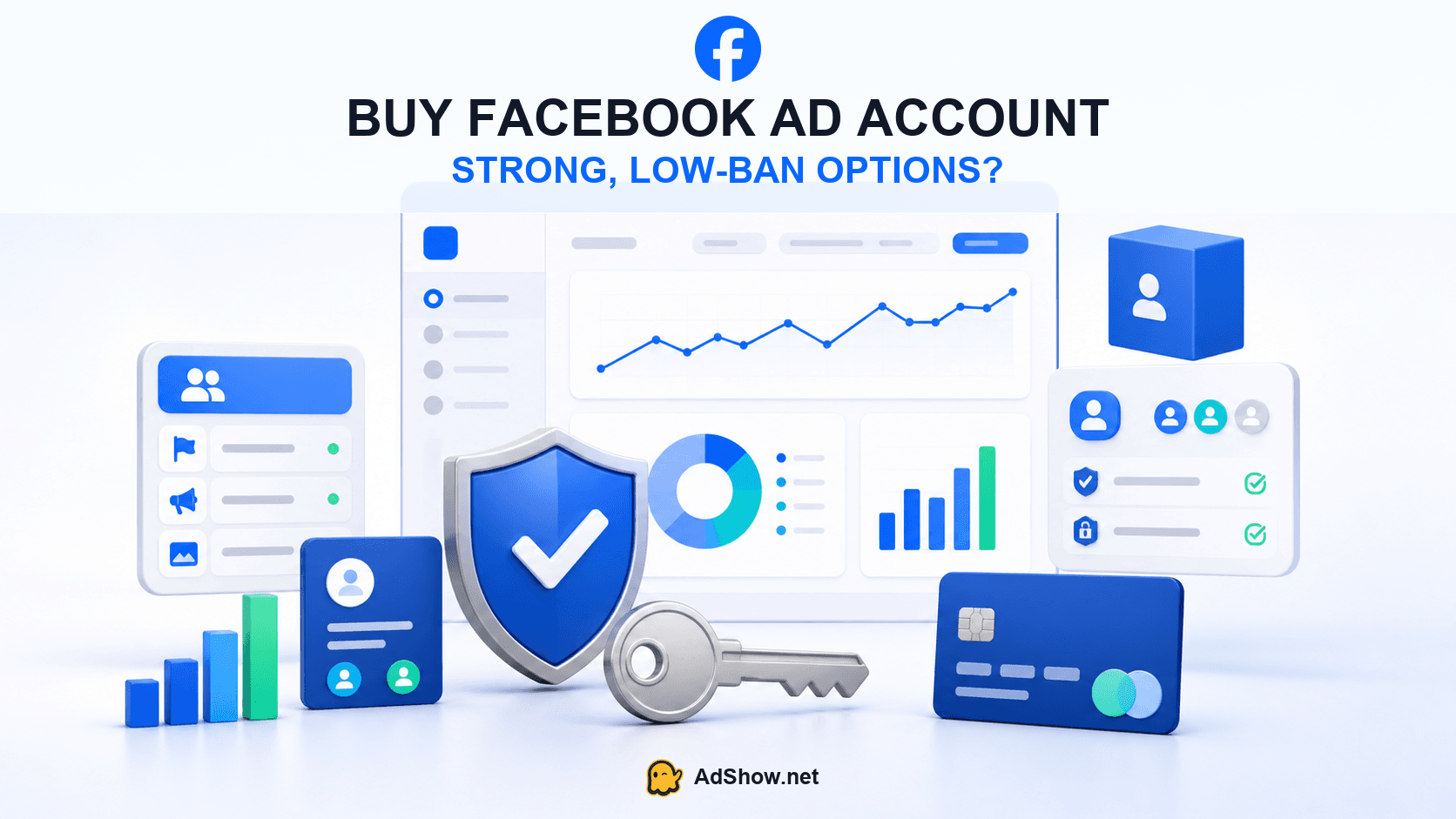
Table of contents
Account strength comes from permissions, business assets, billing consistency, security and campaign support—not a “no ban” label.
Get Stronger Facebook Agency Ad Account Operations With AdShow
AdShow provides self-service Facebook agency ad accounts for media buyers who want more than a login delivered through chat. The dashboard shows market pricing and lets users request accounts, submit top-ups, monitor account operations and report suspensions from one place.
Subscription customers also receive Professional Campaign Setup & Support ($300 Value), with the AdShow team accompanying the customer during campaign setup to help reduce avoidable launch errors. Telegram notifications confirm when account top-ups are completed. Review the available options on the AdShow Facebook agency ad account page.
Operational support can reduce preventable mistakes, but no agency account can guarantee approval or immunity from Meta restrictions.
Why buyers want a “strong, low-ban” Facebook ad account
The search usually begins after something has already gone wrong. A personal profile lost advertising access. A new Business Portfolio could not create another ad account. A payment failed and the account was disabled. Campaigns were restricted just as daily spend started scaling. Or a marketplace seller delivered an account that immediately demanded identity or video verification.
Recent advertiser conversations show the same pattern. Buyers ask for “bulletproof,” “rarely banned,” “verified” or “agency” accounts because they want continuity—not because they enjoy purchasing logins. That urgency creates the perfect conditions for vague promises and difficult-to-recover payments.
A better purchase decision starts by translating the marketing words into operational facts.
What does a strong Facebook ad account actually mean?
A strong setup should answer six questions clearly:
Access: Is your real Facebook user invited through business permissions, or are you receiving someone else's username and password?
Ownership: Who controls the Business Portfolio, ad account, Page, Pixel, catalog and domain?
Billing: Who funds the account, where is the balance recorded and what happens after a payment failure or restriction?
Security: Are real admins protected by two-factor authentication, backup access and monitored business activity?
Compliance: Has anyone reviewed the offer, claims, landing page and campaign before launch?
Operations: Can the buyer request accounts, top up, report restrictions and track status without reconstructing everything from chat messages?
If the seller cannot answer these questions, the word “strong” is only copywriting.
Does “low-ban” mean Meta cannot restrict the account?
No. Meta states that restrictions can apply at different levels, including the ad account, user account, Page or Business Account. It may consider severe or repeated policy violations, attempts to evade review, inauthentic user accounts and connections to abusive assets.
This distinction matters. An agency ad account may remain technically healthy while the personal user accessing it becomes restricted. A Page problem can interrupt advertising even when the payment is fine. A compromised Business Portfolio can affect assets that were not responsible for the original incident.
Therefore, “low-ban” should mean fewer avoidable operational risk signals and better recovery readiness. It should never mean “immune to Meta.”
Buyer rule: choose a provider that explains the conditions under which an account can be restricted. Avoid one that pretends restrictions do not exist.
Four products sold under “buy Facebook ad account”
1. Personal-profile credentials
The buyer receives a Facebook login that was created or aged by someone else. This is the most fragile ownership model. The original owner may retain recovery options, and the new user's device, location and identity may not match the account history.
2. Aged ad account or Business Manager
The seller emphasizes age, previous spend, account limits or country. These attributes may be useful context, but they do not prove that your business, Page, payment method or offer will be accepted.
3. Rented account
The provider retains ownership and grants temporary access. This may support campaign continuity, but the buyer must understand who owns the balance, whether assets can be removed and how access ends.
4. Agency ad account access
A provider gives the advertiser access to an account under an agency operating structure. A legitimate version focuses on permissions, campaign onboarding, transparent funding and support—not on transferring a fake identity.
10 signals of a genuinely stronger account setup
1. Your real user receives permission-based access
Meta's own help documentation describes adding people to ad accounts through permissions. A provider should not require the whole team to share one password. Named access makes removal, auditing and responsibility clearer.
2. The Page and Pixel do not disappear with the account
Map ownership before launch. Determine whether the Page, Pixel, catalog, Instagram account, domain and customer data remain under your legitimate business control. An ad account should not become the only doorway to every valuable asset.
3. The business identity is consistent
The business name, domain, Page identity, payment records and people managing the assets should make sense together. Buying a foreign aged profile does not fix an incoherent business setup.
4. The payment path is documented
Ask whether the model uses direct card billing, provider funding, prepaid balance or another arrangement. Confirm top-up fee, processing time, minimum amount and the difference between wallet balance and credited ad spend.
5. Security is part of onboarding
Require two-factor authentication for admins, remove unused people, inspect business activity and protect the email accounts connected to Meta. A “strong” ad account attached to a phished administrator is not strong.
6. The provider asks about the campaign
A seller that never asks what will be advertised is not evaluating risk. Campaign setup should review the product, creative claims, destination, customer journey and policy-sensitive language.
7. Scaling is controlled
Sudden changes in spend, creatives, countries, payment behavior and administrators make diagnosis harder. A controlled launch establishes a baseline before aggressive scaling.
8. Suspension reporting has a workflow
Know where to report the incident, what evidence is required, who checks the scope and when the provider evaluates appeal or replacement eligibility. “Message us if banned” is not a complete process.
9. Pricing is visible before funding
Calculate account cost, subscription, top-up fee, exchange spread, withdrawal conditions and replacement terms. A zero-rental headline can hide a higher funding cost.
10. There is an audit trail
Account requests, top-ups, status changes and suspension cases should remain visible. This matters even more when a media-buying team operates multiple accounts.
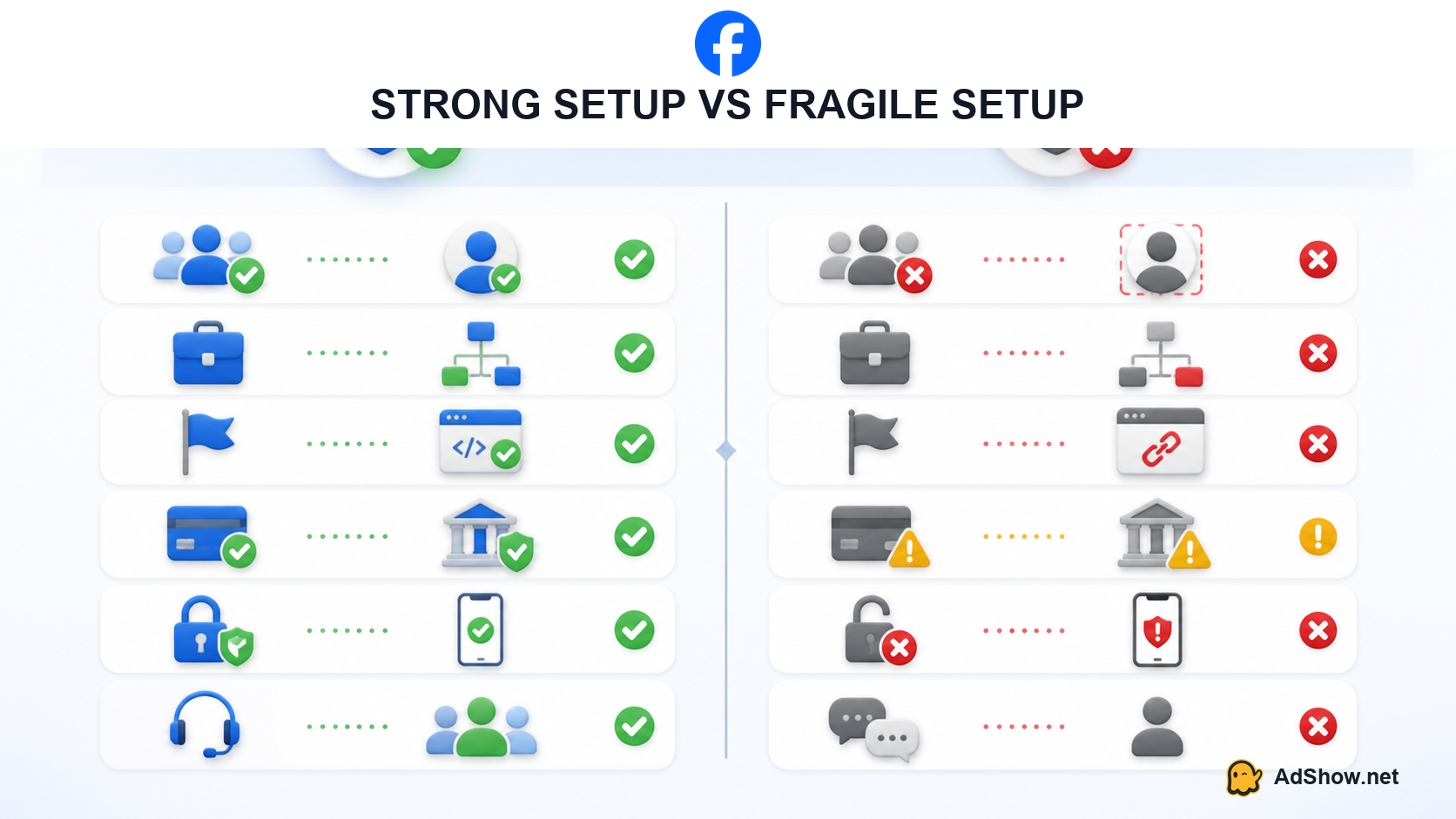
A stronger setup uses real permissions, controlled business assets, consistent payments, security and documented support.
Red flags behind “low-ban,” “whitelisted” and “unlimited” offers
“Never banned”: the provider does not control Meta's review and enforcement.
“Whitelisted for every vertical”: ask for the exact meaning, scope and written limitation.
“Use our profile and documents”: identity mismatch and account recovery become your risk.
“Unlimited spend immediately”: verify actual account limits, payment method and campaign history.
“Replacement guaranteed”: ask whether it applies after policy violations, unpaid balances, compromised users and prohibited offers.
“Fresh IP fixes every ban”: network changes do not correct a prohibited product, misleading page or compromised business.
“Telegram only”: chat is useful for support but weak as the sole system for money, account inventory and incident history.
AdShow has already examined this language in its guide to the Facebook ad account no-ban and whitelisted myth. The useful distinction is between better operating controls and impossible immunity claims.
What recent advertisers are actually afraid of
In a May 2026 Facebook Ads community discussion, a buyer described purchasing marketplace accounts only to encounter video KYC that could not legitimately be completed. A July 2026 thread asked where to buy a “bulletproof” account that rarely gets banned; responses focused on scam and ownership risk.
Another recent advertiser reported several accounts being disabled around periods of scaling before eventually being told that incomplete identity confirmation was involved. These posts are useful evidence of buyer pain, not proof of a universal cause. They show why “aged” and “strong” are insufficient without identity, ownership and support details.
Do not use an agency account as a restriction bypass
If an existing profile, Page, Business Portfolio or advertiser is restricted, first identify the enforcement scope. Meta's published guidance says attempts to evade its review and enforcement can themselves contribute to restrictions.
Creating more profiles, changing devices or moving the same campaign into another account without diagnosing the cause can multiply the number of affected assets. When an account is already disabled, start with the evidence and recovery workflow rather than purchasing the first “low-ban” listing you find.
If the incident began with a billing problem, use AdShow's guide to a Facebook ad account disabled after a failed payment. Payment failure, suspicious payment activity and policy enforcement require different responses.
Security matters as much as policy
A Facebook advertising operation can be lost through phishing even when its campaigns are compliant. Attackers target Pages that are visibly running ads, locate public support emails, then send fake copyright, verification or restriction notices designed to steal credentials.
Before buying access, verify that the operating team knows how to recognize those messages and review alerts inside official Meta surfaces. AdShow's investigation into how Facebook accounts get hacked through fake Meta emails shows the path from a fake notice to a cloned appeal form. The companion Facebook account hacked response guide covers containment and recovery.
Why self-service operations make the account stronger
The ad account is only one part of the product. Media buyers also need to request access, fund accounts, monitor balances, report restrictions and track outcomes across a team.
AdShow provides these operations through a self-service dashboard with visible market pricing. Users can request accounts, submit top-ups, report suspensions and receive Telegram notifications when top-ups are completed. AdShow also includes Professional Campaign Setup & Support ($300 Value) for subscription customers, with the team accompanying the customer during campaign setup.
This support can help reduce avoidable setup errors; it does not guarantee approval or prevent Meta from enforcing its policies.
How to choose among Facebook agency account providers
Compare providers on account type, permissions, approval process, pricing visibility, top-up workflow, asset control, support records and suspension terms. Do not rank them solely by the percentage shown in the hero section.
AdShow's separate Facebook agency ad account provider investigation evaluates different provider models and their tradeoffs. This article answers whether an individual account offer is genuinely strong; the provider comparison answers which operating model fits the buyer.
Pre-purchase checklist
Confirm permission-based access for your real users.
Record who owns the Business Portfolio and ad account.
Keep Page, Pixel, catalog and domain ownership portable.
Verify the account country, currency and time zone.
Document the payment and top-up model.
Read balance, refund and replacement conditions.
Review the campaign and landing page before launch.
Enable 2FA and remove unused administrators.
Define the suspension-reporting and escalation path.
Test support with a specific operational question.
Questions collected from recent advertiser discussions
These questions reflect recurring concerns in Facebook advertising communities during the past year. Individual posts describe user experiences; Meta determines the status of each account and business asset.
Where can I buy a strong Facebook ad account with low ban risk?
Choose permission-based agency access with transparent pricing, real business onboarding, campaign review, visible funding records and documented suspension support. No legitimate provider can guarantee that Meta will never restrict an account.
Are aged Facebook ad accounts less likely to be banned?
Age alone is not protection. A change in user, device, business, Page, payment method, location or offer can create new risk. Evaluate the complete operating setup.
Is a Facebook agency ad account whitelisted?
“Whitelisted” is used inconsistently by sellers. Ask what specific feature or relationship the term describes. It should not be interpreted as immunity from advertising standards or account restrictions.
Can I buy a new account after my Facebook ad account is disabled?
A new account does not resolve the original enforcement cause. First determine whether the restriction applies to the user, ad account, Page or Business Portfolio and use the available review process where appropriate.
What should happen to my balance after a restriction?
The answer depends on the funding model, account status, provider terms and Meta's decisions. Before funding, distinguish provider-wallet balance, pending top-ups, credited advertising funds and already-spent media.
Final verdict
A strong Facebook ad account is not defined by a seller's adjective. It is defined by the permissions you can verify, the assets you control, the funding records you can see, the security you maintain and the support process available when something goes wrong.
Use “strong, low-ban” to attract the right searcher. Use evidence, transparent operations and realistic limits to earn the registration.